-
-
April 8, 2020 at 3:08 pm
AkashVyas
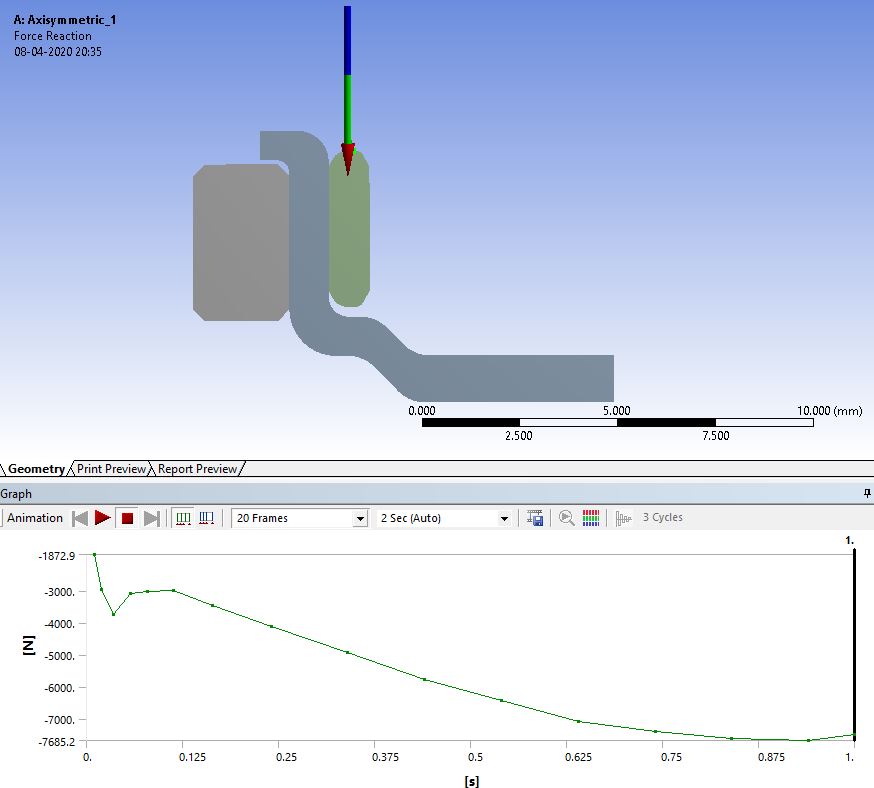
SubscriberHello Everyone, I'm currently working on a non-Linear problem of the sliding seal, I already have a solved solid model of this but I'm trying to reduce the computation time, as it is an axisymmetric model.
I have given input displacement of 3.8mm as shown in this imageÂ

as this solid model was successful and the reaction force at the seal where displacement is applied, is shown in the image,
Â
and I have also tried this problem axisymmetric model, with the same input and my reaction force value isÂ

so my question is why the forces in the solid and axisymmetric model are almost the same.
-
April 8, 2020 at 8:06 pm
peteroznewman
SubscriberIt would be good if you used Excel and put the displacement and force for the solid model in columns A and B and the displacement and force for the axisymmetric model in columns C and D because you have 5 time steps in one and 1 time step in the other so it is hard to compare using the images you provided but would be easy if you overlaid the two curves on the same scale.
If you have the same physics and the same inputs, I would expect to get the same outputs from an axisymmetric model and a 3D model. Maybe I don't understand your question.
-
April 9, 2020 at 8:09 am
AkashVyas
SubscriberI got you point but then why the reaction forces for 1/4 model is less then complete solid model.
-
April 9, 2020 at 5:30 pm
peteroznewman
SubscriberThe reaction force of a 1/4 solid model should be 1/4 of the reaction force for a complete solid model if you are applying the same displacement.
-
- The topic ‘Non-Linear Axisymmetric Analysis’ is closed to new replies.
- LPBF Simulation of dissimilar materials in ANSYS mechanical (Thermal Transient)
- Real Life Example of a non-symmetric eigenvalue problem
- How can the results of Pressures and Motions for all elements be obtained?
- BackGround Color
- Contact stiffness too big
- Element Birth and Death
- Python-Script to Export all Children of a Solution Tree
- Which equations and in what form are valid for defining excitations?
-
4597
-
1495
-
1386
-
1209
-
1021
© 2025 Copyright ANSYS, Inc. All rights reserved.