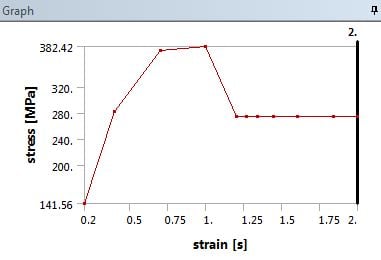
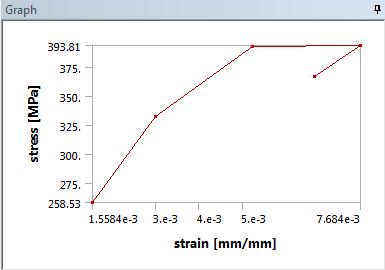
-
-
May 20, 2019 at 9:12 pm
timescavenger
SubscriberHi again Peter,
I regret having to come back to this issue but my last post about it did not finish fully convincing me:
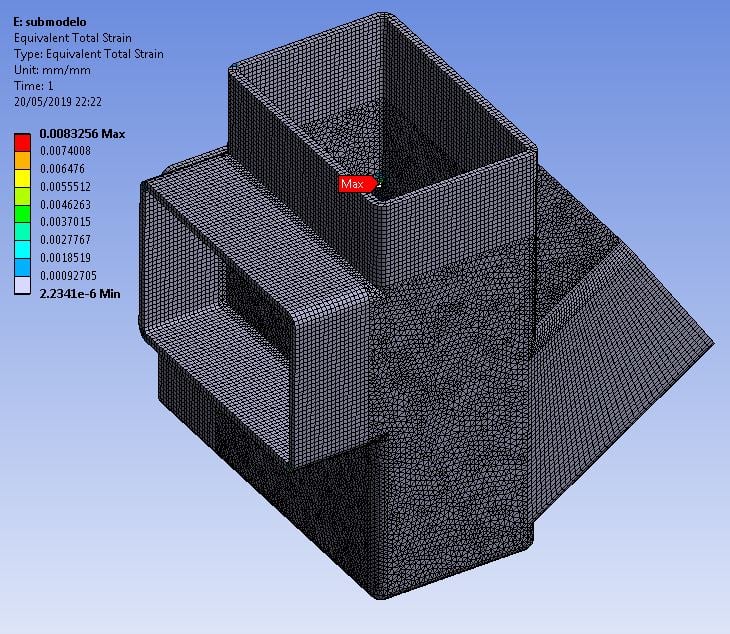
OK, once the plasticity model was introduced stresses (whether they are real coming from stress concentrators or fictitious due to geometric singularities) stop growing up above the yield limit and instead the area around them plasticizes redistributing stress to nearby zones. Then, the failure criterion is not "max. stress < yield" anymore but the new deciding rule becomes "total strain < elongation at break". So far so good: in my submodel this comparison resulted in a large safety margin (0,83% << 23%) so, leaving aside the annoying issue with the cut-boundary misalignment, that closed and solved the problem. Right? Well, here is when my comes again:
I realized the max. total strain was occurring in the inner face of the tubes; in fact, on the hard edge where the two inner surfaces meet (I had rounded the outer edges but indeed forgot the one inside):
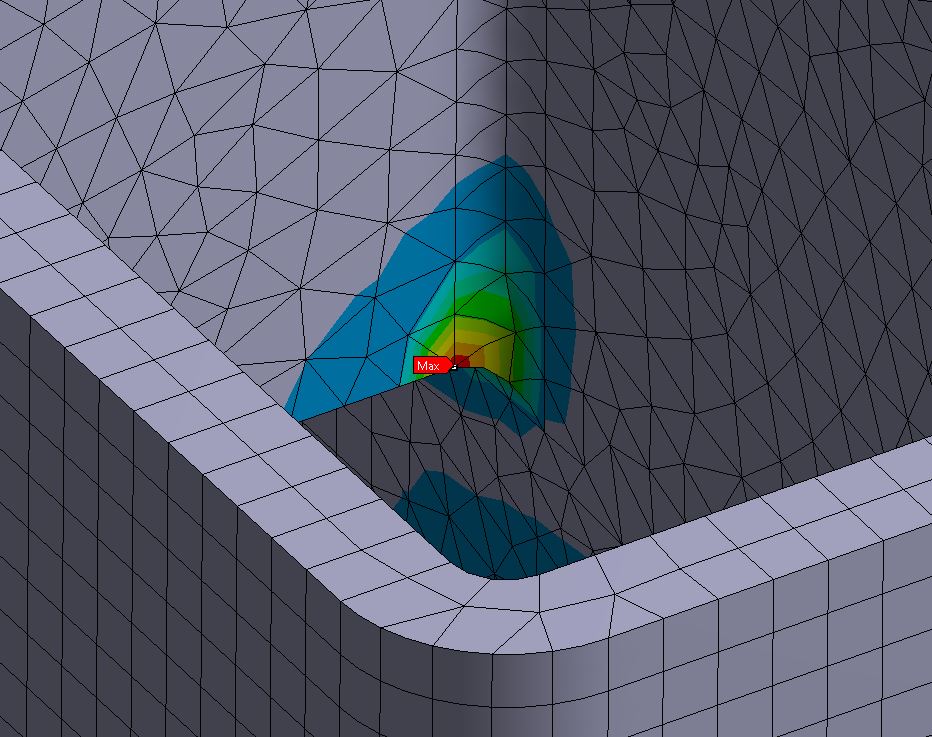
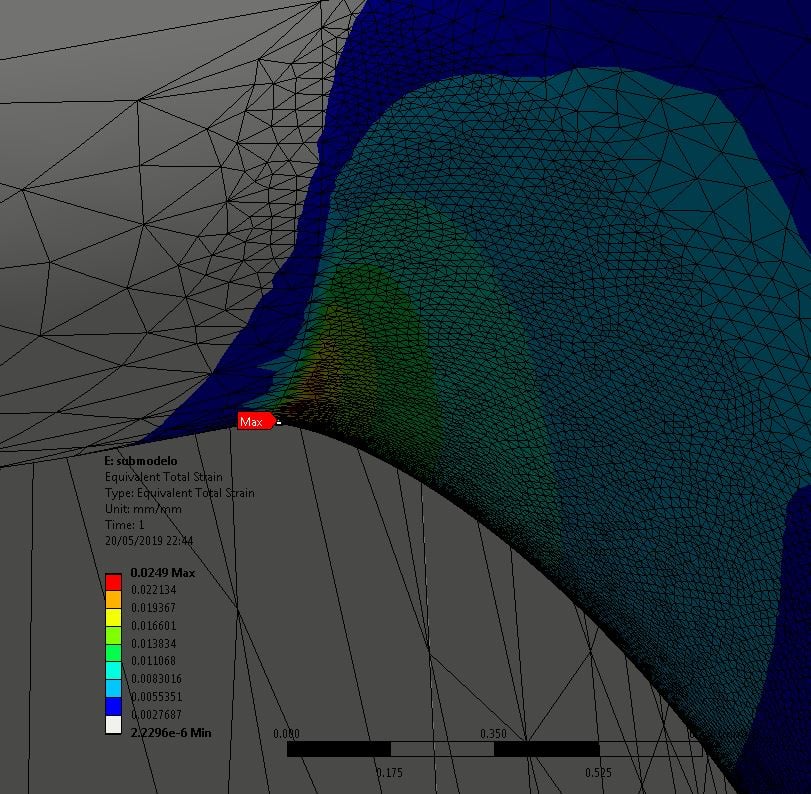
so I thought "what if I refine the mesh in this area to try a mesh-independence convergence there?". And so I did it... but first, in order to avoid the hard edge foreseeable singularity, I rounded the inner edge too:
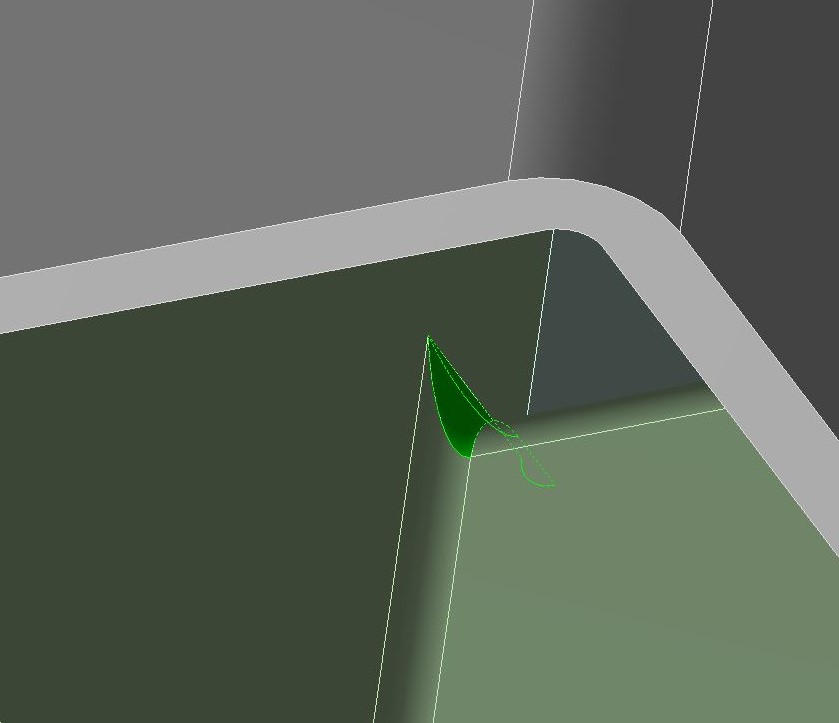
To my surprise with the mesh refinements it came the result escalation:
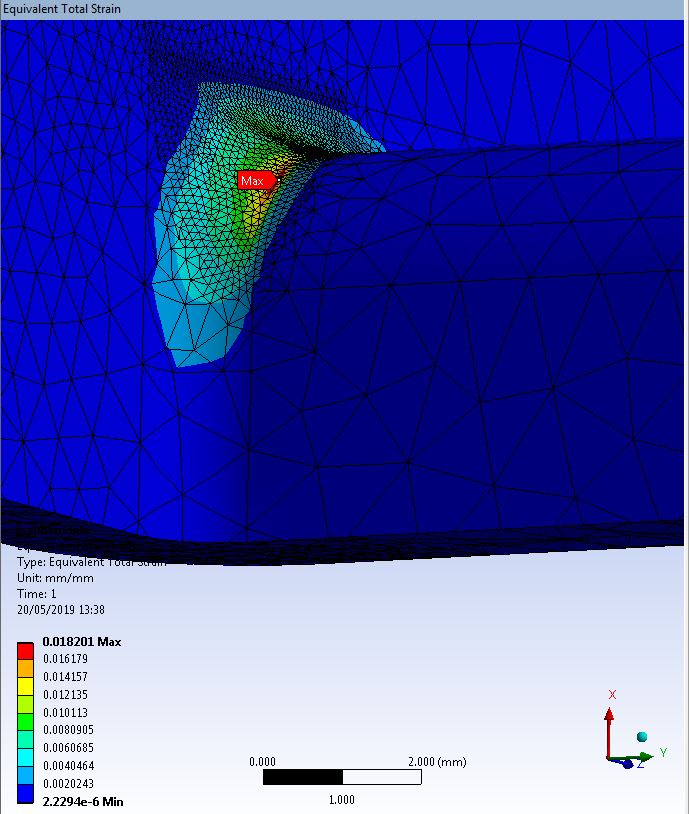
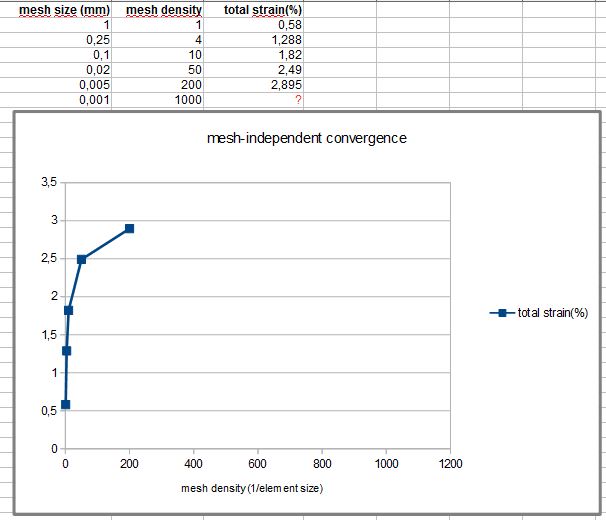
so here I am again with the "same question": even though the obtained values are still quite below the limit (2.49% is still far from 23%) and since the hard-edge singularity should be discarded, how can I be sure the strain will not continue growing with further refinements? (I have not run another refinement step because with a nonlinear setup running times already got long enough...), does it make the same sense to run a mesh-independence convergence study for plastic strains as it did for stresses? and, which value is then to be considered accurate/useful enough?
-
May 20, 2019 at 10:39 pm
peteroznewman
SubscriberI'm glad you want to be convinced. I think the convincing evidence comes from plotting points on a Total Strain vs. Element Size graph. If you can get three or more points on that graph and fit a curve through them that clearly extrapolates to a Total Strain < 0.23 at zero element size, that is your evidence.
This method works well for linear elastic stress models. The one time I tried it on a plasticity model, it didn't work so well. I will be interested to see your results.
jj77 has a post with some links to good articles that talk about convergence and singularities.
-
May 22, 2019 at 11:01 am
timescavenger
SubscriberThat´s fine Peter. I went for this evidence and so far I got this outcome:
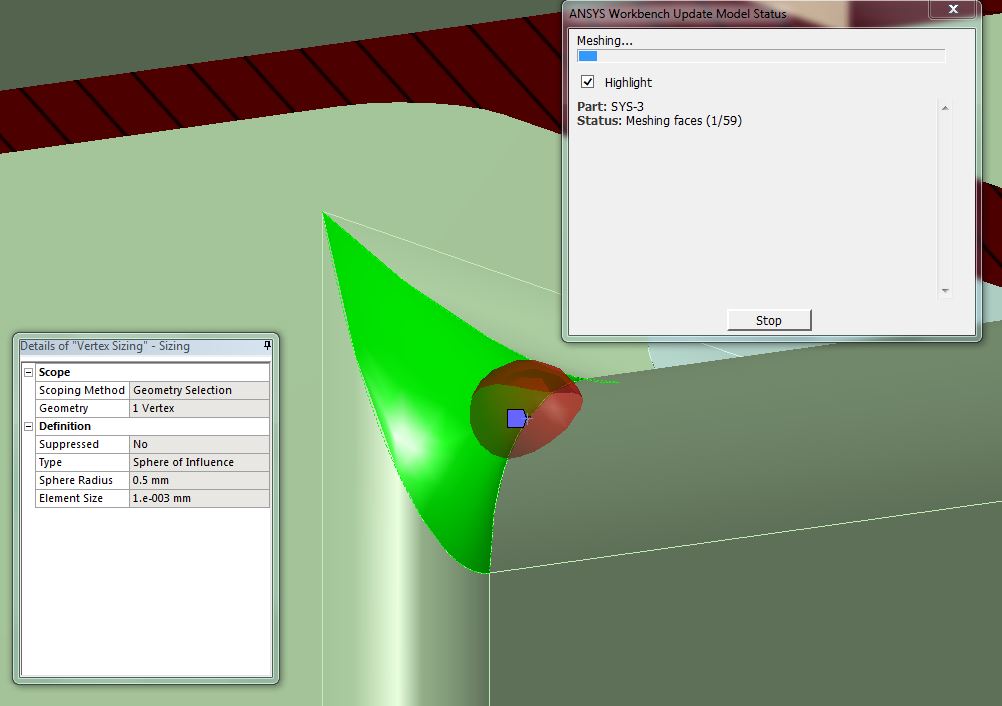
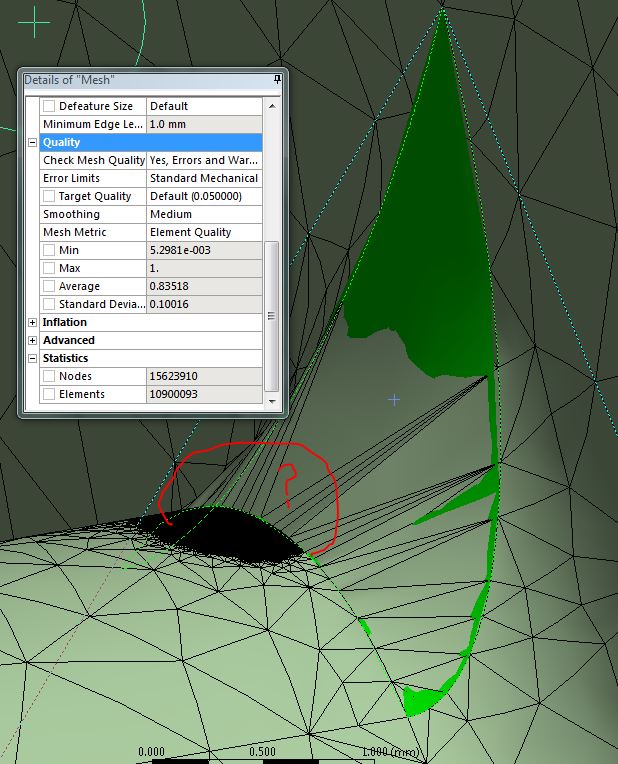
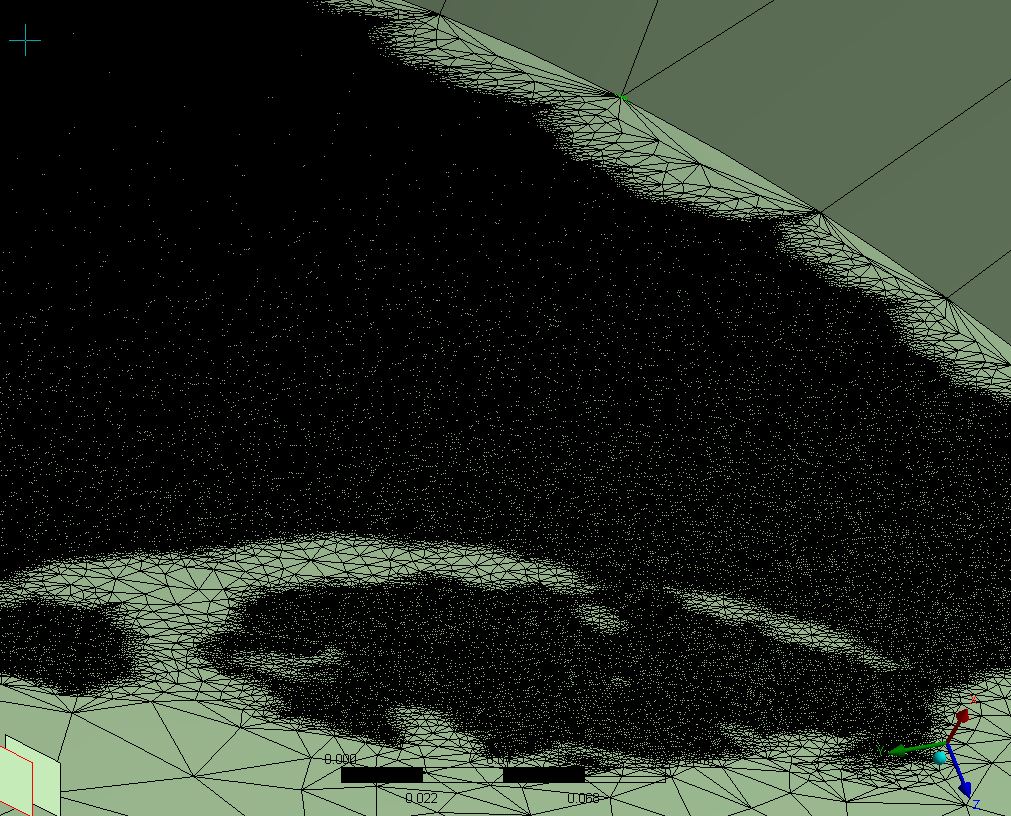
It seems to me there is at least one more point needed to be sure the series converges. However, I am having big problems to go further: when I refine the same curved triangular corner face with a much smaller element size the elements number skyrockets so much that my computer cannot handle it and the solver fails. I tried to reduce this number narrowing the refined area to the local point of interest in different ways (just edge-sizing, smaller cut-face sizing, influence-sphere,refinements,...) but either the meshing fails or takes ages like this last try which has been like this for hours:
I cannot see a way out! What could be done to get out of here?
-
May 22, 2019 at 3:50 pm
-
May 22, 2019 at 9:03 pm
timescavenger
SubscriberNo hints? -
May 23, 2019 at 11:07 pm
timescavenger
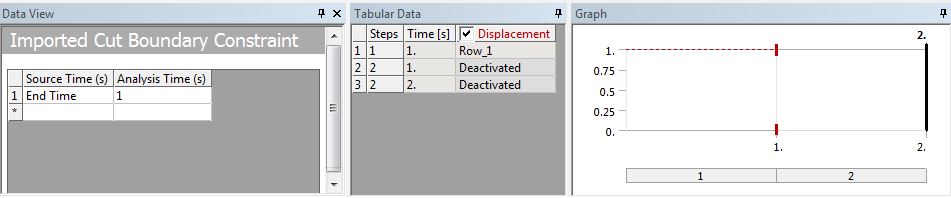
SubscriberPeter, I read the links in the post you recommended: thanks for that, it was very enlightening. After the video on the plasticity analysis I wanted also to check if that could be done in my submodel because there was no explicit applied force unload in a 2nd- step but just imported displacements in the cut-boundary. I set number of steps to 2 but then 3 rows appeared in the Imported-Cut-Boundary object (don´t know why...), however it looks like I could set the 2-steps "loading-unloading" cycle by deactivating the 2nd step like this:
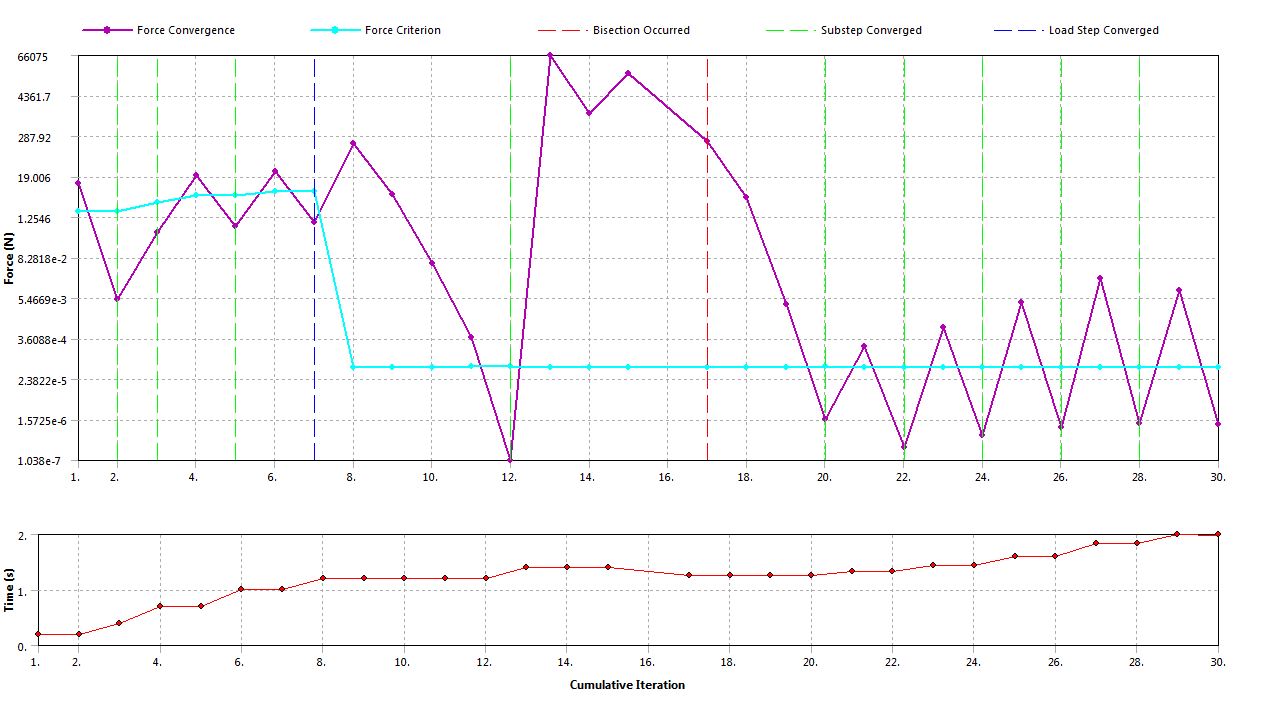
It ran apparently fine:
Then I got different charts depending on where stress and strain were scoped to:
(same point for both magnitudes: does not look much like the one in the video...)
(all bodies for both magnitudes: max. values appeared in different points for each: this one looks more like it should be but origin is not in (0,0) ...
How would you interpret them? Do you think this approach is reliable?
In any case, my doubt about the convergence in the last post remains unsolved yet...
-
May 24, 2019 at 12:48 pm
timescavenger
SubscriberPeter, did you see my results and comments?
-
May 27, 2019 at 7:23 am
timescavenger
SubscriberSorry if I overwhelmed you with too many questions. In any case, thanks a lot for your help
-
- The topic ‘Mesh refinement, convergence and singularities’ is closed to new replies.
-
4833
-
1587
-
1386
-
1242
-
1021
© 2026 Copyright ANSYS, Inc. All rights reserved.