To clarify:
- ANSYS AIM 19.1 Academic version
- Windows 10 x64 Home
- All dimensions are in millimeters
- In Russia decimal separator is "," so 0,01 mm means 0.01 mm
- I am not saying Ansys is wrong, but the result is very strange
I notices this strange behavior in my computer experiment and I remade it to the simpliest form to show you.
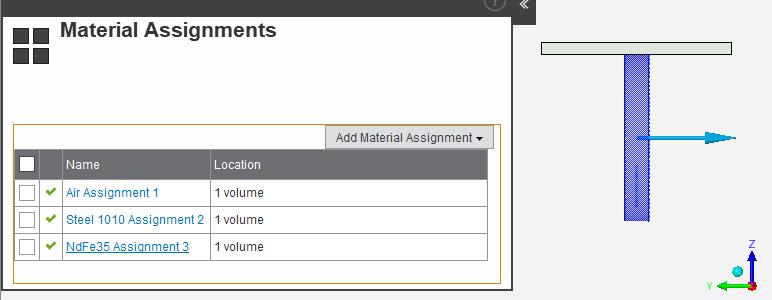
A NdFe35 disk magnet 70 mm in diameter with the thickness 10 mm that is axially magnetized (Y axis) on a steel 1010 plate 5x80x80 mm (on the picture).
While the air gap increases from 0 to 0.001 mm the magnet attraction force decreases but at 0.01 mm the force becomes higher than at 0 mm air gap, after that with increasing the air gap the force decreases again.
You can see it on the picture:
- Magnet attraction force on the Z axis is the Force Z 1
- Plate attraction force on the Z axis - Force Z 2
- Force Z 1 + Force Z 2 = Force Z 3
- The columns F-H are the magnitudes of the same forces

So the trend is on the picture.

I thought this was happening because of the steel plate saturation. I ran another test with the variable thickness of the plate t (column C), but the trend was the same even with a 35 mm steel plate (on the picture).

Ok you can say that +10 N is a very small amount of difference but in my original more complex experiment with a custom more powerfull magnet the difference between 0 mm and 0.01 mm air gap can be +150 N and the original experiment's calculations were done until hitting the maximum precision that can be achieved with the academic version.
I spent a lot of time trying to figure out what is wrong. I hope you can give detailed answer.
PS. Couldn't upload the experiment files on the forum, used another site instead https://www86.zippyshare.com/v/y6as8aAg/file.html


















 You are navigating away from the AIS Discovery experience