Ansys Assistant will be unavailable on the Learning Forum starting January 30. An upgraded version is coming soon. We apologize for any inconvenience and appreciate your patience. Stay tuned for updates.
Fluids

Fluids

Topics related to Fluent, CFX, Turbogrid and more.

Local Time Stepping Question

    • zoelle.wong
      Subscriber

      Happy New Year to All!

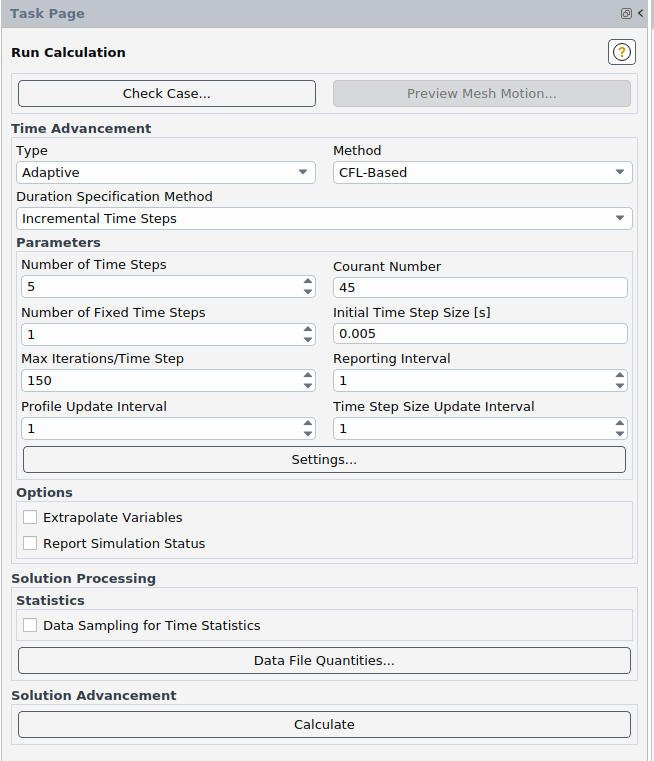
      I need to adjust the CFL in my simulation. I found that the lowest global time step (dt) I can set is 0.0025 but in certain areas of my domain, this is equivalent to a CFL of 800 in some areas or a CFL ~1 in other areas (first screenshot below). I tried adaptive time stepping to an "ideal CFL" (e.g. 1) starting from a flow-field from the dt=0.00025 simulation. However, the model automatically diverges within one subiteration. 

      My thought process is to start at a CFL ~700 then slowly ramp down to a CFL ~1, but I don't think this will work since my model already has areas where CFL ~1. Is there a better method to acheive a CFL ~1 or a parameter I should reconsider under the "time advancement" settings? I already checked my mesh metrics and they satisfy best practices. Thank you!

    • Bhargav Desai
      Ansys Employee

      Hello,

      You can use Adaptive time stepping with target CFL and smaller initial time step (say 1e-5 s). The solver will adjust the time-step size from there on to maintain the target CFL. You mentioned that "lowest global time step (dt) I can set is 0.0025", is there any specific reason for this limitation?

    • zoelle.wong
      Subscriber

      I'm not sure either... I know that when I start with an initial time step of 1e-5 or 0.0025, the model diverges within the first few subiterations. I found that when I start with a time step of 0.005 and slowly ramp down to a time step of 0.0025, then the the model converges to a reasonable mass residual. 0.0025 is the smallest time step I found via troubleshooting. I tried a timestep of 0.0020 with the ramping method, and the model diverged with the first few subiterations 

      • Bhargav Desai
        Ansys Employee


        How does it diverge? i.e. which parameter to begin with?

        Also, it might be worth rechecking the boundary conditions and material properties depending on the physics being modeled. Since it is a Transient simulation, the initialization values are very important. Please ensure appropriate values are provided during initialization.


    • zoelle.wong
      Subscriber

      I'm attaching residuals below. I deduced that the Equation of State (EOS) is a large contributor to divergence. My fluid is supercritical carbon dioxide near 100 bar, using the Peng-Robinson  (PR) EOS. For a given static temperature and static pressure from the transient solution, the predicted density via the PR EOS does not match to the density to experimentally informed databases at the same static temperature and pressure. I tested the same boundary conditions with air using the ideal EOS and the local time stepping method successfully converged. 

      Since the initial guess is important, I ran the simulation for a constant density value, to a coresponding static pressure and density, then used those results to initialize the simulatin with the PR EOS. I was able to achieve local time stepping with an initial time step guess of 0.005 and a target CFL of 1 (iterations 0 to 1300). However, I'm still seeing areas where the local CFL is ~800. My plan is to test other EOS's to see if this will help the solution. In addition to the residuals, I'm monitoring mass-flux (mass flow rate at inlet - mass flow rate at outlet) and it's oscillating within a reasonable bound. 

      Thank you again so much for your help!


Viewing 3 reply threads
  • You must be logged in to reply to this topic.
[bingo_chatbox]