Preprocessing

Preprocessing

Topics related to geometry, meshing, and CAD.

How does this model perform grid encryption?

    • h395523899
      Subscriber

      This model is mainly used in fluent.


      Simulated liquid-liquid two-phase displacement flow.


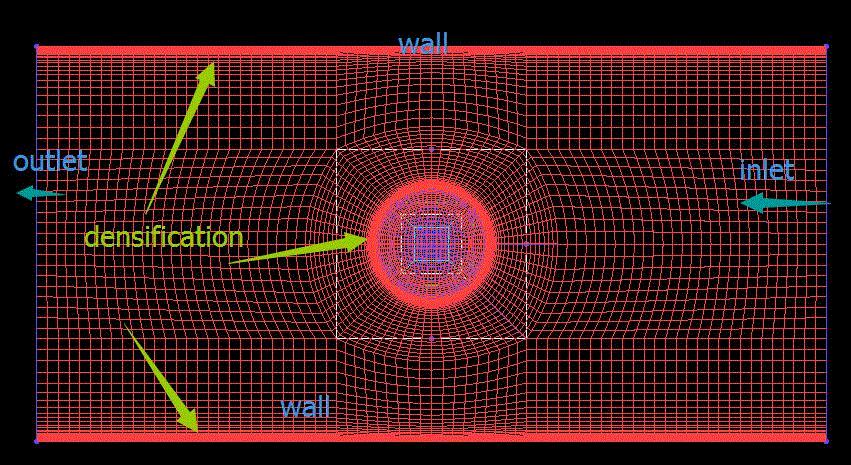
      Size 10m*20m*10mm thin plate channel. Each side of 10m*20m has a hemispherical cavity.


      Hemispherical cavity diameter 3m


      One liquid enters from the 10m*10mm face and exits the other.


      1. Does the entrance and exit need to be refined? (No refinement at 20 meters)


      2. 10 meters, 10 mm edges need to be refined. Should y + be considered? What is the distance from the first node to the 20m edge of the 10m edge?


      3. Is mesh refinement necessary at the contact between the thin plate and the hemispherical cavity?


      4. If you need refinement in 3, there will be four tangents at the round mouth of the hemispherical cavity. These four tangential expansions will also bring refined gridlines. Will this lead to errors?
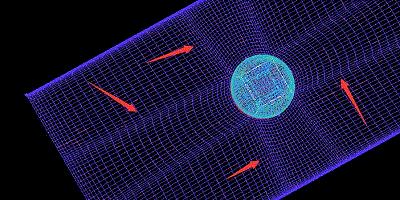


      I uploaded my model, thank you?

    • h395523899
      Subscriber

      Can anyone help me see it

    • Keyur Kanade
      Ansys Employee

      Hello h395523899, 


      Can you please elaborate on what do you mean by encryption at inlet & outlet or at edges?


      Regards,


      Keyur

    • h395523899
      Subscriber

      1. I changed a grid method, such as graph. It should be better than before.


      2. I want to know the extent of mesh refinement.


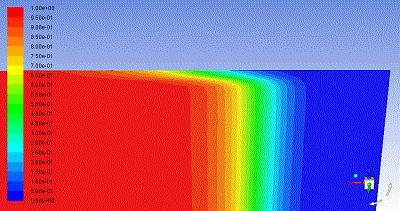
      About grid thinning. The reason is that the simulation process appears at the boundary as shown in the diagram.


      The simulated water replaces oil. But at the boundary, water is faster than oil. This is not in conformity with the facts.


      I think it is related to the thinning of the wall mesh, so I want to refine the wall mesh. But I don't know about the extent to which it is refined. Maybe the thickness of 10mm is not suitable for y+ calculation..


      Volume fraction cloud image, blue is water


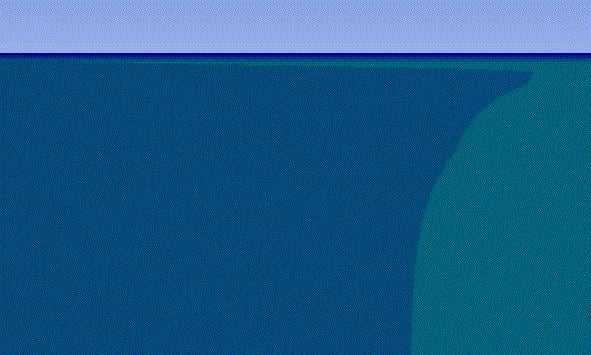
      3. mesh refinement is carried out in the new grid. But when the boundary is enlarged, it still appears as picture.


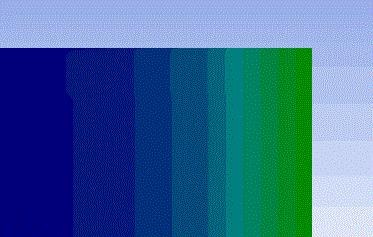
      Water speed cloud


      4. I mainly simulate the change of the volume fraction of the oil in the hemisphere. Is there any need to refine the part of the thin plate and hemispherical contact (including the inner hemisphere)?

    • peteroznewman
      Subscriber

      I think Encryption is a poor translation of what should have been Inflation.

    • Keyur Kanade
      Ansys Employee

      Hello h395523899, 


      Which models you are using? Can you pleas let me know your solver settings. 


      Regards,


      Keyur

    • h395523899
      Subscriber

      Do not consider gravity


      Euler-Eurale two-phase flow


      Standard k-e model


      Material for the material library to give water and oil


      Lf-inlet: The velocity of the water at the entrance is 5m/s, the speed of the oil is 0, and the volume factor is 0.


      Lf-outlet is outflow.


      Rd-inlet1 and 2 are interior, others are wall,


      The initial state setting patch makes the oil volume coefficient in the model 1


      Step size 0.1

    • Keyur Kanade
      Ansys Employee

      Hi, 


      Please use k-w sst. 


      Use pressure outlet


      Use smaller time step. Usually deta t = ((Vcell_min) 1/3) / U


      Vcell_min can be obtained by grid check.


      You can also think of using adaptive time step


      Regards,


      Keyur

    • h395523899
      Subscriber

      If the simulated water enters a container filled with diesel fuel, observe the change in the diesel volume fraction in the container. For example, the diesel volume fraction becomes zero over time.


      Which of the three euler-euler, euler-euler+multi fluid vof, and vof models should be used?

    • h395523899
      Subscriber

      If Volume statistics:


          Minimum volume (m3): 1.000000e-12


        ((Vcell_min) 1/3) / U


      Does this mean ((1.000000e-12)1/3)/speed?


      So my step will reach 3.333e-14, which is too small.

    • Karthik Remella
      Administrator

      Hello h395523899,


      Here is a post by Keyur which clarifies which multi-phase model to use.


      Applicability of euler-euler and euler-euler+multi fluid vof and vof models


      Hope this helps answer you narrow down on the approach.


      Best Regards,


      Karthik

    • h395523899
      Subscriber

      When I use the vof model or the Multi fluid vof model it does not converge.


      Using k-w sst. also does not converge.


      Divergence does not occur only when using the Euler-Euler RNG model or the standard model.

    • Karthik Remella
      Administrator

      Hi,


      Firstly, you should select these models based on the physics you are trying to solve and not because you are able to get a converged solution. 


      Secondly, your time step calculation for VOF should be: ((1.000000e-12)^(1/3))/speed


      Perhaps your divergence issue is because you are not using the appropriate time-step size? 


      Let us know what you get.


      Best Regards,


      Karthik

Viewing 12 reply threads
  • The topic ‘How does this model perform grid encryption?’ is closed to new replies.