Fluids

Fluids

Topics related to Fluent, CFX, Turbogrid and more.

Fluent: Solid UDS equation in solid motion

TAGGED: 

    • 786868082
      Subscriber

      Hi everyone,

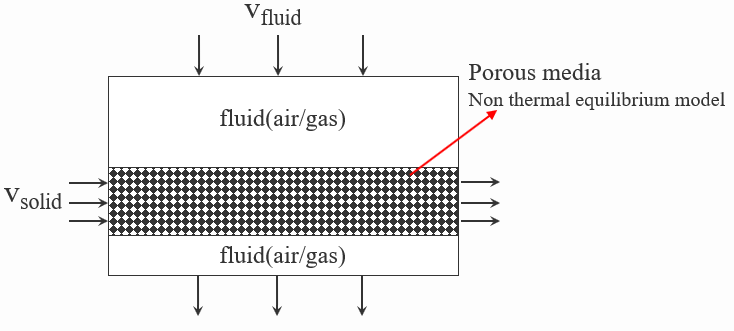
      I'm trying to simulate the solid pellets moving through the air where mass, heat transfer and reaction happened, as the image described below.

      I turned on the porous media model and the non thermal equilibrium model which defined a solid zone spatially coincident with porous fluid zone. Then I enabled the solid motion in that solid zone, set a constant translational velocity. Moving reference frame and mesh motion were not enabled.

      Here's the problem. To simulate the reaction in the solid, limestone calcination(CaCO3→CaO+CO2), a UDS transport equation was established, which represent the CaCO3 content(kg/m3) in the solid. The case was steady-state, so no transient term. The convective term was described in DEFINE_UDS_FLUX  UDF based on the solid motion velocity. The DEFINE_SOURCE UDF has been written based on reaction kinetics. But once the UDS diffusivity in the solid material was set 0, the calculation broke down in the first step. Shouldn't the diffusive term be none? CaCO3 in the solid won't diffuse due to concentration difference between the pellet or within the pellet, right? It's not like O2 or other gas.

      So where the problem might be? Is it something wrong with uds boundary conditions? The faces where the solid came in and went out were set as wall, specific uds value. The faces where solid interacted with fluid were set default, wall, specific uds flux as 0. Is it related to steady or transient state?

      Thanks in advance for your help.


    • Rob
      Forum Moderator

      I suspect your problem is with the scalar and non-equilibrium solid zone. You're probably correct in that the solid shouldn't diffuse but it's also a question of how much you can alter that solid zone using UDS and the like - read the first paragraph https://ansyshelp.ansys.com/public/account/Secured?returnurl=/Views/Secured/corp/v252/en/flu_ug/flu_ug_bcs_sec_cell_zones.html%23flu_ug_sect_porous_heat carefully. 

      Looking at the figure. Limestone enters at the left, travels along the bed and falls out at the right. Is your scalar to track how much is left, and how does that alter the porous media? The calciners I've seen locally involve dropping the limestone in at the top and taking the CaO out of the bottom with all of the chemistry happening on the way down: they're Victorian but an interesting diversion from a walk. I can't help too much with the "how" because of the Forum rules, but I can ask questions... 

      • 786868082
        Subscriber

        Thanks, Rob.

        But I did't quite follow you. The scalar I defined  indeed was to track how much left in the solid and to know the conversion. Through the conversion and other conditions like temperature I can calculate the current reaction rate, which is the source term of the uds and energy in the solid. Is it what you mean "alter the solid zone"? With the energy change in the solid, the temperature of porous media will be affected through non thermal equilibrium model. And is it what you mean "alter the porous media"? The porosity, interfacial area, heat transfer coefficient were constant.

        The user's guide said the porous media only modificated the conduction flux and transient term in standard energy transport equation. Does it mean the diffusive term is necessary? But what I've done was about a uds equation, not energy, and it's in the solid, not porous media fluid. Where did I misunderstand?

        Again, thanks for your reply.

    • Rob
      Forum Moderator

      The interaction between the solid & fluid is thermal only - is your scalar on the fluid or solid zone? A very small diffusivity should be fine, zeros tend to cause problems if there's a multiplication or division somewhere in the maths. 

      • 786868082
        Subscriber

        I see. The scalar is on the solid zone. Thanks for your suggestion.

Viewing 2 reply threads
  • You must be logged in to reply to this topic.