-
-
December 28, 2020 at 12:12 pm
biokill
SubscriberHello, I am new to ANSYS and I have a question regarding damping optimization.nSo I have an accurate model of my structure built in ANSYS (mass/stiffness wise). I also have a frequency response data (acceleration of a point on my structure) from the experiment. The structure was subjected to harmonic excitation at various frequencies while acceleration was measured. Now I would like to now, is it possible to calibrate my damping coefficients which I have parameterized, so that response matches my experimental data. In the sense that I input a few accelerations measured at different frequencies in the experiment and than use some kind of optimization algorithm that ANSYS provides to calibrate my model. If so, how?nI appreciate your answers.nn -
December 28, 2020 at 3:47 pm
peteroznewman
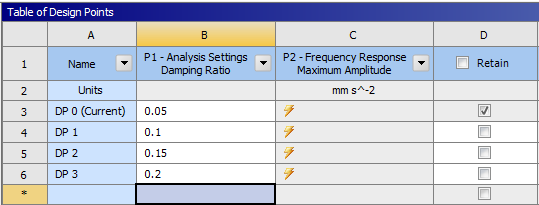
SubscribernClick on the box next to the damping coefficient to put a P there. That makes it an input parameter.n
Click on the box next to the Maximum Amplitude result to put a P there. That makes it an output parameter.n
In Workbench, there is a Parameter Set bar. Click on that to see the Table of Design Points.n
If you click the Update All Design Points button at the top, ANSYS will automatically run the Harmonic Response for each row in the table. That is a simple parameter sweep. If you only had one Damping value at one frequency, that might be all you need.nYou could drop a Response Surface Optimization from the Toolbox under the Parameter Set if you have many frequencies and are looking to minimize the total error.n
-
December 29, 2020 at 2:48 pm
biokill
SubscriberArray, thank you for Your fast reply.nI looked into it but I have a problem. Lets say that I have experimental acceleration data for 10 different excitation frequencies.nFor instance I choose stiffness and mass damping coefficients as my input parameters. For my output parameters I choose 10 directional accelerations amplitudes at given point (for 10 experimentally measured frequencies). So I have 2 input parameters and 10 output parameters.nNow under Parameter and Response surface optimization bar I don´t seem to find a way to input my goal output accelerations that I have from the experiment. I would like to achieve that the program would find optimum combination of damping parameters that the 10 calculated acceleration at given frequencies would match my experimental accelerations (which I don t now how to input) as close as possible. nBest regards -
December 29, 2020 at 3:19 pm
peteroznewman
SubscribernThe Response Surface is to explore the parameter space by using a DOE to sample it, then by statistical analysis, fit a Response Surface to the simulation data.nThe Optimization is where you specify multiple goals, and the optimizer uses the Response Surface to search for the optimum values of the input parameters to minimize the error between the RS value and the target value. The optimization Method is MOGA (Multi-Objective Genetic Algorithm). In the example below, I have added two Objectives and their target values. You could have ten Objectives.n
n
-
January 5, 2021 at 3:45 pm
biokill
SubscriberThank You! nDo You now if it is possible to paramaterize an individual modal damping ratio for each mode (inputted in MDAMP command)?n
-
Viewing 4 reply threads
- The topic ‘Damping parameters optimization in Harmonic analysis’ is closed to new replies.

Innovation Space
Trending discussions
Top Contributors
-
4828
-
1587
-
1386
-
1242
-
1021
Top Rated Tags
© 2026 Copyright ANSYS, Inc. All rights reserved.
Ansys does not support the usage of unauthorized Ansys software. Please visit www.ansys.com to obtain an official distribution.