-
-
December 29, 2019 at 5:13 am
Hanh
SubscriberDear Ansys experts,
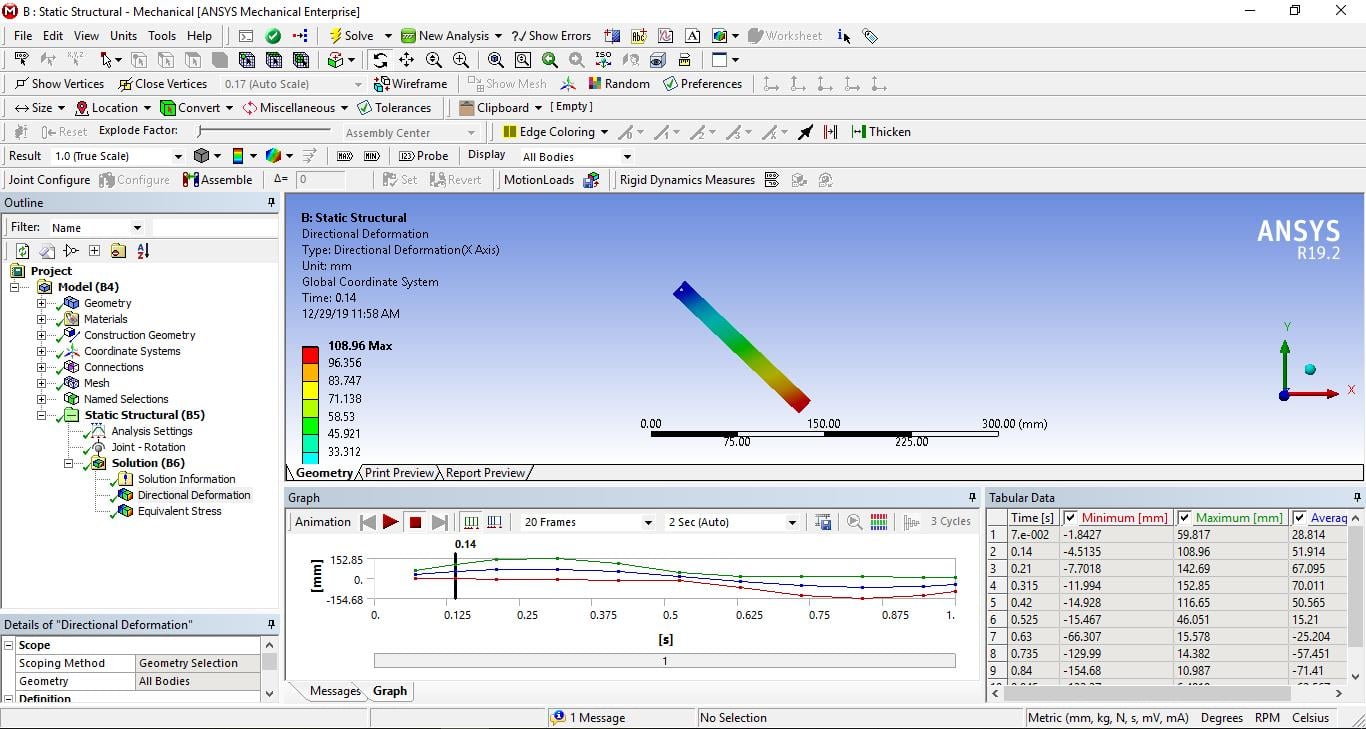
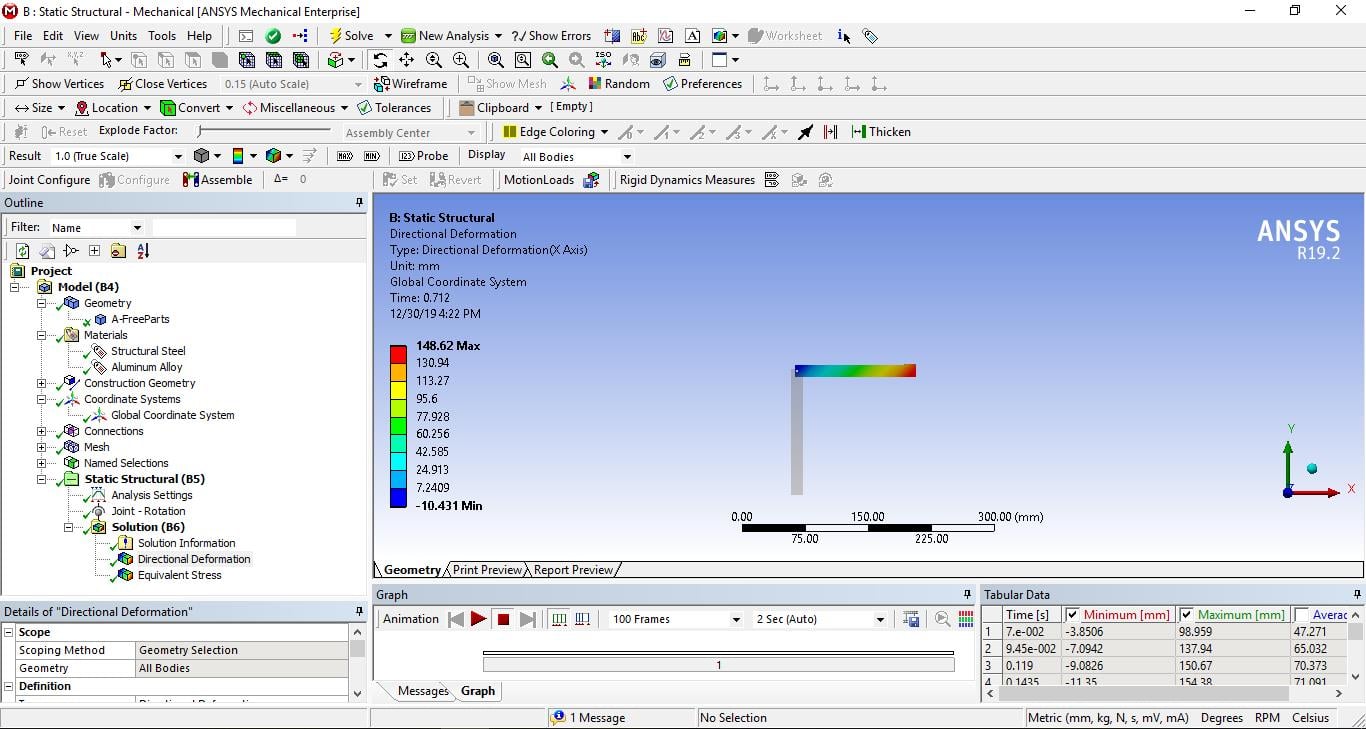
I am a student, I'd like to computing lengths and stresses for a rotating rod in Static Structural module. the boundary condition just only the degree of rotation is 360*time. Time equal 1 minute. As a results, I received the results like the picture:
How can I verify and extract the axial stress and elongation of the rod?
Can you help me?
-
December 29, 2019 at 11:17 am
peteroznewman
SubscriberTime in ANSYS is measured in seconds. When you say rotation(degrees) = 360*time, do you mean 1 rotation in 1 minute? If so, the equation would be 6*time so that in 60 seconds, the rotation would be 360 degrees.
Do you want to include the effect of gravity on this rotating rod, or is this happening in space? If you want to include gravity, which direction is gravity?
Do you want to include the inertia forces (centrifugal force)? Probably not if you are making 1 rotation in 1 minute, but there would be a small effect of 1 rotation per second.
-
December 30, 2019 at 9:26 am
Hanh
SubscriberThanks for your reply, Peter,
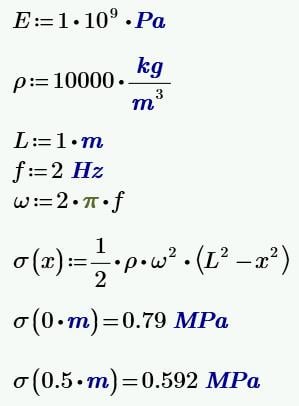
I mean that the rod is rotating about a fixed axis (z-axis) with a constant angular velocity of 720 deg/sec (not 720 deg/minute). I also neglected the affect of the gravity thus I did not assign the “standard earth gravity” in “static structural”. My purpose is calculating the stress and the elongation of the rod due to the centrifugal force. As I known, the elongation of the rod should be equal 1/(3*E)*rho*omega^2*L^3 (where, E is Young’s Modulus, rho is mass density, omega is angular velocity in rad/s, L is the length of the rod). However, my results from Ansys is not similar to the above analytical result. Is there any special step to simulate this problem in Ansys in order to get the correct result?
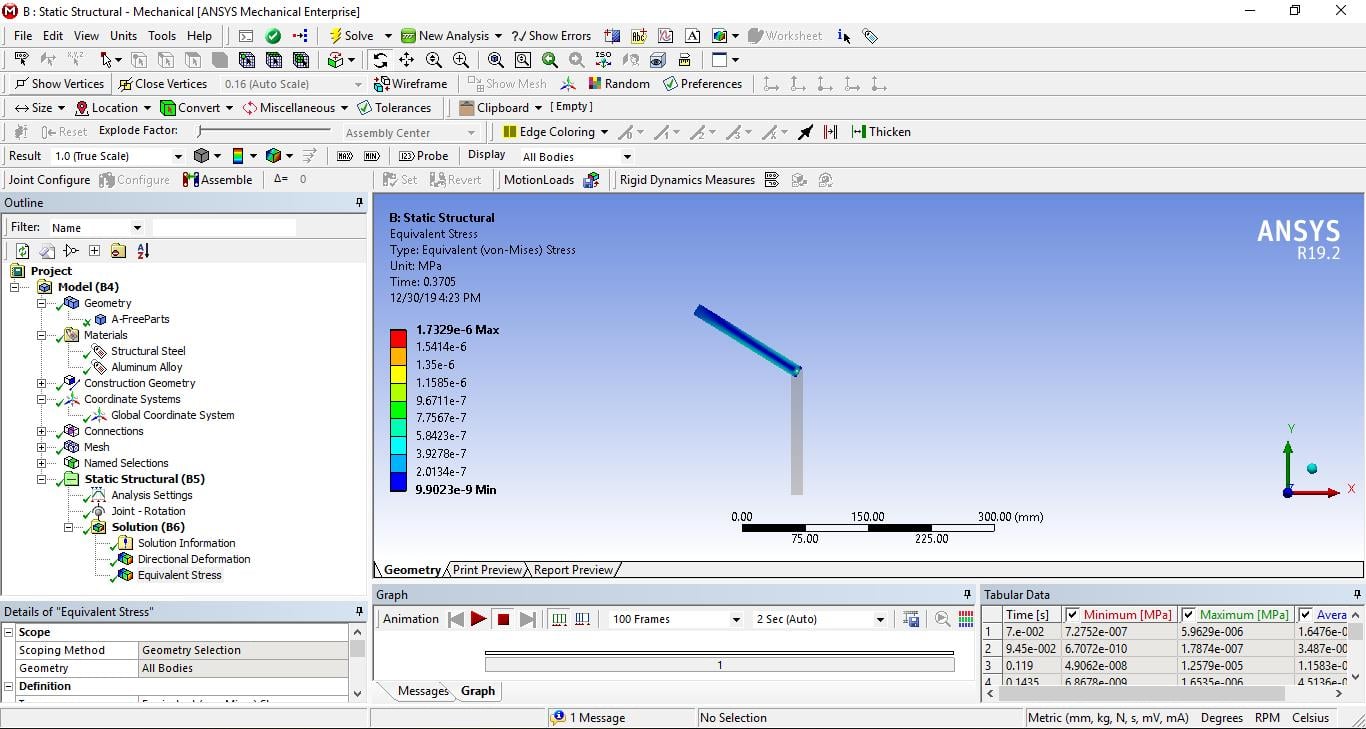
I also exported the equivalent stress and I saw that the stress result is not proper as shown in the attached Figure. Because the stress can be calculated by using analytical formulation (sigma = 0.5*rho*omega^2*(L^2-r^2), where r is the distant from the rotation axis (z-axis) to the location that the sigma is calculated.
Thank you in advance for your help.
Hanh.
-
December 30, 2019 at 4:50 pm
peteroznewman
SubscriberStatic Structural with a Joint that rotates is just a series of static solutions with no rotational velocity.
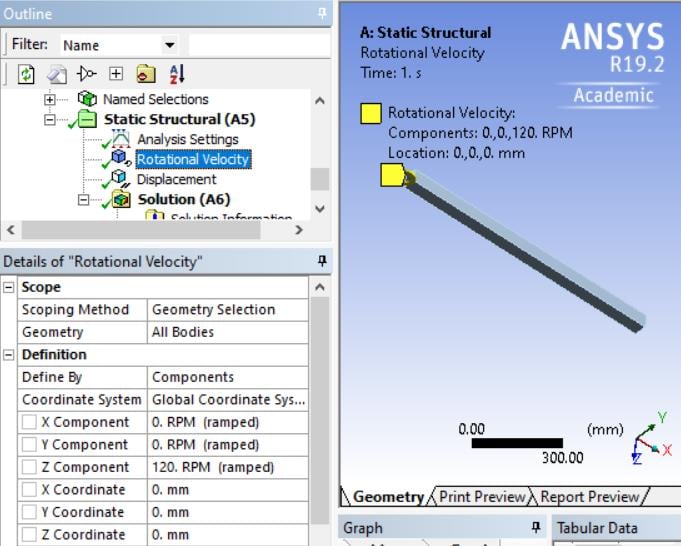
You want to use an Inertia load called Rotational Velocity, which can be input in rad/sec or RPM. I put in 120 RPM by components on the Z axis.
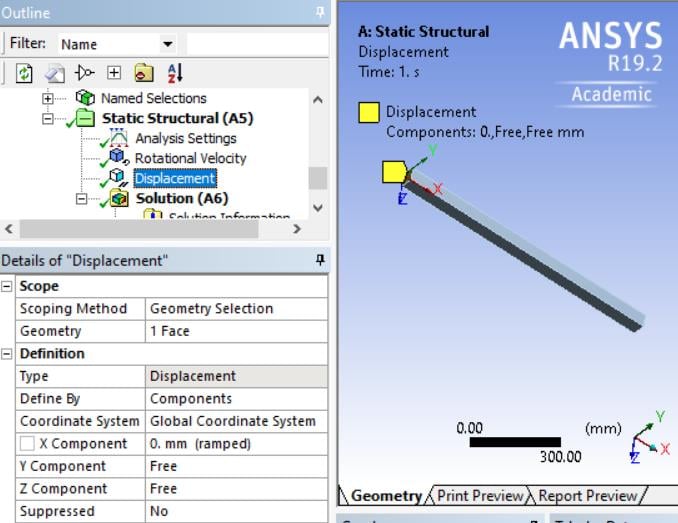
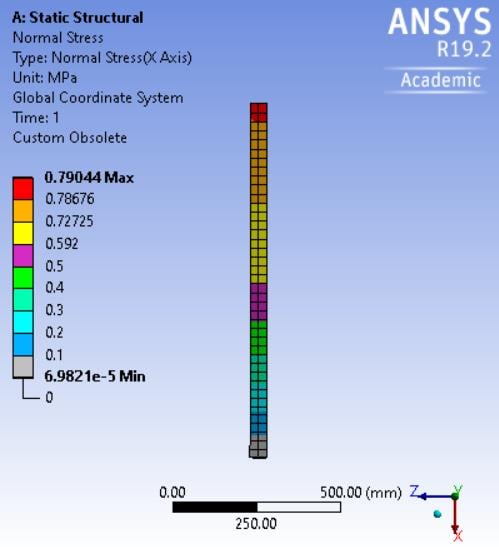
To get a nice uniform stress along the length of the rod, which is along the X axis, put a displacement of X = 0 on the face at the origin, leaving the others free.
To complete the constraint pattern, use symmetry in the XZ and XY planes (equivalent to putting Y = 0 on one face and Z = 0 on the other).
Now when you solve, you get exactly what the formula predicts. The origin is at the top of the screen with the highest stress.
-
January 3, 2020 at 2:01 am
Hanh
SubscriberThanks for your concern.
Best regards,
Hanh
-
- The topic ‘computing lengths and stresses for a rotating rod’ is closed to new replies.
-
4708
-
1565
-
1386
-
1242
-
1021
© 2026 Copyright ANSYS, Inc. All rights reserved.