-
-
November 19, 2024 at 5:22 pm
-
November 19, 2024 at 8:09 pm
Armin
Ansys EmployeeHello John,
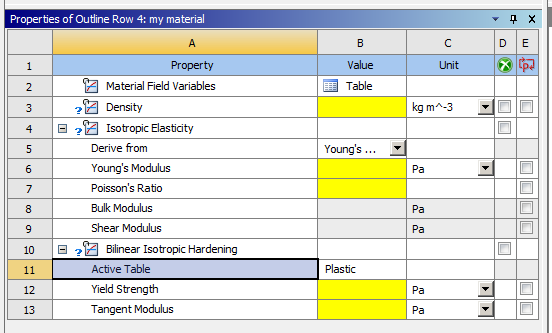
You don't need to specify both elastic and plastic properties under the Bilinear Isotropic Hardening. The entry "Active Table" is ready-only and is re-named to "Tangent Modulus Type" since 2024R2. Using the Bilinear Isotropic Hardening model, you only need to provide the initial yield stress and the slope of the stress-plastic strain curve. Elastic properties are defined earlier under Isotropic Elasticity (row 4 in your screenshot).
-
March 25, 2026 at 2:10 pm
sebastijan353
SubscriberI am experiencing the same problem in Workbench 2025. The plastic option is selected by default, and after entering values into the Yield Strength and Tangent Modulus tables, the stress–strain diagram shows a constant (straight horizontal line). Please help.
-
March 25, 2026 at 3:48 pm
Armin
Ansys EmployeeHello Sebastijan,
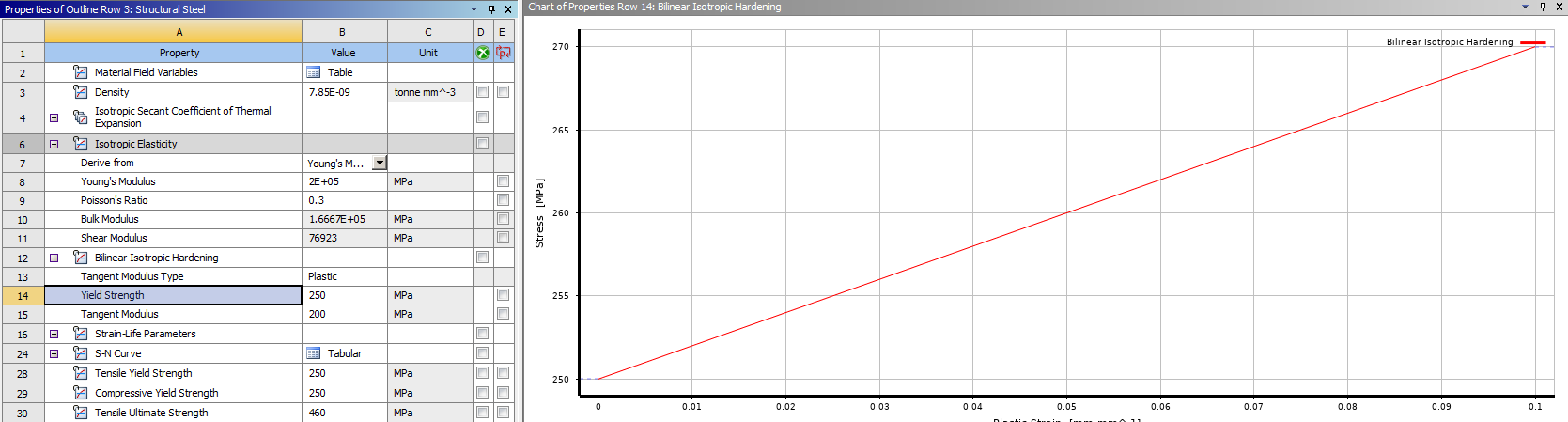
It's normal for the displayed plot not to show the elastic portion of the curve. The elastic portion will be considered using the properties you specify under Isotropic Elasticity.
Ensure you enter the correct values for the Tangent Modulus and Yield Strength, and you should be able to see the plastic portion (which is linear as expected) of the Bilinear Isotropic Hardening model.
-
-
March 27, 2026 at 10:36 am
sebastijan353
SubscriberHello,
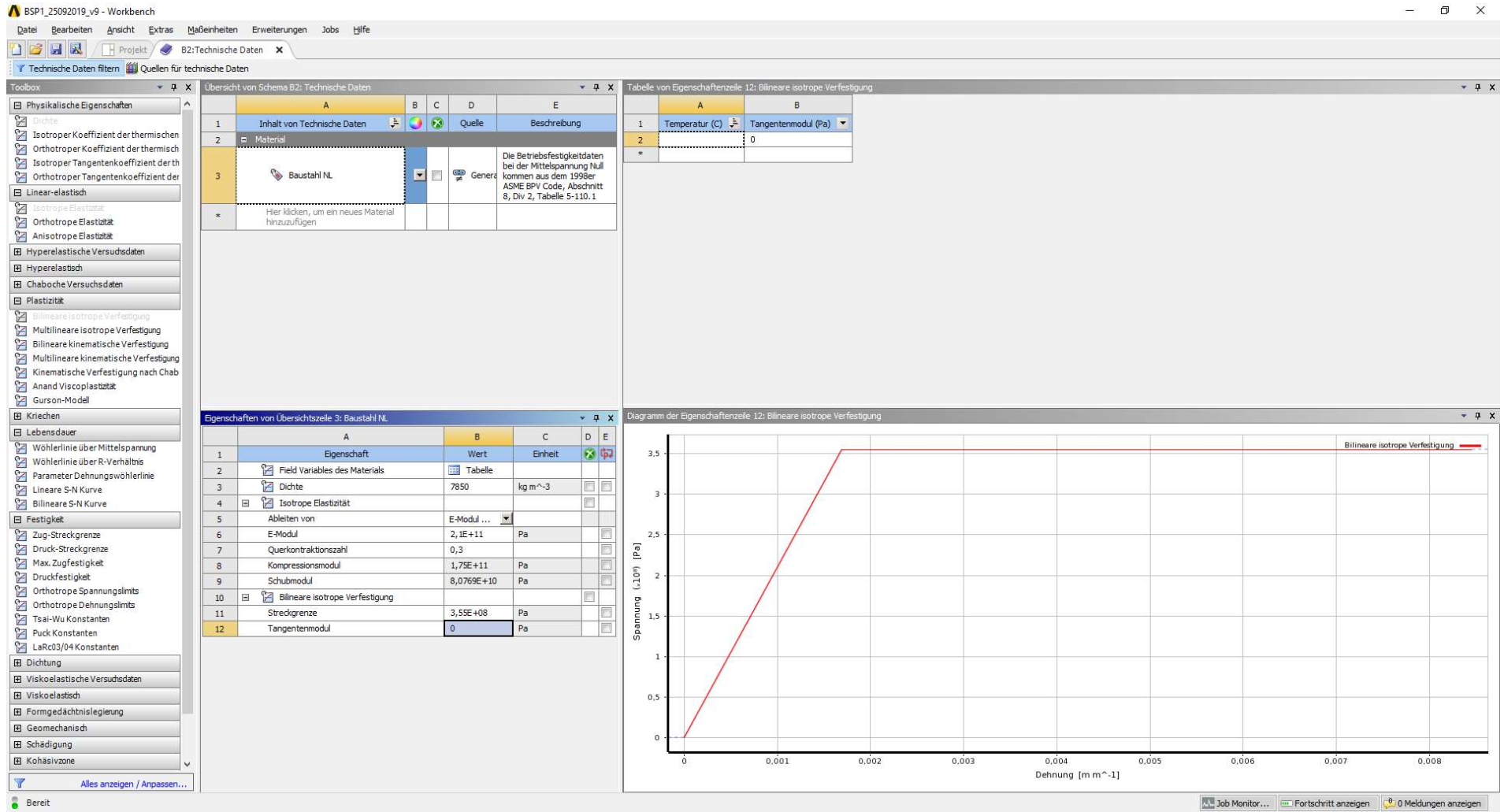
I am currently trying to recreate an analysis that was originally performed in ANSYS R19, and I have attached the stress–strain diagram that I am attempting to reproduce in ANSYS Workbench 2025.
Could you please confirm whether, by entering:
- Yield Strength = 3.55E+08 Pa
- Tangent Modulus = 0
I should obtain the same stress–strain diagram as shown in the attached image from R19?
Thanks to your reply, I understand that in the current version the elastic portion of the curve is not displayed (as it is defined separately under Isotropic Elasticity). However, this is somewhat impractical from a visualization standpoint and, to me, feels like a downgrade compared to the older version.
-
March 27, 2026 at 8:35 pm
Armin
Ansys EmployeeHi Sebastijan,
No problem.
Based on the properties you indicated, the material should be elastic–perfectly plastic. But to confirm this, you can run a single-element model (under uniaxial tension) using these material properties and then extract the resulting stress–strain curve to verify that the expected elastic–perfectly plastic behavior is obtained.
-
- You must be logged in to reply to this topic.
-
5944
-
1906
-
1420
-
1307
-
1021
© 2026 Copyright ANSYS, Inc. All rights reserved.