-
-
November 24, 2019 at 9:00 am
Alhussein
SubscriberHello,
I've created this model of Wand Loop (copper) surrounding a ring (carbon steel) embedded in a plastic pipe. I'm exciting the wand loop with a current as shown in the attached picture. The geometry is perfectly symmetric and the operating frequency is 13.56 MHz. The problem I'm having is that when I measured the current magnitude on the surface of the ring, it's not uniform all around the ring. I'm getting a maximum difference of about 800 A/m for different angles. I've increased my meshing aggressiveness and even changed to manual meshing and although I can say I got better results, the non-uniformity is still significantly showing. I've been having this problem for a while now and I don't know where exactly is the problem. I've attached some picture for meshing, electric field, and magnetic field. I'm also will to share the HFSS file if needed. I would appreciate any help. Thank you.
-
November 25, 2019 at 5:12 pm
slouie
Ansys EmployeeHi,Â
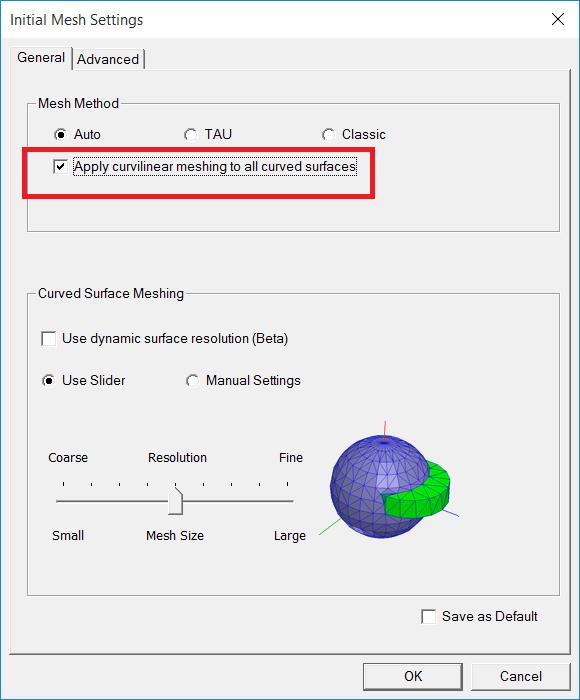
You could try our curvilinear mesh setting (HFSS>>Mesh>>Initial Mesh Settings):
Or you could try segmenting the loop so it's not a true curve. Final mesh may still not be uniform or symmetric as the HFSS adapted mesh is developed based on field gradients rather than geometry, but curvilinear elements should create a more conformal initial mesh to represent this curved geometry.Â
You may also try the beta feature pictured in the above screen shot: "Use dynamic surface resolution"
-
November 25, 2019 at 6:35 pm
Alhussein
SubscriberHello Slouie, I've tried the curvilinear meshing but the results still looked weird. For the "dynamic surface resolution", I don't have that feature. Do you know how could I get it?
-
December 4, 2019 at 11:17 am
David Prestaux
Ansys Employee
Hello,
I've created this model of Wand Loop (copper) surrounding a ring (carbon steel) embedded in a plastic pipe. I'm exciting the wand loop with a current as shown in the attached picture. The geometry is perfectly symmetric and the operating frequency is 13.56 MHz. The problem I'm having is that when I measured the current magnitude on the surface of the ring, it's not uniform all around the ring. I'm getting a maximum difference of about 800 A/m for different angles. I've increased my meshing aggressiveness and even changed to manual meshing and although I can say I got better results, the non-uniformity is still significantly showing. I've been having this problem for a while now and I don't know where exactly is the problem. I've attached some picture for meshing, electric field, and magnetic field. I'm also will to share the HFSS file if needed. I would appreciate any help. Thank you.
Â
Hello, probably some issues related to the curvature. The suggested curvilinear may work but it may not always be robust... the dynamic resolution is available in 2019R3 I think so you probably need to update your version. You can also tackle the issue in a robust way by using segmented curvature say a lot (100 segments?) for the ring...you give a help doing so for the surface mesher and you are somehow forcing the regularity of the mesh generation... I'd say it is the most robust methodology.
with only curvature, you can also play with the mesh surface approximation setting and increase the number of segments...You can also balance mesh resolution with both angle deviation similarly to the attached picture..
Â
-
- The topic ‘Asymmetric Current Density for a Symmetric Model’ is closed to new replies.

-
4904
-
1598
-
1386
-
1242
-
1021
© 2026 Copyright ANSYS, Inc. All rights reserved.