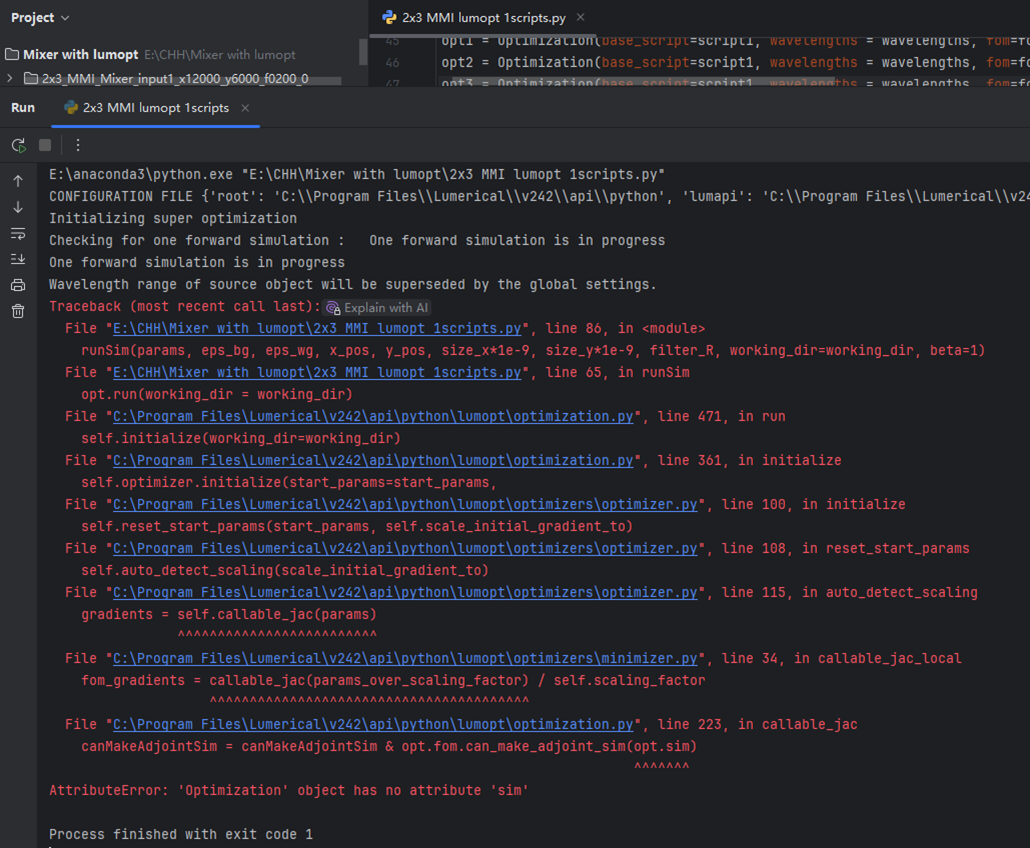
We've written the following code to attempt the inverse design of a 2x3 MMI device using Lumopt. The goal is to achieve equal power at the three output ports when two mode light sources enter through two input ports respectively. However, we've noticed that the actual FOM curve doesn't trend towards a gradual reduction in insertion loss. Why is this the case? Could you please provide me with professional advice and assistance? Thank you!
def runSim(params, eps_bg, eps_wg, x_pos, y_pos, size_x, size_y, filter_R, working_dir, beta):
######## DEFINE GEOMETRY ########
geometry = TopologyOptimization2D(params=params, eps_min=eps_bg, eps_max=eps_wg, x=x_pos, y=y_pos, z=0, filter_R=filter_R, beta=beta)
######## DEFINE FIGURE OF MERIT FOR EACH OUTPUT WAVEGUIDE ########
#fom1 = ModeMatch(monitor_name = 'fom_1', mode_number = 'Fundamental TE mode', direction = 'Forward', norm_p = 2, target_fom=1/3)
#fom2 = ModeMatch(monitor_name = 'fom_2', mode_number = 'Fundamental TE mode', direction = 'Forward', norm_p = 2, target_fom=1/3)
#fom3 = ModeMatch(monitor_name = 'fom_3', mode_number = 'Fundamental TE mode', direction = 'Forward', norm_p = 2, target_fom=1/3)
fom1 = ModeMatch(monitor_name='fom_1', mode_number='Fundamental TE mode', direction='Forward', norm_p=2, target_T_fwd=lambda wl: 1/3 * np.ones(wl.size))
fom2 = ModeMatch(monitor_name='fom_2', mode_number='Fundamental TE mode', direction='Forward', norm_p=2, target_T_fwd=lambda wl: 1/3 * np.ones(wl.size))
fom3 = ModeMatch(monitor_name='fom_3', mode_number='Fundamental TE mode', direction='Forward', norm_p=2, target_T_fwd=lambda wl: 1/3 * np.ones(wl.size))
######## DEFINE OPTIMIZATION ALGORITHM ########
optimizer1 = ScipyOptimizers(max_iter=400, method='L-BFGS-B', pgtol=1e-6, ftol=1e-5, scale_initial_gradient_to=0.25)
optimizer2 = ScipyOptimizers(max_iter=400, method='L-BFGS-B', pgtol=1e-6, ftol=1e-5, scale_initial_gradient_to=0.25)
optimizer3 = ScipyOptimizers(max_iter=400, method='L-BFGS-B', pgtol=1e-6, ftol=1e-5, scale_initial_gradient_to=0.25)
optimizer4 = ScipyOptimizers(max_iter=400, method='L-BFGS-B', pgtol=1e-6, ftol=1e-5, scale_initial_gradient_to=0.25)
optimizer5 = ScipyOptimizers(max_iter=400, method='L-BFGS-B', pgtol=1e-6, ftol=1e-5, scale_initial_gradient_to=0.25)
optimizer6 = ScipyOptimizers(max_iter=400, method='L-BFGS-B', pgtol=1e-6, ftol=1e-5, scale_initial_gradient_to=0.25)
######## DEFINE SETUP SCRIPT AND INDIVIDUAL OPTIMIZERS ########
script1 = load_from_lsf('E:/CHH/Mixer with lumopt/2x3 MMI Mixer input1 bend 6x6.lsf')
script2 = load_from_lsf('E:/CHH/Mixer with lumopt/2x3 MMI Mixer input2 bend 6x6.lsf')
# script1 = script.replace('opt_size_x=36e-6','opt_size_x={:1.6g}'.format(size_x))
# script1 = script.replace('opt_size_y=6e-6','opt_size_y={:1.6g}'.format(size_y))
wavelengths = Wavelengths(start = 1550e-9, stop = 1550e-9, points = 1)
opt1 = Optimization(base_script=script1, wavelengths = wavelengths, fom=fom1, geometry=geometry, optimizer=optimizer1,
use_deps=False, hide_fdtd_cad=True, plot_history=False, store_all_simulations=False, save_global_index=True)
opt2 = Optimization(base_script=script1, wavelengths = wavelengths, fom=fom2, geometry=geometry, optimizer=optimizer2,
use_deps=False, hide_fdtd_cad=True, plot_history=False, store_all_simulations=False, save_global_index=False)
opt3 = Optimization(base_script=script1, wavelengths = wavelengths, fom=fom3, geometry=geometry, optimizer=optimizer3,
use_deps=False, hide_fdtd_cad=True, plot_history=False, store_all_simulations=False, save_global_index=False)
opt4 = Optimization(base_script=script2, wavelengths=wavelengths, fom=fom1, geometry=geometry, optimizer=optimizer4,
use_deps=False, hide_fdtd_cad=True, plot_history=False, store_all_simulations=False, save_global_index=True)
opt5 = Optimization(base_script=script2, wavelengths=wavelengths, fom=fom2, geometry=geometry, optimizer=optimizer5,
use_deps=False, hide_fdtd_cad=True, plot_history=False, store_all_simulations=False, save_global_index=False)
opt6 = Optimization(base_script=script2, wavelengths=wavelengths, fom=fom3, geometry=geometry, optimizer=optimizer6,
use_deps=False, hide_fdtd_cad=True, plot_history=False, store_all_simulations=False, save_global_index=False)
######## PUT EVERYTHING TOGETHER AND RUN ########
weights = [0.5, 0.5, 0.5, 0.5, 0.5, 0.5]
opT = [opt1, opt2, opt3, opt4, opt5, opt6]
opt = SuperOptimization(optimizations=opT,weights=weights)
opt.run(working_dir=working_dir)
if __name__ == '__main__':
size_x = 12000
size_y = 6000
filter_R = 200e-9
x_points=int(size_x/20)+1
y_points=int(size_y/20)+1
eps_wg = 2.8**2
eps_bg = 1.44**2
x_pos = np.linspace(-size_x/2*1e-9,size_x/2*1e-9,x_points)
y_pos = np.linspace(-size_y/2*1e-9,size_y/2*1e-9,y_points)
## We need to pick an initial condition. Many different options:
# params = 0.5*np.ones((x_points,y_points)) #< Start with the domain filled with (eps_wg+eps_bg)/2
#params = np.ones((x_points,y_points)) #< Start with the domain filled with eps_wg
#params = np.zeros((x_points,y_points)) #< Start with the domain filled with eps_bg
params = None #< Use the structure defined in the project file as initial condition
working_dir = '2x3_MMI_Mixer_2scripts_x{:04d}_y{:04d}_f{:04d}'.format(size_x,size_y,int(filter_R*1e9))
runSim(params, eps_bg, eps_wg, x_pos, y_pos, size_x*1e-9, size_y*1e-9, filter_R, working_dir=working_dir, beta=1)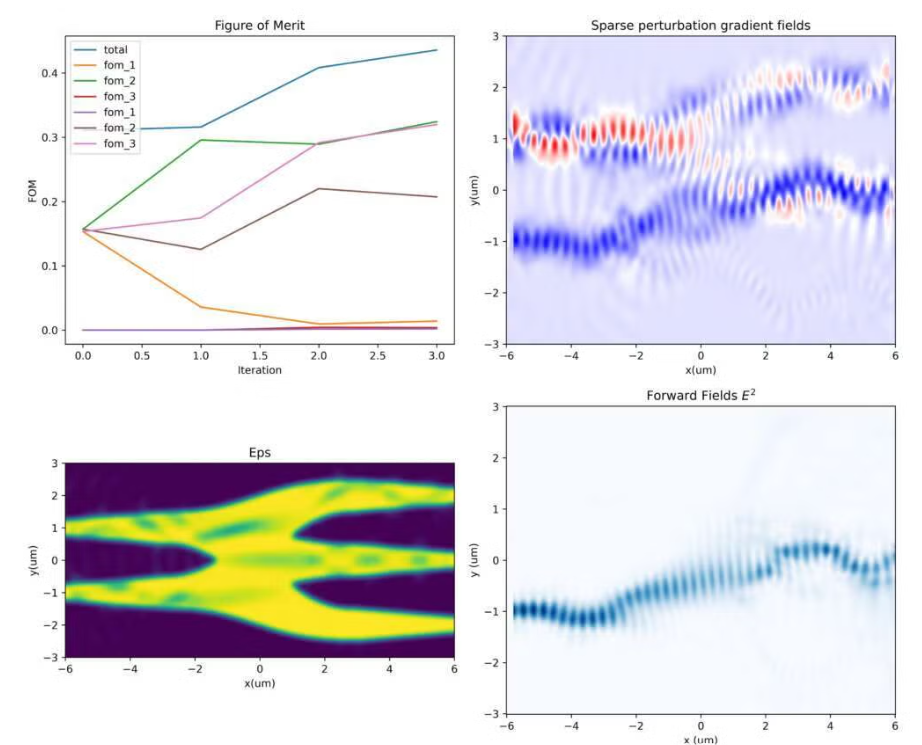

















 You are navigating away from the AIS Discovery experience