Ansys Learning Forum › Forums › Discuss Simulation › General Mechanical › step controls in transient structural analysis sittings › Reply To: step controls in transient structural analysis sittings
 peteroznewman
I pulled the earthquake acceleration data from your project archive, subtracted 10 from the time, and plotted a small snip.
The red dots are the tabular data, the blue lines are the linear interpolation values for times between the tabulated data.
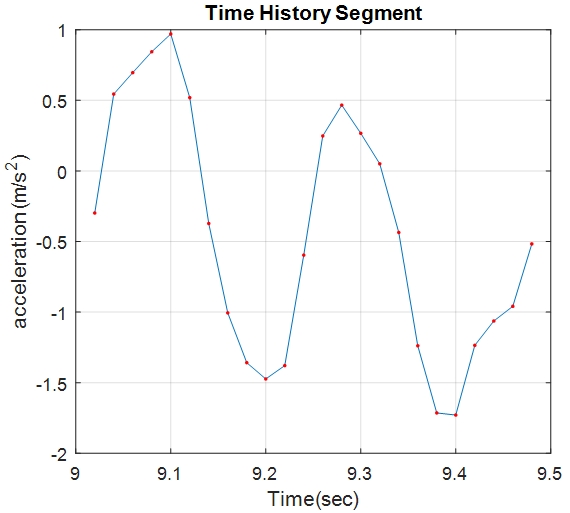
The earthquake was sampled at 0.02 seconds or 50 Hz, which are the red dots.
The simulation has an integration time step of 0.003 sec or 333 Hz. So as the solver steps through those tiny time steps, it will use an acceleration value on the blue line.
I mentioned it is possible to smooth out that data by using a spline fit and resampling. In the plot below, that was done at a sample rate of 333 Hz. Again, this is not required.

Divide 333 Hz by 20 to get 17 Hz. This is the 20 time steps per cycle rule to get good resolution of the motion at 17 Hz.
Since the earthquake was sampled at 50 Hz, there is not going to be any content above 25 Hz. You can see that in the FFT.
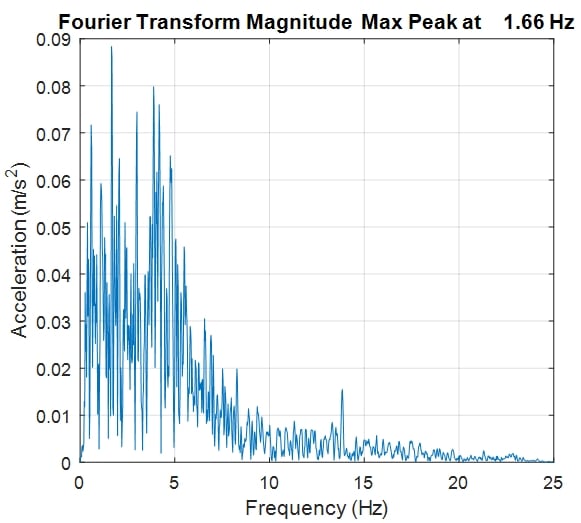
There is not much energy in the earthquake above 10 Hz so .003 s is a reasonable time step.
The Modal analysis provides you with the Participation Factor Summary. If you wanted to link the solution of the Modal into the Setup cell of the Transient Structural model to do a MSUP Transient analysis, you would look at that table in the X direction, which is what the earthquake is exciting.
I've never done a Plane Strain Transient Structural. Since the bodies are considered infinite, Workbench does not compute a mass for them, but Modal prints the Participation Factor Summary. The sum of the effective mass at Mode 14 at 24 Hz has accounted for 95% of the mass so 14 modes is plenty for a Linear analysis.

However, you want to use a nonlinear material, so you can't use MSUP Transient Structural, but it is good to know that the cumulative effective mass up to Mode 8 at 17 Hz is 86%.
To answer question 2, no, the integration time step size is independent of the load step size.
It seems that the choice of 0.003 s is a reasonable choice for this model for efficiency.
The inefficiency in the model is that it spends 10 seconds simulating a static gravity load before the earthquake starts. The efficient way to do that is to have Step 1 be 10 seconds but turn off integration and it will become a simple Static Structural solution. You can get that to converge in 4 iterations.

Then step 2 can run with time integration on. There is not much going on after 35 s, do you need to go out to 70 s?


 You are navigating away from the AIS Discovery experience