

-
-
March 22, 2021 at 6:12 pm
Alaa Ahmed
SubscriberHello,
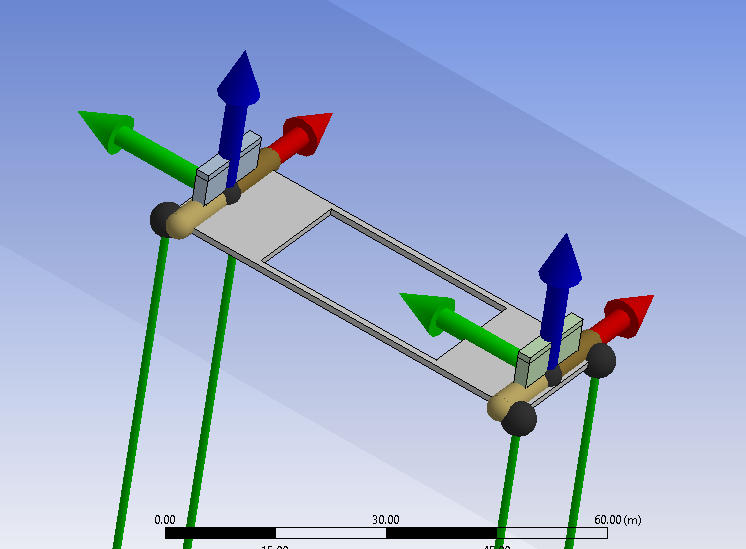
I'm trying to simulate oscillating plates installed on a floating platform connected to seabed with mooring lines.
From what I read, I can solve the mooring lines and the motion of the floating platform in AQWA, and then transfer those results to Fluent to include it in the solving process for the oscillating plates.
I can't find anyway to couple AQWA with Fluent, could you please advise me how to do that?
Thank you,
March 23, 2021 at 1:42 pmkarthik.remella
AdministratorHello,nThere is no built-in capability to couple Fluent and AQWA. Let me check with an AQWA expert to see if your problem can be modeled entirely in AQWA.nKarthiknMarch 25, 2021 at 4:19 pmSubscriberI think it can be fully modeled in AQWA, but we're trying to solve it in high-fidelity simulations.nIn one of the tutorials, it was mentioned that we can use a combination of ANSYS Fluent and ANSYS AQWA to get a detailed assessment. That's what I'm trying to do.n n
March 26, 2021 at 11:16 am
n
March 26, 2021 at 11:16 amMike Pettit
Ansys EmployeeHello,nWe don't have the functionality to perform 2-way coupling between Fluent and Aqwa at the moment. I think the best you can do is to export the structure motions from the time domain hydrodynamics calculation (plot the motions as graphical results, and use 'Export CSV File...' from the graph details) and then impose these motions in the Fluent calculations.nTo model this in Aqwa you can use Morison Disc elements to model the viscous drag effects on the plates; you may also consider increasing the drag coefficients to account for vortex shedding.nI hope this helps! MikenViewing 3 reply threads- The topic ‘Coupling AQWA with Fluent’ is closed to new replies.
Innovation Space Trending discussions
 Top Contributors
-
peteroznewman
 6880
6880 -
scabo
 1906
1906 -
Dennis Chen
 1544
1544 -
javat33489
 1344
1344 -
NickFL
1217
Top Rated Tags
© 2026 Copyright ANSYS, Inc. All rights reserved.
Ansys does not support the usage of unauthorized Ansys software. Please visit www.ansys.com to obtain an official distribution.
-


The Ansys Learning Forum is a public forum. You are prohibited from providing (i) information that is confidential to You, your employer, or any third party, (ii) Personal Data or individually identifiable health information, (iii) any information that is U.S. Government Classified, Controlled Unclassified Information, International Traffic in Arms Regulators (ITAR) or Export Administration Regulators (EAR) controlled or otherwise have been determined by the United States Government or by a foreign government to require protection against unauthorized disclosure for reasons of national security, or (iv) topics or information restricted by the People's Republic of China data protection and privacy laws.

 You are navigating away from the AIS Discovery experience