

-
-
March 4, 2021 at 3:54 am
Gumang
SubscriberHi Guys,
According to Mechanical User's Guide - A Modal Acoustic analysis models a structure and the surrounding the fluid medium to determine frequencies and standing wave patterns within a structure. In the Analysis Settings it says - The default is to extract the first 6 natural frequencies.
I have performed Modal Acoustic for a Plate enclosed with a Sphere. I gave the Sphere air properties. Solver Controls were Damped = No and Solver Type = Programm Controlled.
and expected it to give the first 6 natural frequencies of the plate.
March 4, 2021 at 9:08 amErKo
Ansys EmployeeHinnYou are having a free plate.nnThe freq., of the pure plate modes (structure only) have 6 rigid body modes which are close to 0 Hz (so the plate moving like a rigid body - in the acoustic analysis we do not see to get that), but the 7th mode at ~129 Hz is not, and is probably the same as the 1st mode (~129 Hz) of the vibroacoustic model, so they are very likely the same structural plate modes.nnSo that is, and we need to check the modes in both models to see which are the same and so on, because in the vibroacoustic model we can also have acoustic and coupled modes on top of pure structural modes.nnAll the bestnnEriknMarch 4, 2021 at 12:30 pmSubscriberHey Erik (ekoston), nBut I actually get rigid body movement for certain frequencies in Modal Acoustics. For example: as shown in the Screenshot below at 152,04 Hz. nSo in order to find the natural frequencies of a structure surrounded by a fluid one has to look for pure structural modes and ignore the acoustic and coupled modes? nThank you very much for replying.nRegards nUmangn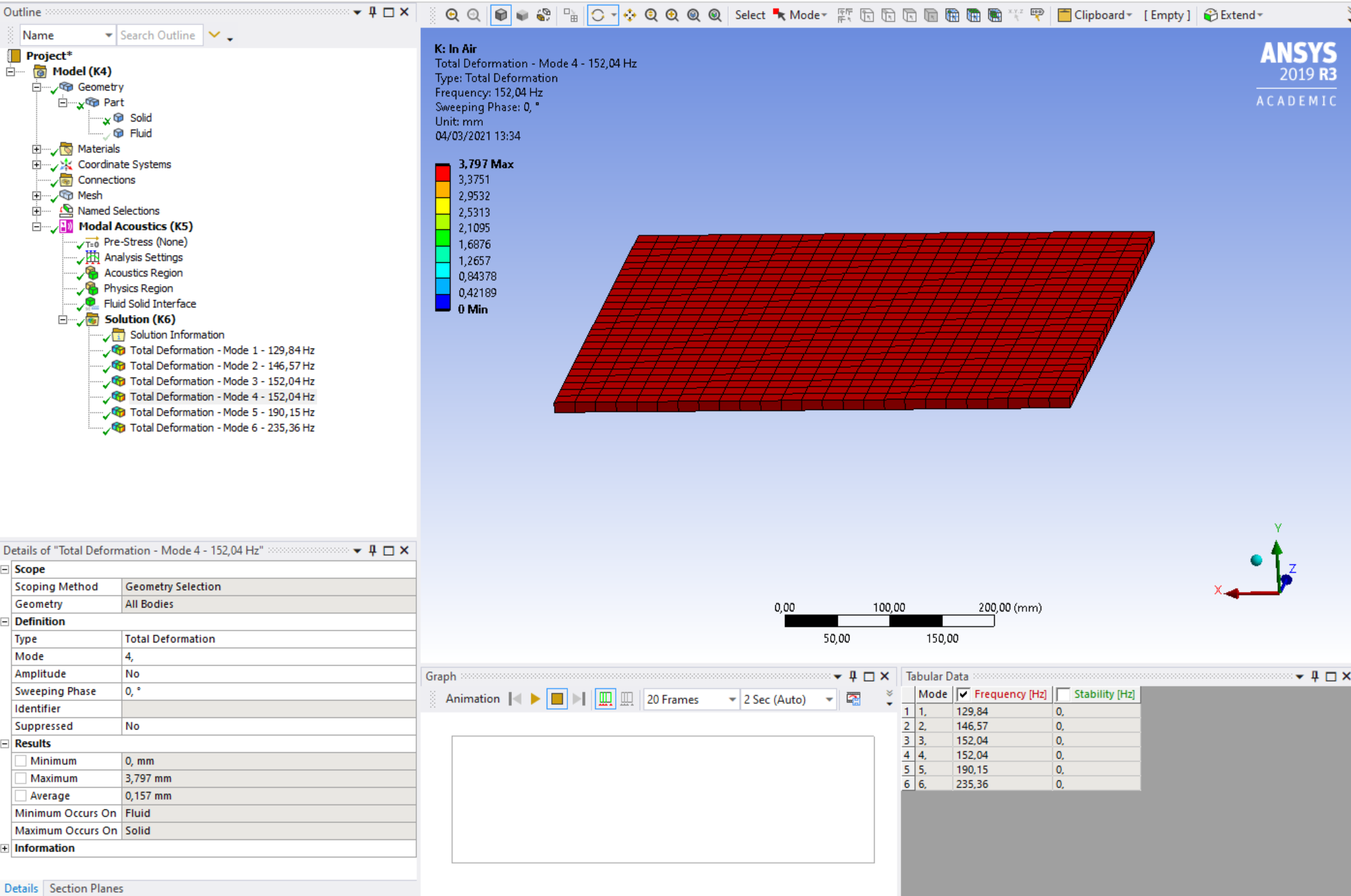 n
n March 4, 2021 at 1:49 pmSubscriber^ (Forgot to tag you in my last comment ;P) nMarch 4, 2021 at 4:11 pmAnsys EmployeeHi Modal acoustics will calculate acoustic and / or structural modes if we have a structure present .nnSo we have a rectangular enclosure, then the first acoustic mode for (2mx1mx0.1m) say should f=343/(2*2)=85.75 HznnI would suggest to do some simple example without structure to study the pure acoustic modes.nnThen start add in a structure, but of course fix it as it would be in reality (there are no free floating structure, so we need some restraints), and look also on realistic enclosures (not a sphere).nnFinally for the theory and some possible examples see the help manual.nnAll the bestnnEriknMarch 4, 2021 at 4:19 pmSubscriberArray Thank for the help nMarch 4, 2021 at 4:45 pmAnsys EmployeeYou are more than welcome - just to finish of this discussion, and perhaps this will help others - to the points that a vibroacoustic modal analysis predicts acoustic and / or structural modes if we have a structure present . In the right image below there is a room which is 3 m by 2.5 by 2 (the plate inside the room is 1 x 0.5 x 0.01), so the first acoustic mode along the longest direction, should be f=(343m/s)/(2*3m) = 57 Hz, and that is what we get (see highlight with red in the right image below). The plate mode is 52 Hz which is a free bending mode in that model (highlight in blue in the right image below), and is exactly like the pure structural modal analysis (52 Hz, left image highlighted in blue) and as expected. Of course since the structure is not fixed anywhere in the pure structural modal analysis in the left image below, it also has 6 rigid body modes before we get the 52 Hz plate bending mode.nn
 n
Viewing 6 reply threads
n
Viewing 6 reply threads- The topic ‘what is Modal Acoustic Analysis calculating?’ is closed to new replies.
Innovation Space Trending discussions
 Top Contributors
-
peteroznewman
 6485
6485 -
scabo
 1906
1906 -
Dennis Chen
 1458
1458 -
javat33489
 1308
1308 -
Shyam Prasad V Atri
1022
Top Rated Tags
© 2026 Copyright ANSYS, Inc. All rights reserved.
Ansys does not support the usage of unauthorized Ansys software. Please visit www.ansys.com to obtain an official distribution.
-


The Ansys Learning Forum is a public forum. You are prohibited from providing (i) information that is confidential to You, your employer, or any third party, (ii) Personal Data or individually identifiable health information, (iii) any information that is U.S. Government Classified, Controlled Unclassified Information, International Traffic in Arms Regulators (ITAR) or Export Administration Regulators (EAR) controlled or otherwise have been determined by the United States Government or by a foreign government to require protection against unauthorized disclosure for reasons of national security, or (iv) topics or information restricted by the People's Republic of China data protection and privacy laws.

 You are navigating away from the AIS Discovery experience