

TAGGED: chemical-reaction, fluent, porous, porous-media
-
-
February 17, 2021 at 4:57 am
Anshul
SubscriberHi all,
I am working on methanol steam reforming with simple cylindrical packed bed reactor. For backed bed catalyst zone, I am using porous model. I have a confusion with the modelling approach of porous media. There are two approaches present in FLUENT, physical and superficial velocity.
When I have compared the transport equation involving porous effect present in the reference paper to that of FLUENT theory guide, there are some deviations in it. This is shown in the attached image.
Also, I am getting deviations in velocity and pressure contours when compared my simulation to that of reference paper. I am thinking this is due to this porous modelling approach.
Please guide me about which approach should I use?
Anshul
February 17, 2021 at 5:24 amYasserSelima
SubscriberThe equations in the reference paper assumes steady incompressible fluid ... FLUENT has general equations nFebruary 17, 2021 at 5:42 amSubscriberHi,nNo. I am asking about eqnations, see for example in FLUENT the porosity factor is taken into continuity eqn also and similar in others..nThe equations present in papet and FLUENT seems to be diffrent.nnFebruary 17, 2021 at 10:18 amRob
Forum ModeratorAs we have no idea where the paper is from I can't comment. Similarly, I don't know what your results are to compare with the paper. Check you're modelling like for like re geometry, chemistry, materials etc and that the problem is well posed (ie good mesh and converged). nFebruary 17, 2021 at 1:07 pmSubscribernContinuity ... in fluent nassume steady , first term disappear ... constant porosity ... take it out of the derivative .. divide the whole equation by the porosity ... now both equations are similarnnMomentumnput all derivative wrt as zeros ... assume constant porosity and fluid density and take them out of the derivatives ... divide the equation by the density Now they are similar except last term ... nIn the last term the paper uses approximation, fluent has more general solution .. go to the referenced equation ... As recommended, look at your model ... the mesh ... the parameters .. inputs and outputs .. nFebruary 17, 2021 at 3:45 pmSubscribernYes, I got it. But as you said there is deviation in the last source term in momentum equation, so what approach should I use:nSUPERFICIAL VELOCITY: Having source term for pressure drop but not multiplying the porosity factor with each derivative term.nPHYSICAL VELOCITY: Along with source term, porosity factor multiplied with each derivative term.nThis is what I found in FLUENT user guiden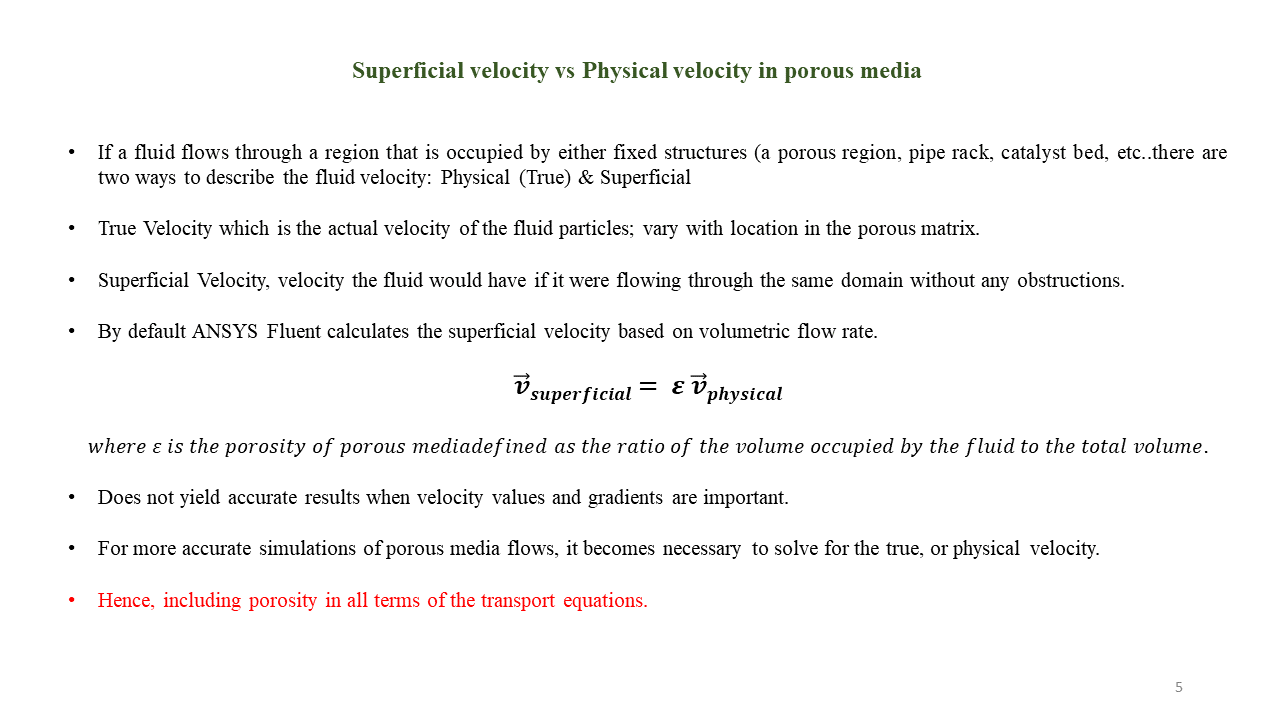 .nPlease help me in clearing the confusion!nn
February 17, 2021 at 4:21 pmSubscriberI am not experienced in porous media ... But the last few lines in your photo. would answer your question. If you are interested in gradient, use the physical velocity. If you just need a faster overall solution, use the superficial nViewing 6 reply threads
.nPlease help me in clearing the confusion!nn
February 17, 2021 at 4:21 pmSubscriberI am not experienced in porous media ... But the last few lines in your photo. would answer your question. If you are interested in gradient, use the physical velocity. If you just need a faster overall solution, use the superficial nViewing 6 reply threads- The topic ‘Modelling of catalytic porous zone: Superficial and Physical velocity’ is closed to new replies.
Innovation Space Trending discussions
 Top Contributors
-
peteroznewman
 6465
6465 -
scabo
 1906
1906 -
Dennis Chen
 1458
1458 -
javat33489
 1308
1308 -
Shyam Prasad V Atri
1022
Top Rated Tags
© 2026 Copyright ANSYS, Inc. All rights reserved.
Ansys does not support the usage of unauthorized Ansys software. Please visit www.ansys.com to obtain an official distribution.
-


 You are navigating away from the AIS Discovery experience