


-
-
January 20, 2021 at 4:33 am
kirstenbraun
SubscriberHello all,
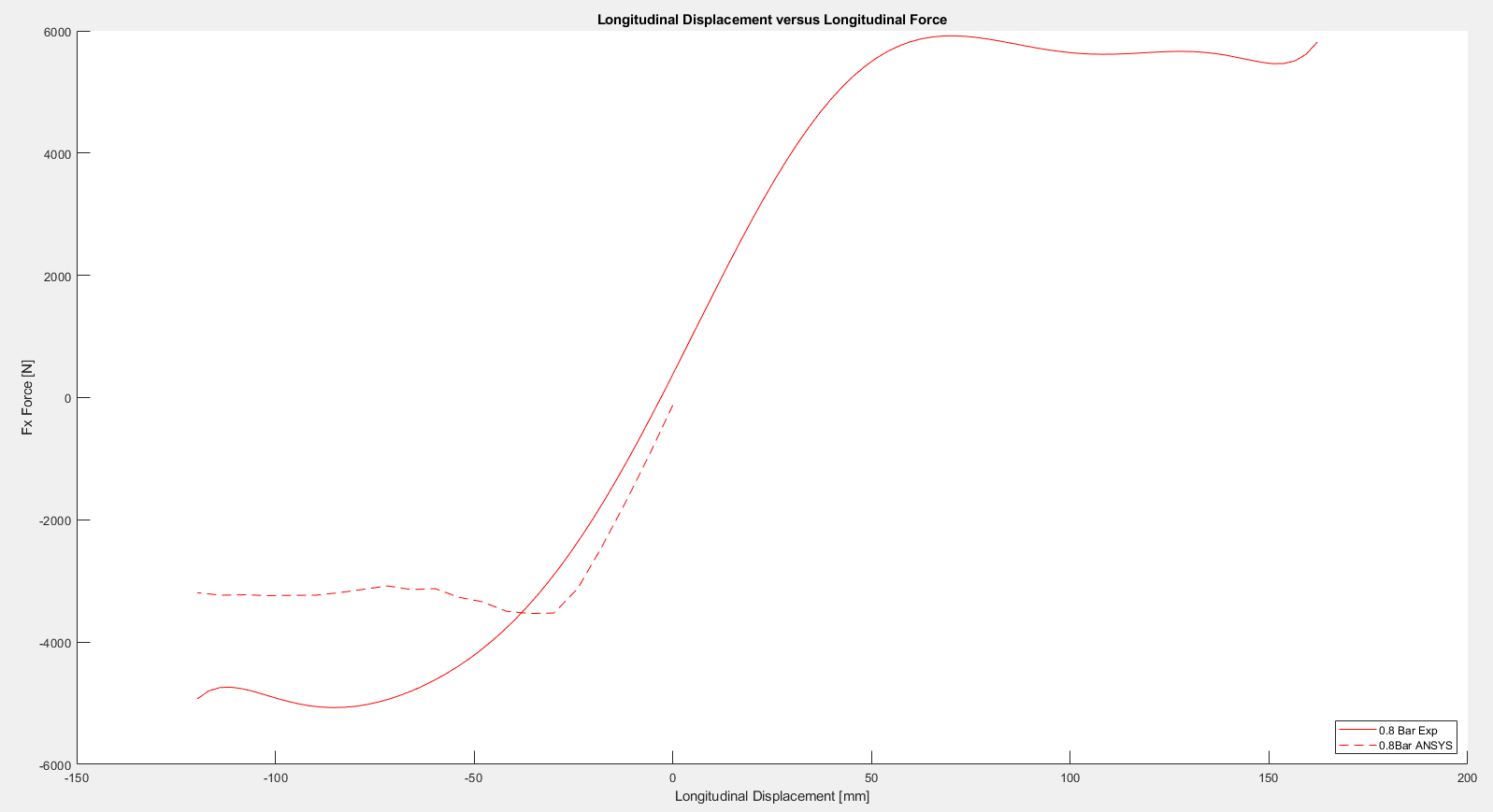
At the moment I am modelling a tyre in which the tyre is inflated to 0.8Bar, a road has displaced a distance towards the tyre along the z-axis (46.99587126mm as this equates to 5.5kN loading of my tyre) which thereafter is then displaced along the x-axis (-119.6748820213mm). The purpose of this is to obtain what forces the model tyre experiences under longitudinal forces. However, when running my simulation at around [time, x disp] = [2.25sec, -29.919mm, -3140.6N] the tyre seems to slip and the Force flattens out and remains at around 3000N. The graph below shows the experimental results (red solid line) and simulated results (red dotted line).
January 20, 2021 at 4:15 pmpeteroznewman
SubscribernIncrease the Coefficient of Friction in the Frictional Contact.nOr, change the Frictional Contact to Rough Contact. Rough contact does not allow any slipping.nJanuary 21, 2021 at 12:55 pmSubscriberThank you very much for your speedy response. I have run my simulation with both an increased coefficient of friction as well as using a rough contact setting rather than the frictional contact. nI found that when simulating the case where the rough setting was used, the simulation did not solve. I then instead increased the friction coefficient from 0.64 to a value of 0.85, and found the following:n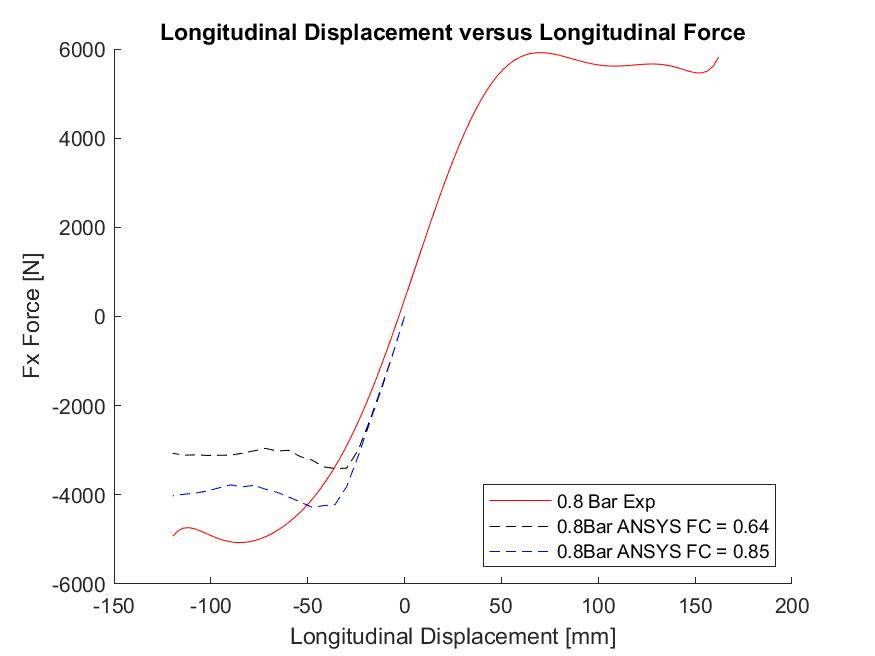 As you can see, with an increase in the friction coefficient the simulated data became a better approximation of the experimental data, and the slipping effect occurs at a later stage, at 0.3 seconds rather than at 2.25 seconds into the simulation. To further see if I can get a better approximation I changed the coefficient of friction to a value of 1.5, and am now just waiting for the simulation to solve. I read that the coefficient of friction does not have t be a value between 0 and 1, and that a friction coefficient greater than 1 just implies that the frictional force is stranger than that of the normal force. Am I correct in making this theoretical assumption ?nThank you for your timennRegards, nKirsten Braunn
January 21, 2021 at 8:12 pmSubscribernYes, friction coefficient can be greater than 1 since it is the ratio of the tangential force divided by the normal force. So if you have a COF of 1.5 and you push down with 100 N, it will take 150 N to begin sliding.nJanuary 31, 2021 at 9:42 amSubscriber, nI figured out that the reason as to why my test was not matching the experimental data was because the incorrect friction coefficient was being used. The friction coefficient I calculated off of the experimental data was 0.9. I adjusted the coefficient and received a better approximation. nI have a new question regarding the friction coefficient. I found that for my 0.8Bar case that a friction coefficient above 0.95 led to the simulation not solving. For the 2Bar case the friction coefficient was limited to a value below 0.9 (as a simulation with a friction coefficient of 0.9 failed, running a simulation currently with a 0.85 friction coefficient). nThe errors I get at a high friction value are as follows:nContact status has experienced an abrupt change. Check results carefully for possible contact separation.nThe unconverged solution (identified as Substep 999999) is output for analysis debug purposes. Results at this time should not be used for any other purpose.nAlthough the solution failed to solve completely at all time points, partial results at some points have been able to be solved. Refer to Troubleshooting in the Help System for more details.nLarge deformation effects are active which may have invalidated some of your applied supports such as displacement, cylindrical, frictionless, or compression only. Refer to Troubleshooting in the Help System for more details.nMoment summations are based upon the displaced mesh since large deflection is in effect (NLGEOM,ON).nThis error generally occurs at around 85% on the progress bar, which is around 3.5-4 hours into the run. nMy question is, is there any friction limits to ANSYS Mechanical? From your previous comments, it sounded like there isn't, however, it is unclear as to why this time wasting issue keeps reoccurring. nThank you nJanuary 31, 2021 at 2:08 pmSubscribernHello Kirsten,nYou are using an Implicit solver, which must converge on equilibrium at every load increment, and as you have found, this can be very challenging.nYou could switch to an Explicit solver, which operates on a different mathematical principle, and has no convergence criterion. Every time step is acceptable. It does this using a Dynamics formulation, and extremely tiny time steps.nI had an elastomer bellows model running in Static Structural which needed contact to prevent the bellows folds from passing through each other. I spent many hours trying to get the contact to work. I converted the model to Explicit Dynamics and it worked on the first try! nI don't want to over-sell this solver, it comes with a long list of its own problems and frustrations, I just wanted you to be aware of another approach.nDo you have a license for Explicit Dynamics or LS-DYNA?nThose are available in the limited node count Student license, but I believe your models don't fit in those limits.nThere is also a new feature in Static Structural, where the Implicit solver will automatically engage the Explicit solver to get past a difficulty. I have not used that feature yet. You can read about it in the ANSYS Help system. Copy and paste this URL into an open ANSYS Help browser.nhttps://ansyshelp.ansys.com/account/secured?returnurl=/Views/Secured/corp/v211/en/ans_adv/Hlp_G_ADVSEMI.htmlnApril 6, 2023 at 2:52 pm
As you can see, with an increase in the friction coefficient the simulated data became a better approximation of the experimental data, and the slipping effect occurs at a later stage, at 0.3 seconds rather than at 2.25 seconds into the simulation. To further see if I can get a better approximation I changed the coefficient of friction to a value of 1.5, and am now just waiting for the simulation to solve. I read that the coefficient of friction does not have t be a value between 0 and 1, and that a friction coefficient greater than 1 just implies that the frictional force is stranger than that of the normal force. Am I correct in making this theoretical assumption ?nThank you for your timennRegards, nKirsten Braunn
January 21, 2021 at 8:12 pmSubscribernYes, friction coefficient can be greater than 1 since it is the ratio of the tangential force divided by the normal force. So if you have a COF of 1.5 and you push down with 100 N, it will take 150 N to begin sliding.nJanuary 31, 2021 at 9:42 amSubscriber, nI figured out that the reason as to why my test was not matching the experimental data was because the incorrect friction coefficient was being used. The friction coefficient I calculated off of the experimental data was 0.9. I adjusted the coefficient and received a better approximation. nI have a new question regarding the friction coefficient. I found that for my 0.8Bar case that a friction coefficient above 0.95 led to the simulation not solving. For the 2Bar case the friction coefficient was limited to a value below 0.9 (as a simulation with a friction coefficient of 0.9 failed, running a simulation currently with a 0.85 friction coefficient). nThe errors I get at a high friction value are as follows:nContact status has experienced an abrupt change. Check results carefully for possible contact separation.nThe unconverged solution (identified as Substep 999999) is output for analysis debug purposes. Results at this time should not be used for any other purpose.nAlthough the solution failed to solve completely at all time points, partial results at some points have been able to be solved. Refer to Troubleshooting in the Help System for more details.nLarge deformation effects are active which may have invalidated some of your applied supports such as displacement, cylindrical, frictionless, or compression only. Refer to Troubleshooting in the Help System for more details.nMoment summations are based upon the displaced mesh since large deflection is in effect (NLGEOM,ON).nThis error generally occurs at around 85% on the progress bar, which is around 3.5-4 hours into the run. nMy question is, is there any friction limits to ANSYS Mechanical? From your previous comments, it sounded like there isn't, however, it is unclear as to why this time wasting issue keeps reoccurring. nThank you nJanuary 31, 2021 at 2:08 pmSubscribernHello Kirsten,nYou are using an Implicit solver, which must converge on equilibrium at every load increment, and as you have found, this can be very challenging.nYou could switch to an Explicit solver, which operates on a different mathematical principle, and has no convergence criterion. Every time step is acceptable. It does this using a Dynamics formulation, and extremely tiny time steps.nI had an elastomer bellows model running in Static Structural which needed contact to prevent the bellows folds from passing through each other. I spent many hours trying to get the contact to work. I converted the model to Explicit Dynamics and it worked on the first try! nI don't want to over-sell this solver, it comes with a long list of its own problems and frustrations, I just wanted you to be aware of another approach.nDo you have a license for Explicit Dynamics or LS-DYNA?nThose are available in the limited node count Student license, but I believe your models don't fit in those limits.nThere is also a new feature in Static Structural, where the Implicit solver will automatically engage the Explicit solver to get past a difficulty. I have not used that feature yet. You can read about it in the ANSYS Help system. Copy and paste this URL into an open ANSYS Help browser.nhttps://ansyshelp.ansys.com/account/secured?returnurl=/Views/Secured/corp/v211/en/ans_adv/Hlp_G_ADVSEMI.htmlnApril 6, 2023 at 2:52 pmDr. / Abdalla Mohamed
SubscriberHi satff
Please tell me what is the suitable contact type which can model the bond slippage between concrete and steel bars ?
Viewing 6 reply threads- The topic ‘How to avoid frictional slip between a frictional contact?’ is closed to new replies.
Innovation Space Trending discussions
 Top Contributors
-
peteroznewman
 6450
6450 -
scabo
 1906
1906 -
Dennis Chen
 1457
1457 -
javat33489
 1308
1308 -
Shyam Prasad V Atri
1022
Top Rated Tags
© 2026 Copyright ANSYS, Inc. All rights reserved.
Ansys does not support the usage of unauthorized Ansys software. Please visit www.ansys.com to obtain an official distribution.
-
Ansys Assistant will be unavailable on the Learning Forum starting January 30. An upgraded version is coming soon. We apologize for any inconvenience and appreciate your patience. Stay tuned for updates.


 You are navigating away from the AIS Discovery experience