

TAGGED: electrostatic
-
-
January 20, 2021 at 1:46 am
18409680
SubscriberHey guys,
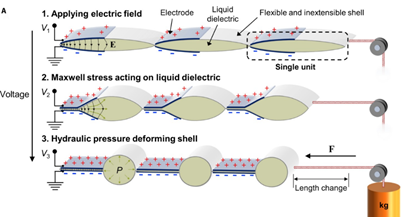
I've been working on modelling the HASEL actuator, specifically the peano HASEL actuator ( demonstrated in the following video). https://www.youtube.com/watch?v=-TKjJBZEZe4
I'm having trouble matching my simulated results with the practical results. before showing how I modelled the HASEL actuator below in Fig 1. shows how the HASEL actuator should look when it is 'fully strained'.
January 20, 2021 at 1:46 amSubscriberHere are the files that I have been runningn nFirst with the transducer elements supplying the force and then with the penalty method setting the electrode displacement.nnJanuary 21, 2021 at 1:57 pmdlooman
Ansys EmployeeThe retraction of the acuator is a large deflection effect and the input has the nlgeom command commented out. With nlgeom,on the model won't converge so that may be the reason it is commented out. The plane183 mesh is very poor due to the thinness of the geometry. This may contribute to the convergence difficulty. A shell element would be more appropriate for such thin geometry (after converting the model to 3D by giving it a unit depth. ) Applying the pressure gradually over many steps may be necessary also. The analysis of thin membranes under internal pressure is always difficult and not always possible. A command like STABILIZE may help.nJanuary 23, 2021 at 2:58 pmSubscriberThanks dlooman,nYes, I had to comment out the 'nlgeom,on' because it was highly distorted my geometry. nI did think of the thinness of the model and recently tried to do the simulation BEAM element. nI was able to mesh with 'nlgeom,on' working.nhowever the issue now is the contact stiffness of the TRANS126 is not taking over when the beam element reaches the 'minimum gap' as described in the TRANS126 element description. No matter what I change the beam elements just pass right through each other and thus the electrode can't 'zip', as shown in the figure below. Even when I try to add a contact element it still does nothing. n Should I try it with the 3D shell model? Is it more compatible with contact stiffness? Or is there something wrong with the way I have used the TRANS126 element?nHere are all the codes associated with the TRANS element (the scale is in umks units)n pouch_thickness = 20n pouch_width = 100e3nelectrode_mat=3npermittivity_of_air = 8.85e-6n relative_permittivity = 2.1n permittivity = relative_permittivity*permittivity_of_airnMP, PERX, electrode_mat, permittivityt!nLSEL,NONE nLSEL,S, , , 6 nNSLL,S,0nCM,ELECT1,NODEnnLSEL,NONE nLSEL,S, , , 7nNSLL,S,0nCM,ELECT2,NODEnn*do,i, 1, no_of_coup_pairs,nCMGRP, ELECT_COUP_%i%,Elect1n*do,j, 2, no_of_electnCMEDIT, ELECT_COUP_%i%, add, Elect%j%n*enddon*enddonn*do,i, 1,no_of_elect, nnALLSEL,allnCMSEL,S,ELECT%i%,nn*get, n_count_elect, node,, COUNT,n*DIM, initial_ny%i%, ARRAY, n_count_elect, n*VGET, electrode%i%_nodes, NODE, , nlist,n*do, j, 1, n_count_elect,ninitial_ny%i%(j)= ny(electrode%i%_nodes(j))n*enddon*enddonnET, electrode_mat,TRANS126 n!* nKEYOPT,electrode_mat,2,2nKEYOPT,electrode_mat,3,0nKEYOPT,electrode_mat,4,0nKEYOPT,electrode_mat,6,0n!* n nTYPE, electrode_mat nMAT,telectrode_matnESYS, 0 nSECNUM, nntt! 3.4.1. Divide into Elementsn*do,i, 1, no_of_coup_pairs,nii= i+1nallseln*do,j, 1, n_count_elect, ntrans_I_node= electrode%i%_nodes(j)ntrans_J_node= electrode%ii%_nodes(j)nnGAP=DISTND(trans_I_node,trans_J_node)nGAPMIN= pouch_thicknessnarea= ARNODE(trans_I_node)*pouch_widthnKN= pouch_Ex*pouch_width*area/pouch_thicknessnC0= -permittivity*area!/scale_mnnr, electrode_mat+j-1, , , GAP, GAPMIN, KN, ,nrmore, C0, !C1, C2, C3, C4nreal,electrode_mat+j-1nE,trans_I_node,trans_J_noden*enddon*enddonnThanks for all the helpnLevin
January 23, 2021 at 9:59 pmSubscriberHey dlooman,nI just noticed that my material don't have a contact coefficients defined accept for the stiffness constant defined in with the TRANS126 element. Would that effect the contact force of the elements or should the TRANS126 stiffness be enough? nLevinJanuary 25, 2021 at 8:24 pmSubscriberHey dlooman,nI realized the TRANS126 was backwards, so I switched the nodes around and the contact stiffness for the element now seem to be working.nI now seem to just have an issue of converging all the model with all the TRANS126 forces involved. nHere the latest file I've been using nIf there are any suggestion to help with the convergence it would be much appreciatednLevinViewing 5 reply threads
Should I try it with the 3D shell model? Is it more compatible with contact stiffness? Or is there something wrong with the way I have used the TRANS126 element?nHere are all the codes associated with the TRANS element (the scale is in umks units)n pouch_thickness = 20n pouch_width = 100e3nelectrode_mat=3npermittivity_of_air = 8.85e-6n relative_permittivity = 2.1n permittivity = relative_permittivity*permittivity_of_airnMP, PERX, electrode_mat, permittivityt!nLSEL,NONE nLSEL,S, , , 6 nNSLL,S,0nCM,ELECT1,NODEnnLSEL,NONE nLSEL,S, , , 7nNSLL,S,0nCM,ELECT2,NODEnn*do,i, 1, no_of_coup_pairs,nCMGRP, ELECT_COUP_%i%,Elect1n*do,j, 2, no_of_electnCMEDIT, ELECT_COUP_%i%, add, Elect%j%n*enddon*enddonn*do,i, 1,no_of_elect, nnALLSEL,allnCMSEL,S,ELECT%i%,nn*get, n_count_elect, node,, COUNT,n*DIM, initial_ny%i%, ARRAY, n_count_elect, n*VGET, electrode%i%_nodes, NODE, , nlist,n*do, j, 1, n_count_elect,ninitial_ny%i%(j)= ny(electrode%i%_nodes(j))n*enddon*enddonnET, electrode_mat,TRANS126 n!* nKEYOPT,electrode_mat,2,2nKEYOPT,electrode_mat,3,0nKEYOPT,electrode_mat,4,0nKEYOPT,electrode_mat,6,0n!* n nTYPE, electrode_mat nMAT,telectrode_matnESYS, 0 nSECNUM, nntt! 3.4.1. Divide into Elementsn*do,i, 1, no_of_coup_pairs,nii= i+1nallseln*do,j, 1, n_count_elect, ntrans_I_node= electrode%i%_nodes(j)ntrans_J_node= electrode%ii%_nodes(j)nnGAP=DISTND(trans_I_node,trans_J_node)nGAPMIN= pouch_thicknessnarea= ARNODE(trans_I_node)*pouch_widthnKN= pouch_Ex*pouch_width*area/pouch_thicknessnC0= -permittivity*area!/scale_mnnr, electrode_mat+j-1, , , GAP, GAPMIN, KN, ,nrmore, C0, !C1, C2, C3, C4nreal,electrode_mat+j-1nE,trans_I_node,trans_J_noden*enddon*enddonnThanks for all the helpnLevin
January 23, 2021 at 9:59 pmSubscriberHey dlooman,nI just noticed that my material don't have a contact coefficients defined accept for the stiffness constant defined in with the TRANS126 element. Would that effect the contact force of the elements or should the TRANS126 stiffness be enough? nLevinJanuary 25, 2021 at 8:24 pmSubscriberHey dlooman,nI realized the TRANS126 was backwards, so I switched the nodes around and the contact stiffness for the element now seem to be working.nI now seem to just have an issue of converging all the model with all the TRANS126 forces involved. nHere the latest file I've been using nIf there are any suggestion to help with the convergence it would be much appreciatednLevinViewing 5 reply threads- The topic ‘HASEL actuator model’ is closed to new replies.
Innovation Space Trending discussions
 Top Contributors
-
peteroznewman
 6575
6575 -
scabo
 1906
1906 -
Dennis Chen
 1463
1463 -
javat33489
 1311
1311 -
Shyam Prasad V Atri
1022
Top Rated Tags
© 2026 Copyright ANSYS, Inc. All rights reserved.
Ansys does not support the usage of unauthorized Ansys software. Please visit www.ansys.com to obtain an official distribution.
-


The Ansys Learning Forum is a public forum. You are prohibited from providing (i) information that is confidential to You, your employer, or any third party, (ii) Personal Data or individually identifiable health information, (iii) any information that is U.S. Government Classified, Controlled Unclassified Information, International Traffic in Arms Regulators (ITAR) or Export Administration Regulators (EAR) controlled or otherwise have been determined by the United States Government or by a foreign government to require protection against unauthorized disclosure for reasons of national security, or (iv) topics or information restricted by the People's Republic of China data protection and privacy laws.

 You are navigating away from the AIS Discovery experience