

-
-
December 15, 2020 at 12:26 pm
m.caragiuli
SubscriberHi,
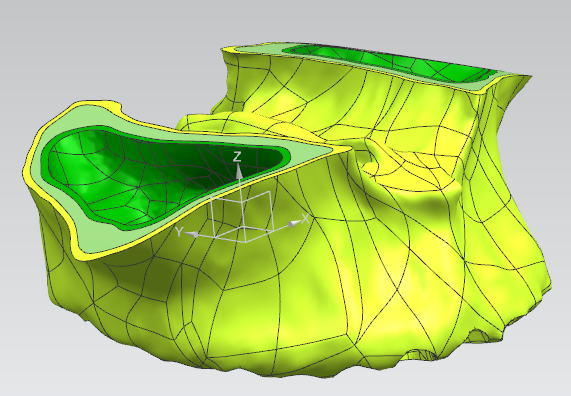
I need to constrain an assembly to prevent any rigid body motion. It consists of the bodies highlighted in different colours. Other bodies not displayed in the picture are in contact with the yellow body on the inferior side. I want to apply a fixed support to this assembly. The idea is to scope the top faces of the displayed bodies, but would it be sufficient to prevent any motion? Should I scope the whole bodies instead?
December 15, 2020 at 12:42 pmRahul Kumbhar
Ansys EmployeeIf you apply 'Fixed support'on the faces, it should be sufficient to stop rigid body motion. But depending upon the loads and material properties, if the material deforms a lot, then it can give element distortion.nDecember 15, 2020 at 1:25 pmSubscriberok thanks. By applying the fixed support on the entire bodies will it be an overconstraint?nDecember 16, 2020 at 3:52 pmAnsys EmployeeI am not sure. It depends upon your boundary condition. Sorry if my previous reply created confusion. I meant if you just select one face for fixed support, that should be sufficient.nDecember 17, 2020 at 4:13 pmSubscriberPlease note that the depicted bodies are flexible and a shared topology has been used to create a conformal mesh, thus they are bonded together. However, I think I should constrain the top surface of each of them, not just one, despite the present bond. Am I wrong?nMany thanks for your reply. nDecember 18, 2020 at 8:30 amAnsys Employeeyes, you should select top surface of each of themnDecember 18, 2020 at 1:58 pmSubscriberOk thanks. nViewing 6 reply threads- The topic ‘Fixed support scoping differences’ is closed to new replies.
Innovation Space Trending discussions
 Top Contributors
-
peteroznewman
 5639
5639 -
scabo
 1885
1885 -
Dennis Chen
 1403
1403 -
javat33489
 1303
1303 -
Shyam Prasad V Atri
1021
Top Rated Tags
© 2026 Copyright ANSYS, Inc. All rights reserved.
Ansys does not support the usage of unauthorized Ansys software. Please visit www.ansys.com to obtain an official distribution.
-


The Ansys Learning Forum is a public forum. You are prohibited from providing (i) information that is confidential to You, your employer, or any third party, (ii) Personal Data or individually identifiable health information, (iii) any information that is U.S. Government Classified, Controlled Unclassified Information, International Traffic in Arms Regulators (ITAR) or Export Administration Regulators (EAR) controlled or otherwise have been determined by the United States Government or by a foreign government to require protection against unauthorized disclosure for reasons of national security, or (iv) topics or information restricted by the People's Republic of China data protection and privacy laws.

 You are navigating away from the AIS Discovery experience