TAGGED: explicit-dynamics, springs, static-structural
-
-
December 11, 2020 at 1:50 pm
alessandropantone
SubscriberHi, i have to valuate strains and stresses but the body contains only tension springs elements and i can't apply them in a static structural. I don't know if it is enough change into an explicit-dynamic analysis with same loads and costraints but with the correct springs or i have to do more.n -
December 11, 2020 at 2:08 pm
peteroznewman
SubscribernIn Static Structural, change the element type of the spring to COMBIN40. That has a Gap capability that can be used to turn a spring into a Tension Only spring.nCOMBIN40 (ansys.com)nn -
December 15, 2020 at 2:48 pm
alessandropantone
Subscriber@peteroznewmannHi Peter, thanks for your answer...i've built a simple model of two cubes linked by a spring to test and understand how the element type combin40 works, unfortunately i've encountered some problems.nI set one of the cubes fully constrained(fixed support on the face) and the other with possible translation only in the axis of the force(displacement free on x-axis). If i run the analysys with the simple spring(tension and compression together) the solution is as i expected so the spring works in compression or tension depending on the direction of the force(+ or -). Instead if I use the element combin40 the solution converges only with the force directed into the body and with the following command conditions:n
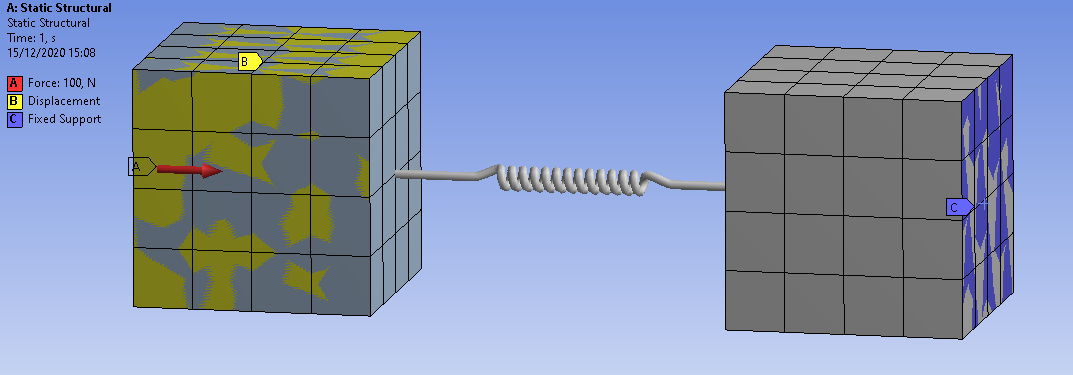
As you can see, the spring length increase, so the spring works in tension though the force is directed into the body.n
The gap that i set is the initial distance of the bodies (spring's length)...if i change the direction of the force or FSLIDE the analysis doesn't converge (an internal solution magnitude limit was exceeded...). nMaybe in the command lines i set something wrong.nMy aim is to schematize human ligaments so when they don't work they act like a rope. I found in the library the element LINK180 that seems perfect for my model.nUnfortunately i'm not able to set these new elements, thanks again for your answer, I would be very grateful if you could help me again.nn
-
December 15, 2020 at 9:49 pm
peteroznewman
SubscribernThat's great that you built a small model to understand this element. It's better if you apply a displacement to the Translation Joint instead of a Force, that way, the solver can always converge.nYou will find the answer on how to use the COMBIN40 element as a Hook, that operates with tension, instead of a Gap, that operates with compression in this link.n/forum/discussion/1110/how-do-i-implement-combin40-for-springs-in-wbn -
December 16, 2020 at 9:22 am
alessandropantone
Subscriber@peteroznewmannHi Peter, thanks for your answer...i've built a simple model of two cubes linked by a spring to test and understand how the element type combin40 works, unfortunately i've encountered some problems.nI set one of the cubes fully constrained(fixed support on the face) and the other with possible translation only in the axis of the force(displacement free on x-axis). If i run the analysys with the simple spring(tension and compression together) the solution is as i expected so the spring works in compression or tension depending on the direction of the force(+ or -). Instead if I use the element combin40 the solution converges only with the force directed into the body and with the following command conditions:n
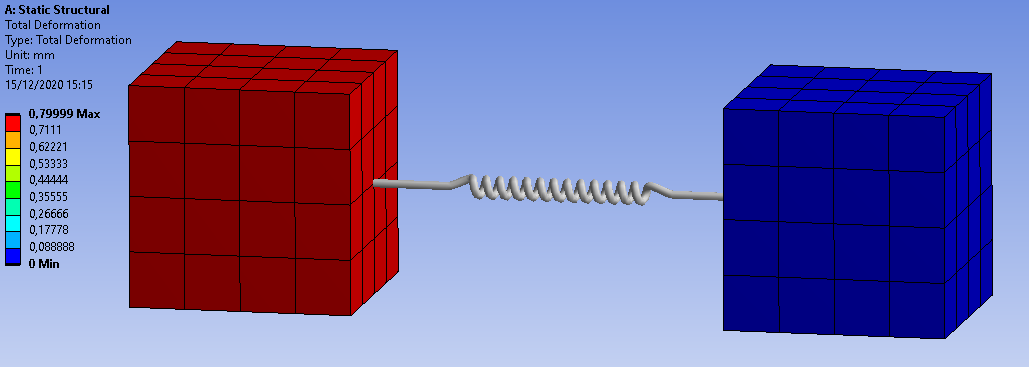
As you can see, the spring length increase, so the spring works in tension though the force is directed into the body.n
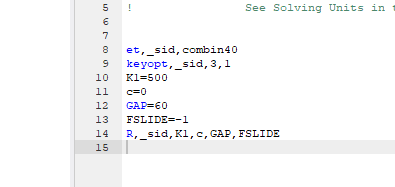
The gap that i set is the initial distance of the bodies (spring's length)...if i change the direction of the force or FSLIDE the analysis doesn't converge (an internal solution magnitude limit was exceeded...). nMaybe in the command lines i set something wrong.nMy aim is to schematize human ligaments so when they don't work they act like a rope. I found in the library the element LINK180 that seems perfect for my model.nUnfortunately i'm not able to set these new elements, thanks again for your answer, I would be very grateful if you could help me again with the problem.nn

-
December 17, 2020 at 1:03 am
peteroznewman
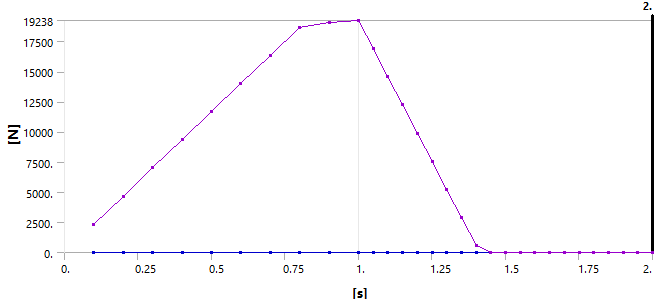
SubscribernIt's better if you apply a displacement to the Translation Joint instead of a Force, that way, the solver can always converge and you won't get an error.nAttached is a model that exhibits a tension only spring, with a FSLIDE limiting force. The displacement moves the light gray beam -3 mm along X, stretching the spring in step 1 and then to the +3 mm position in step 2 where the force reduces to zero at zero extension then goes slack in the next 3 mm of motion.n
n
Attached is an ANSYS 18.2 archive. nn
-
December 17, 2020 at 1:25 pm
alessandropantone
SubscribernHi Peter, thank you for the model you send me, it works good and it helps me a lot to understand the behavior of the element. I think the biggest problem was the order of the nodes I and J that i assigned to the spring. I noticed that if FSLIDE is greater of the reaction force along X the system put F.reaction in the solution, if FSLIDEDecember 17, 2020 at 1:42 pmpeteroznewman
SubscribernThe coordinate direction is the nodal coordinate direction.nViewing 7 reply threads- The topic ‘How to simulate an only tension spring in a static structural analysis?’ is closed to new replies.
-
Innovation Space
Trending discussions
Top Contributors
-
6379
-
1906
-
1457
-
1308
-
1022
Top Rated Tags
© 2026 Copyright ANSYS, Inc. All rights reserved.
Ansys does not support the usage of unauthorized Ansys software. Please visit www.ansys.com to obtain an official distribution.