

TAGGED: explicit-dynamics, meshing
-
-
December 6, 2020 at 3:35 am
djtan
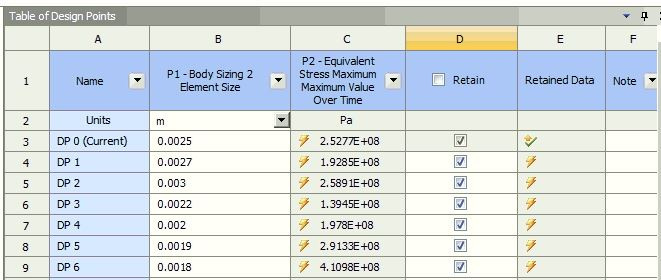
Subscriberive been testing trying to fine a suitable mesh size for the structure that i'm simulating however when i change the mesh size, the equivalent maximum stress tend to vary a lot, instead of decreasing linearly when mesh becomes coarse and increasing up till a limit when mesh becomes fine
What ive been doing so far is using parametize set to parametize the mesh while obtaining maximum equivalent stress within the structure
meanwhile my simulation is an impact simulation of an Arrowhead auxetic
Why is this so? is there a limit to how fine a mesh can be before it gives invalid results? what is the explanation behind it ? is there a way to fix this and how do i find the perfect mesh size in such a scenario?
December 6, 2020 at 3:34 pmpeteroznewman
SubscribernData from Explicit Dynamics solutions are well known to be noisy. Stress, which is a derivative of displacements, is even more noisy. This is because the formulation of the equations is based on tracking pressure waves that travel at the speed of sound in the material and bounce around inside the structure.nI suggest you pick a fixed point on the model and plot the data at that point. This is better than the overall maximum, which can jump around to different locations as the mesh size changesnCopy the tabulated stress data at that point and paste it into a program that can low pass filter the data to remove the high frequency noise. Take the maximum value of the filtered data as the measure of stress at that point. Repeat this process for different element sizes.nHere is an example the unfiltered data on force and displacement from three simulations with a parameter change between them, solved in Explicit Dynamics.n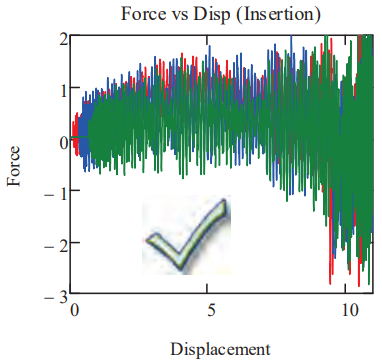 Here is that data low-pass filtered and now the three curves are easily seen.n
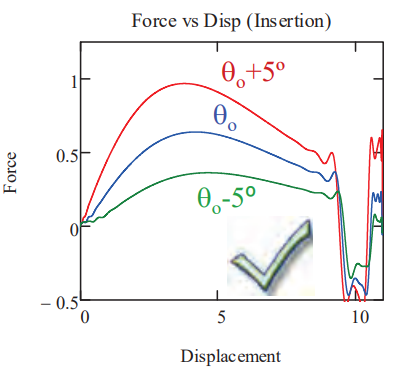 You should always filter data from Explicit Dynamics if it is noisy. Some output is inherently smoothed because it averages many elements, such as the system energy plots.n
December 15, 2020 at 12:35 pmSubscriberthankyou ! Peter!!!!nDecember 18, 2020 at 10:54 pmSubscribernHere is a helpful paper on filtering Explicit Dynamics data to get smooth curves. Look in particular at section 2.3nhttps://bodietech.com/pdfs/DSP_for_Explicit_FEA_AUC1999.pdfnDecember 19, 2020 at 2:00 pmSubscriberThankyou !nnViewing 4 reply threads
You should always filter data from Explicit Dynamics if it is noisy. Some output is inherently smoothed because it averages many elements, such as the system energy plots.n
December 15, 2020 at 12:35 pmSubscriberthankyou ! Peter!!!!nDecember 18, 2020 at 10:54 pmSubscribernHere is a helpful paper on filtering Explicit Dynamics data to get smooth curves. Look in particular at section 2.3nhttps://bodietech.com/pdfs/DSP_for_Explicit_FEA_AUC1999.pdfnDecember 19, 2020 at 2:00 pmSubscriberThankyou !nnViewing 4 reply threads- The topic ‘Mesh convergence on Explicit dynamics’ is closed to new replies.
Innovation Space Trending discussions
 Top Contributors
-
peteroznewman
 6465
6465 -
scabo
 1906
1906 -
Dennis Chen
 1458
1458 -
javat33489
 1308
1308 -
Shyam Prasad V Atri
1022
Top Rated Tags
© 2026 Copyright ANSYS, Inc. All rights reserved.
Ansys does not support the usage of unauthorized Ansys software. Please visit www.ansys.com to obtain an official distribution.
-


 You are navigating away from the AIS Discovery experience