

-
-
August 23, 2020 at 8:09 pm
mbenn
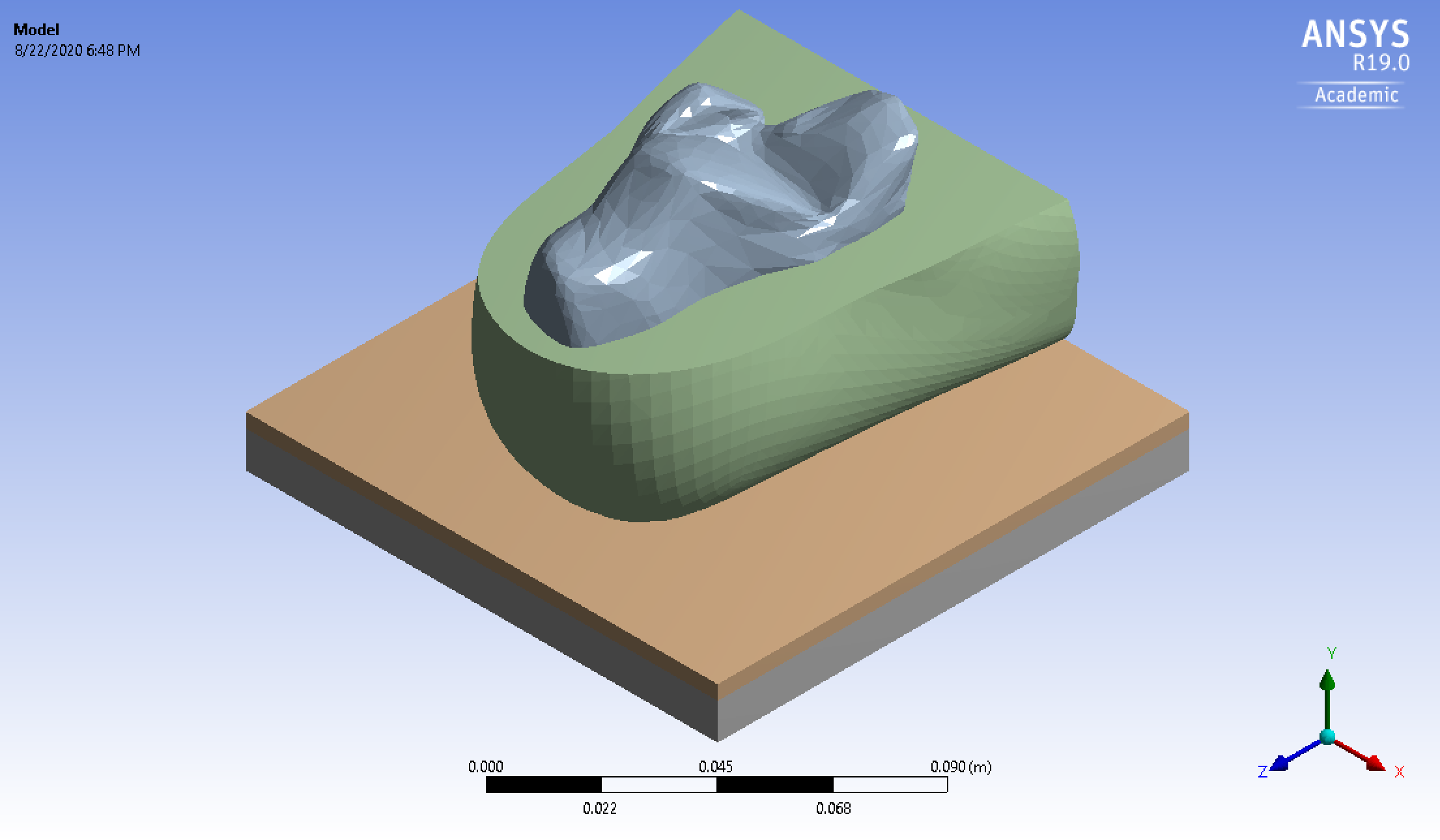
SubscriberI am compressing a body with an inner structure of hollow cylinders (axis in the y direction) (tan body) between a steel plate (gray body) and a model of the human heel (green and grey) by applying a load to the bottom of the plate and holding the heel bone fixed. The steel plate is fixed to only displace in the y direction and the top surface and flat side (xy face) of the skin are fixed in the y and z directions respectively.
In controls (with no hollow body), this model converges well and quickly.
However when I add in the hollow body, the model fails. At very early time steps 1e-2, the top surface of the hollow body insects with the bottom surface (see second picture).
The bottom surface of the hollow body is contacting the steel plate with a bonded contact (no Trim), and the top surface of the hollow body is contacting the skin of the heel with a Frictional contact (0.6, no Trim). I have tried different pinball radii (larger and smaller) to see if it was a issue of the top surface contacting the steel plate. I tried with a Bonded contact with the skin. I also tried allowing the hollow body freedom to move in the x and z directions, as well as the y that it already had.
For material reference (if it helps), the skin is a second order polynomial, nonlinear material, and the hollow body is linearly elastic with E=12 MPa.
Any help would be greatly appreciated!
August 24, 2020 at 3:46 pmpeteroznewman
SubscriberThe hollow body has E = 12 MPa while steel has E = 20,000 MPa which means the steel is practically rigid.nI recommend you suppress the steel layer altogether, and simply make the bottom surface of the hollow body be a fixed surface, which replaces the Bonded Contact.nAssuming the material of the cylindrical structure inside the hollow body the same material and is bonded to the inside faces of the hollow body, I recommend going into SpaceClaim, making sure the hollow body and the internal structure are in the same component and using the Share button on the Workbench tab. That way, the meshing software will connect the mesh between the internal cylindrical structure and top and bottom inside faces of the hollow body. Now no contact is needed inside the hollow body.nnAugust 24, 2020 at 3:54 pmAniket Chavan
Forum ModeratorCan you try using Material designer (https://ansyshelp.ansys.com/account/Secured?returnurl=/Views/Secured/corp/v201/en/acp_md/acp_md.html) to replace bottom part with with solid part with equivalent homogenized material properties?n-AniketnHow to access Ansys help linksnGuidelines for Posting on Ansys Learning ForumnAugust 24, 2020 at 4:58 pmSubscriberI have checked and the hollow body is one solid body, so there are no internal contacts. As for making the bottom rigid, would there be a way to still apply a load to the bottom of the body so that it is pushed into the heel? I am trying to ensure that the loading conditions are the same between the control and test trials. For example, could I make one face of the body rigid, or apply a constraint that allows rigid body motion but no strain?nI have not worked with Material Designer in the past, but I will take a look!n nAugust 24, 2020 at 5:30 pmSubscriberYes, you can apply a Displacement in Y and set X and Z to 0.nThe image in pasted implies the top surface is passing through the internal structure, but perhaps the Displacement Result Display Scale is set to a high value and not 1.0 (True Scale). Please show the true scale plot and maybe make a section view through the soft hollow body.nAugust 24, 2020 at 9:03 pmSubscriberI checked because I thought about the Result Display Scale, and it was set to 1.0. nIt looks as if the top face of the hollow body is intersecting because it is trying to stay in contact with the skin (and is doing so), but the skin to not deforming (I have attached a side view of of the intersection) (there is a different scale because I reran the model after trying some different things and stopped them at different times).n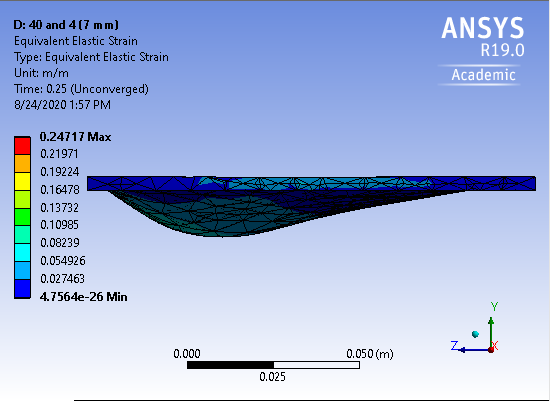 The skin (body that is not deforming) is set to flexible so it should be deforming.n
August 24, 2020 at 9:59 pmSubscriberI will look at your model if you create a .wbpz Archive File, and put in a .zip file to attach to this site in your reply. Delete the mesh to minimize the file size.nAugust 24, 2020 at 10:50 pmSubscriberThank you so much! I have attached the archive file here. The first analysis is the control (which runs and converges) and the second is test trial that is having issues.nnAugust 25, 2020 at 4:01 amSubscriberThere is a gap between the top sheet of the hollow pad and the cylindrical structure. What is the point of that gap? The top sheet has no stiffness, so it will immediately move down to make contact with the cylindrical structure.n
The skin (body that is not deforming) is set to flexible so it should be deforming.n
August 24, 2020 at 9:59 pmSubscriberI will look at your model if you create a .wbpz Archive File, and put in a .zip file to attach to this site in your reply. Delete the mesh to minimize the file size.nAugust 24, 2020 at 10:50 pmSubscriberThank you so much! I have attached the archive file here. The first analysis is the control (which runs and converges) and the second is test trial that is having issues.nnAugust 25, 2020 at 4:01 amSubscriberThere is a gap between the top sheet of the hollow pad and the cylindrical structure. What is the point of that gap? The top sheet has no stiffness, so it will immediately move down to make contact with the cylindrical structure.n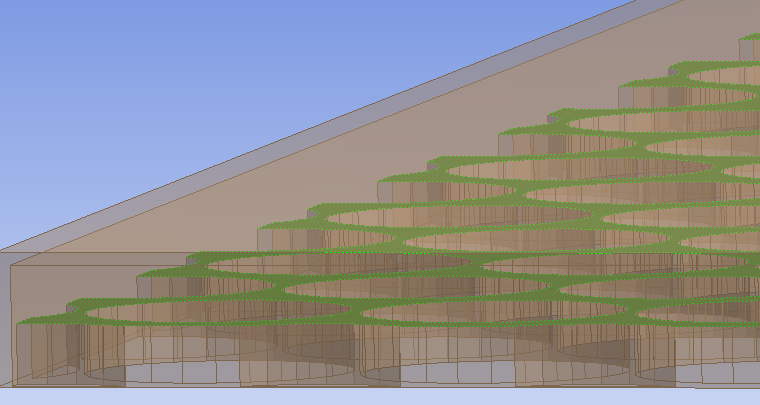
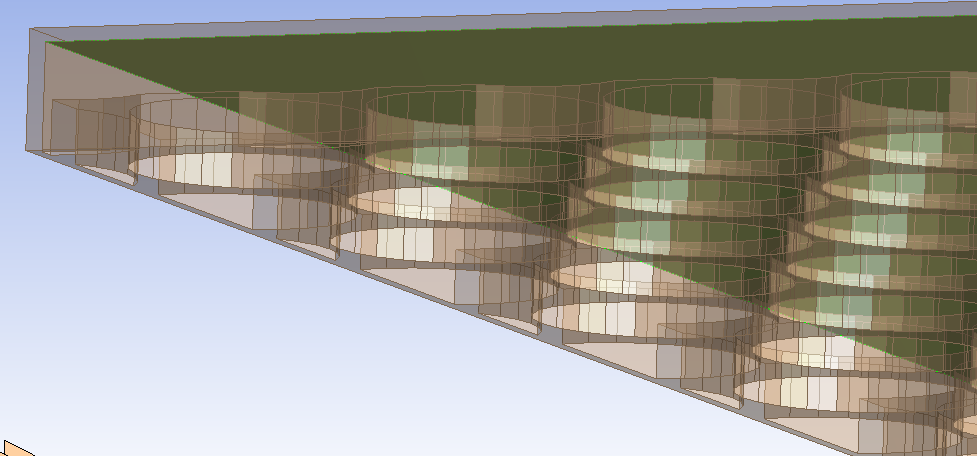 Is that a mistake in the geometry construction and the cylindrical structure is supposed to completely fill the hollow cavity?nIf it is not a mistake, then it is wasteful to have the gap. You should just move the top sheet down until it touches the cylindrical structure.n
Viewing 8 reply threads
Is that a mistake in the geometry construction and the cylindrical structure is supposed to completely fill the hollow cavity?nIf it is not a mistake, then it is wasteful to have the gap. You should just move the top sheet down until it touches the cylindrical structure.n
Viewing 8 reply threads- The topic ‘Hollow Body in compression self intersecting’ is closed to new replies.
Innovation Space Trending discussions
 Top Contributors
-
peteroznewman
 6485
6485 -
scabo
 1906
1906 -
Dennis Chen
 1458
1458 -
javat33489
 1308
1308 -
Shyam Prasad V Atri
1022
Top Rated Tags
© 2026 Copyright ANSYS, Inc. All rights reserved.
Ansys does not support the usage of unauthorized Ansys software. Please visit www.ansys.com to obtain an official distribution.
-
Ansys Assistant will be unavailable on the Learning Forum starting January 30. An upgraded version is coming soon. We apologize for any inconvenience and appreciate your patience. Stay tuned for updates.


 You are navigating away from the AIS Discovery experience