

-
-
August 5, 2020 at 1:55 am
rumth
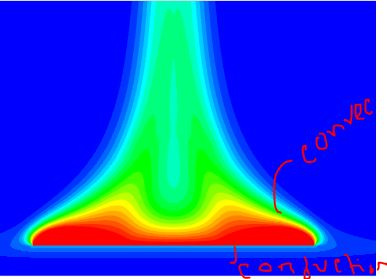
SubscriberI am simulating a heated droplet impacting on a surface in 2D asymmetric model. The droplet transferring heat to the surroundings by convection. How can I calculate the convective temperature loss from the droplet surface.
I tried to calculate by creating an iso-surface for of droplet-ambient interface. But the interface is not giving the real temperature.
August 5, 2020 at 6:00 amAmine Ben Hadj Ali
Ansys EmployeeYou can monitor the temperature in the volume occupied by the droplet or at least area-average of the temperature at the iso-surface VOF=0.5nAugust 6, 2020 at 8:05 amSubscriberI did area average temperature but not getting the expected temperature because in 2D, iso-surface is actually giving a boundary line of droplet. Are there any way to calculate the temperature of whole volume fraction of droplet?nAugust 6, 2020 at 11:18 amAnsys EmployeeNo: You should at least use 2D-Axis to model a correct droplet.nAugust 7, 2020 at 1:31 amSubscriberSorry for using the term 2D in the above comment. Actually, I have used 2D asymmetric to model the droplet. In this model, iso-value of liquid is actually giving a interface which is not providing actual temperature.nViewing 4 reply threads- The topic ‘How to calculate convective temperature loss from a surface.’ is closed to new replies.
Innovation Space Trending discussions
 Top Contributors
-
peteroznewman
 5059
5059 -
scabo
 1770
1770 -
Dennis Chen
 1387
1387 -
javat33489
 1248
1248 -
Shyam Prasad V Atri
1021
Top Rated Tags
© 2026 Copyright ANSYS, Inc. All rights reserved.
Ansys does not support the usage of unauthorized Ansys software. Please visit www.ansys.com to obtain an official distribution.
-


The Ansys Learning Forum is a public forum. You are prohibited from providing (i) information that is confidential to You, your employer, or any third party, (ii) Personal Data or individually identifiable health information, (iii) any information that is U.S. Government Classified, Controlled Unclassified Information, International Traffic in Arms Regulators (ITAR) or Export Administration Regulators (EAR) controlled or otherwise have been determined by the United States Government or by a foreign government to require protection against unauthorized disclosure for reasons of national security, or (iv) topics or information restricted by the People's Republic of China data protection and privacy laws.

 You are navigating away from the AIS Discovery experience