Title: Question regarding Buoyancy Model setup in ANSYS CFX for stratified multiphase flow
Hello CFD experts,
Currently, I am using ANSYS CFX to simulate the multiphase flow (slag and molten iron) inside the molten pool of a submerged arc furnace. There are two immiscible fluids in the domain with a significant density difference (slag ~2800 kg/m³, molten iron ~7200 kg/m³). My question is regarding the Buoyancy Model settings.
1. Physical Assumptions:
The literature I am referencing states that the "influence of thermal buoyancy on the molten pool flow can be neglected, and the pool is primarily driven by the Lorentz force". However, physically, the molten iron must sink to the bottom and the slag must float on top due to gravity, meaning gravity-driven stratification must exist.
2. Software Setting Confusion:
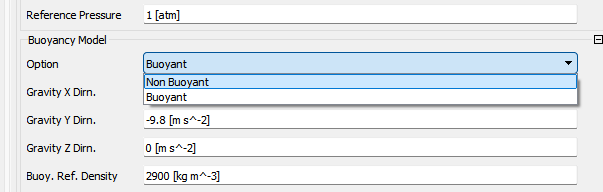
In the CFX Domain settings, if I set the Buoyancy Model option to Non Buoyant, does this mean the CFX solver will completely ignore not only thermal buoyancy, but also gravitational acceleration (i.e., gravity will not be included in the momentum equation)?
3. Seeking the Correct Configuration:
If setting it to Non Buoyant directly prevents the flow from achieving density-based stratification, how should I correctly configure the settings in CFX to achieve the physical assumption of "ignoring thermal buoyancy (i.e., ignoring natural convection caused by temperature differences), while retaining gravity to allow the molten iron and slag to stratify"?
Thank you very much for your guidance and corrections in advance!


















 You are navigating away from the AIS Discovery experience