Ansys Assistant will be unavailable on the Learning Forum starting January 30. An upgraded version is coming soon. We apologize for any inconvenience and appreciate your patience. Stay tuned for updates.
General Mechanical

General Mechanical

Topics related to Mechanical Enterprise, Motion, Additive Print and more.

Rotating the roller body and find the element stresses

    • venugopal-chatla
      Subscriber

      Hello everyone,


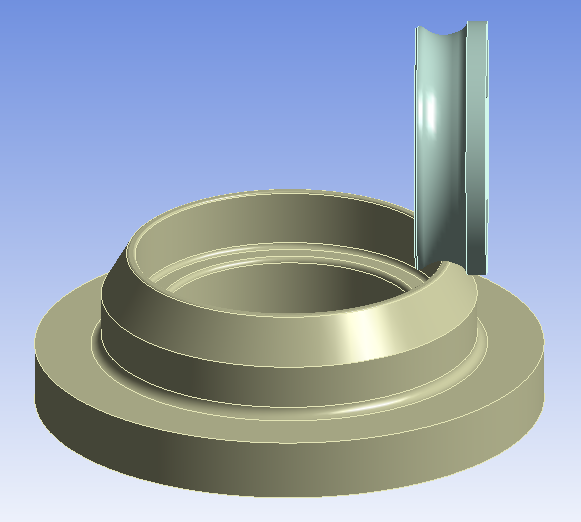
      I am not able to rotate the roller body.

      can anyone help me out?

    • peteroznewman
      Subscriber

      What materials are the two bodies made from?

      How is each body supported?  What DOF are free on each body?

      Which body has a motion input?

      Is the roller body the green one?

      Does the roller body have frictional contact with the other body?

      Is there a force that pushes the roller body down onto the rib of the other body (and a translational DOF to allow the roller body to move up and down) or is the roller body on a fixed axle and deformation in the materials takes care of the interference between the bodies?

    • venugopal-chatla
      Subscriber

      What materials are the two bodies made from?(bottom part is aluminum and roller part is structural steel)

      How is each body supported?  What DOF are free on each body?

      The bottom part is fixed and having the frictional contact between each other. 

      The roller part is free to rotate.

      Which body has a motion input?

      The roller part green one.

      Is the roller body the green one? yes

      Does the roller body have frictional contact with the other body?

      yes it has(0.25)

      Is there a force that pushes the roller body down onto the rib of the other body (and a translational DOF to allow the roller body to move up and down) or is the roller body on a fixed axle and deformation in the materials takes care of the interference between the bodies?

      yes there is a force on the roller that pushes the rib of the bottom part.The Y - direction is free to translate up and down.

      the bottom part axle rib has to deform and the roller part is rigid with no deforamation is allowed.


    • peteroznewman
      Subscriber

      Aluminum is about 3 times more flexible than steel, so it would be more accurate to leave both bodies flexible and to have them each deform as necessary to find equilibrium, but if you want you can set the steel roller to rigid and force all local deformation into the aluminum rib.

      If you want to observe the stress in the aluminum rib, there is no need to actually rotate the roller.  A static structural model can show the stress in the aluminum rib at the initial angle.  Nothing changes as the roller rotates except the stress moves in a circle around the vertical axis.

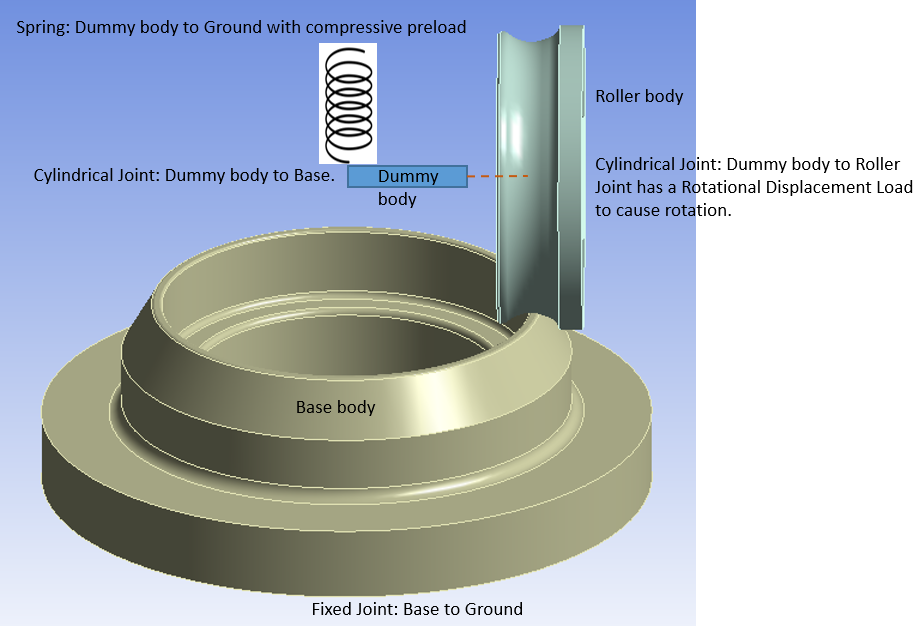
      If you want to see rotation, you need to add a Dummy body and connect that with a cylindrical joint on a horizontal axis to the Roller body and another cylindrical joint  on a vertical axis between the Dummy body and the Base body.

    • venugopal-chatla
      Subscriber

      Thank you so much Peteroznewman san.

      I would like to know whether the force will be transfered to the base body and deform the rib area of the base body.

    • venugopal-chatla
      Subscriber

      do you mean I need to create the two cylindrical joints between the base body and roller body? 

    • peteroznewman
      Subscriber

      Here I will repeat the sentence from above, “If you want to see rotation, you need to add a Dummy body and connect that with a cylindrical joint on a horizontal axis to the Roller body and another cylindrical joint  on a vertical axis between the Dummy body and the Base body.”

      You need to open the geometry in the CAD program (such as SpaceClaim or other) and add another body that you can name Dummy becuase it does not need to be an accurate representation of any real body in the real assembly.  It can be a simple cube with the center of the bottom face on the vertical axis of the Base body and the center of the right face on the horizontal axis of the Roller body.

      A refinement of the description of the joints is that the cylindrical joint on the vertical axis to the bottom face of the Dummy body could be a joint to Ground as you don’t have a feature on the Base body where you want the loads transfered to.  The function of the verical cylindrical joint is to provide two DOF to the Roller body: Y axis (vertical) translation and rotation about the Y axis through the Dummy body.  The function of the horizontal cylindrical joint is to provide two DOF to the Roller body: radial translation to allow the Roller to find equilibrium through the frictional contact with the Base body rib, and rotation of the roller about the horizontal axis, and to insert a load on that joint to cause the roller to rotate.

      The spring with a preload force will be reacted by the contact force between the rib and the roller and you will see local deformation at the contact point.

    • venugopal-chatla
      Subscriber

      Dear Petroznewman,


      Thank you so much for the information.

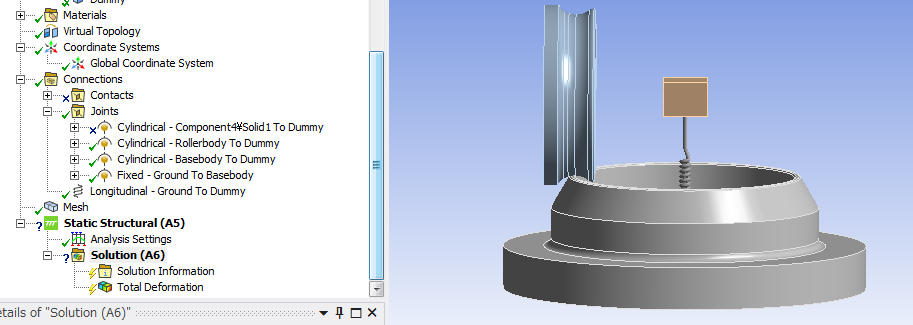
      I have created the dummy please check it once.


      I hope my understanding is correct.

    • peteroznewman
      Subscriber

      This looks good to solve the Static case (no rolling) as long as you have created a tension preload in the spring to pull the roller down onto the base. Is the reason for the ? on the Static Structural because you don't have any loads yet?  Do you still have a ? after you create a tension preload in the spring?

      If you want my help getting this running, in Workbench use File Archive, and create a .wbpz file.  Upload that file (not the .wbpj file) to a file sharing site such as Google Drive and set the sharing to Anyone with link can download and reply with the link.

Viewing 8 reply threads
  • You must be logged in to reply to this topic.
[bingo_chatbox]