-
-
July 7, 2020 at 3:06 pm
Stat
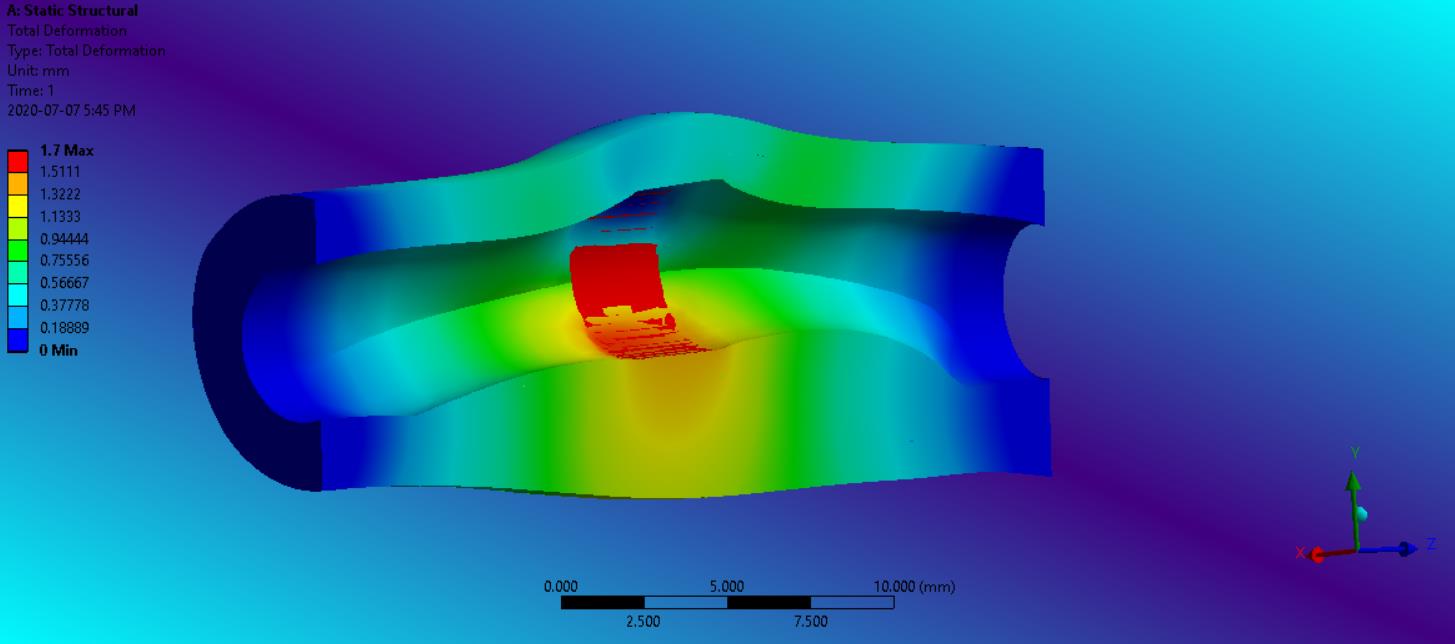
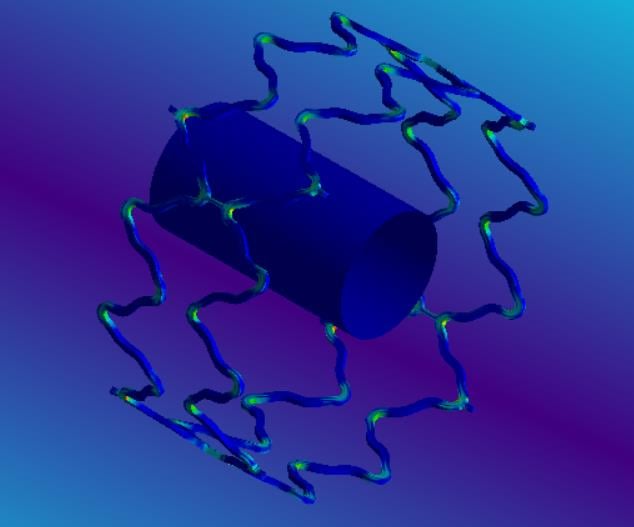
SubscriberHello everyone, I am trying to simulate a stent expansion inside an artery. When I expand just the balloon (simulated as a cylinder) inside the artery there appears no convergence issue (image 1). However when the stent is also introduced, the solution fails to converge without reasoning in the solver output (image 2). Are there any recommendations? Feel free to ask me any questions regarding my model.
-
July 7, 2020 at 4:22 pm
Wenlong
Ansys EmployeeHi Stat,
Have you tried balloon and stent only (without artery)? That can probably give you insight into the possible reason for this non-convergence.Â
Regards,
Wenlong

Â
-
July 7, 2020 at 4:51 pm
-
July 7, 2020 at 5:00 pm
peteroznewman
SubscriberI expect the extra edges of the stent pressing on the artery cause convergence issues.
One strategy is to soften the contact between the stent and the artery, relaxing slightly the penetration tolerance.
-
July 7, 2020 at 5:24 pm
-
July 7, 2020 at 5:57 pm
Wenlong
Ansys EmployeeHi Stathis,
If you right-click on "Solution information" --> Insert --> Contact, you can create a contact tracker and find out the current penetration in your model. You can adjust based on that value.Â
In case you are using asymmetric contact, it will be a good idea to set the artery as the contact surface because its stiffness is much lower than the stent. At the same time, make sure the mesh in the artery in the contact area is small enough to capture contact behavior. As Peteroznewman mentioned, you can try a lower normal stiffness factor, such as 0.1
You can also define multiple steps to help improve efficiency. For example, in the first step, you can define the B.C so that the stent almost contacts the artery, and in the second step, the contact between them starts. In this way, you can have fewer substeps in step 1, since no convergence difficulty is involved. This way it can save some computational time.Â
Regards,
Wenlong
-
July 7, 2020 at 8:45 pm
peteroznewman
SubscriberAs Wenlong says, soften the contact stiffness by using the Normal Stiffness Factor and a good first try is 0.1
-
July 17, 2020 at 8:53 am
Stat
SubscriberSince I am investigating the structural integrity of the stent, I don't need a dense mesh for the whole artery, because computational time increases dramatically.
Is there a way to create a thin layer of dense mesh at the contact areas between the stent and the artery, while maintaining the rest of the mesh intact?
-
July 17, 2020 at 2:09 pm
Wenlong
Ansys EmployeeHi Stat,
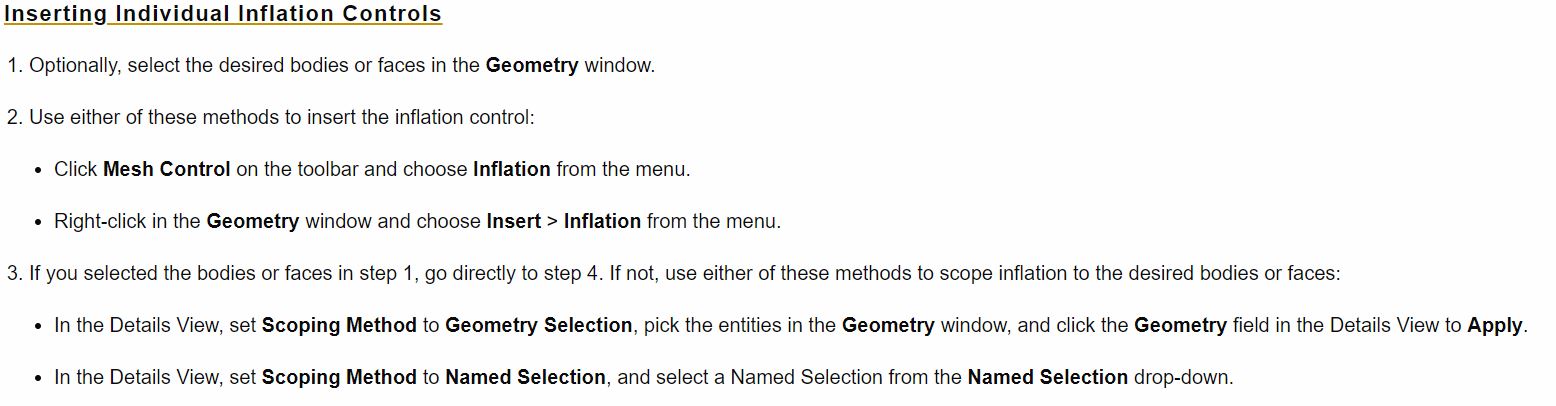
You can try "inflation" when you do the mesh. (https://ansyshelp.ansys.com/account/secured?returnurl=/Views/Secured/corp/v201/en/wb_msh/ds_Inflation.html)
But be careful the element aspect ratio in the inflation region should be close to 1 (in other words, don't make the element too thin in the inflation region compared to its other two dimensions).Â
Also refer to :Â https://www.youtube.com/watch?v=SzoQ1WPZk74
Regards,
Wenlong
Â
-
July 21, 2020 at 10:15 am
Stat
SubscriberInflation method works but without the Hex dominant method. I guess there is no way those two can coexist right?
-
July 21, 2020 at 12:09 pm
peteroznewman
SubscriberCorrect, it is one or the other. They are exclusive.
-
- The topic ‘Stent deployment’ is closed to new replies.
-
6455
-
1906
-
1457
-
1308
-
1022
© 2026 Copyright ANSYS, Inc. All rights reserved.