Ansys Assistant will be unavailable on the Learning Forum starting January 30. An upgraded version is coming soon. We apologize for any inconvenience and appreciate your patience. Stay tuned for updates.
Fluids

Fluids

Topics related to Fluent, CFX, Turbogrid and more.

Fixed vs adaptive time-step gives different VOF bubble-rise results

    • saiskandagiri
      Subscriber

      Hello everyone,

      I am simulating a single rising gas bubble using the VOF method in both ANSYS Fluent and OpenFOAM.

      I am comparing the bubble rise velocity, centroid position, lateral velocity, and interface evolution. The physical setup, mesh, material properties, boundary conditions, and initialisation are kept as consistent as possible between Fluent and OpenFOAM.

      My issue is with fixed and adaptive time stepping in Fluent.

      From the attached velocity plot, OpenFOAM adaptive, OpenFOAM fixed time-step cases, and Fluent adaptive give very similar results. However, Fluent fixed time-step cases give noticeably lower bubble rise velocity, especially for time step = 0.0001 s.

      My Fluent setup is:

      VOF explicit formulation
      Fixed and adaptive time stepping tested separately
      Fixed time steps: 0.001 s and 0.0001 s
      Adaptive minimum time step: 1e-5 s
      Adaptive maximum allowed time step: 1 s
      Maximum iterations per time step: 30
      Same Fluent case/setup used for fixed and adaptive runs

      I expected the Fluent fixed time-step result to be close to the adaptive result, especially because the time step is small. However, the fixed time-step result is different.

      Why can this happen in Fluent VOF simulations? Are there any Fluent settings or solver behaviours that I should check when comparing fixed and adaptive time stepping for a VOF bubble-rise case?

      Any suggestions would be very helpful.

      Thank you.

      Here is the bubble rise velocity comparison among OpenFOAM adjustable, Fixed and Ansys adaptive and fixed.
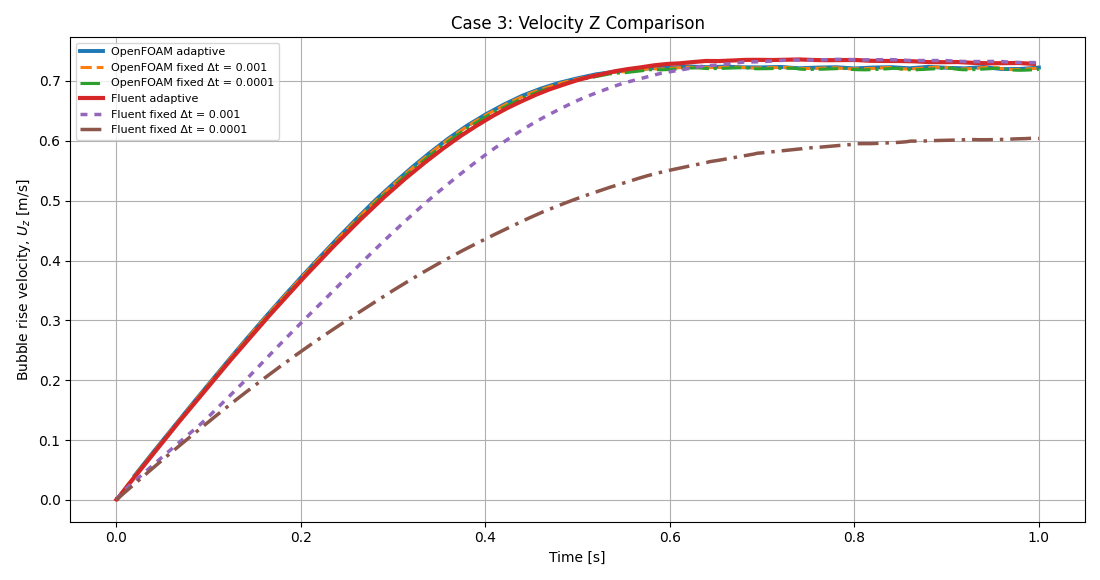

      Bubble rise velocity comparison

    • Ahmed Hussien
      Ansys Employee

      Hello,

      There may be some inherent differences between Fluent and OpenFOAM, so for an accurate comparison it is important to ensure consistency across all aspects of the setup, including mesh resolution, solver settings, and discretization schemes.

      For the Fluent results, one thing to check is the actual time step sizes reached when using adaptive time stepping. It is possible that the solver is reducing the time step toward the minimum value (around 1e-5 s), which could explain why the adaptive case agrees better with OpenFOAM, while the fixed time-step cases may still be too large to capture the interface dynamics accurately.

      It is also important to verify that the solution is sufficiently converged within each time step for the fixed cases (0.001 s and 0.0001 s). If the iterations per time step are not fully converged, the results may not be reliable.

      Additionally, since you are using the explicit VOF formulation, the solution accuracy is very sensitive to the time step size. Even relatively small time steps can still introduce numerical diffusion or affect the predicted rise velocity.

      As a further check, you may consider running the same cases using the implicit VOF formulation with time steps of 0.001 s and 0.0001 s and comparing the results. This can help determine whether the discrepancy is primarily related to the explicit scheme and its sensitivity to the time step.

Viewing 1 reply thread
  • You must be logged in to reply to this topic.
[bingo_chatbox]








