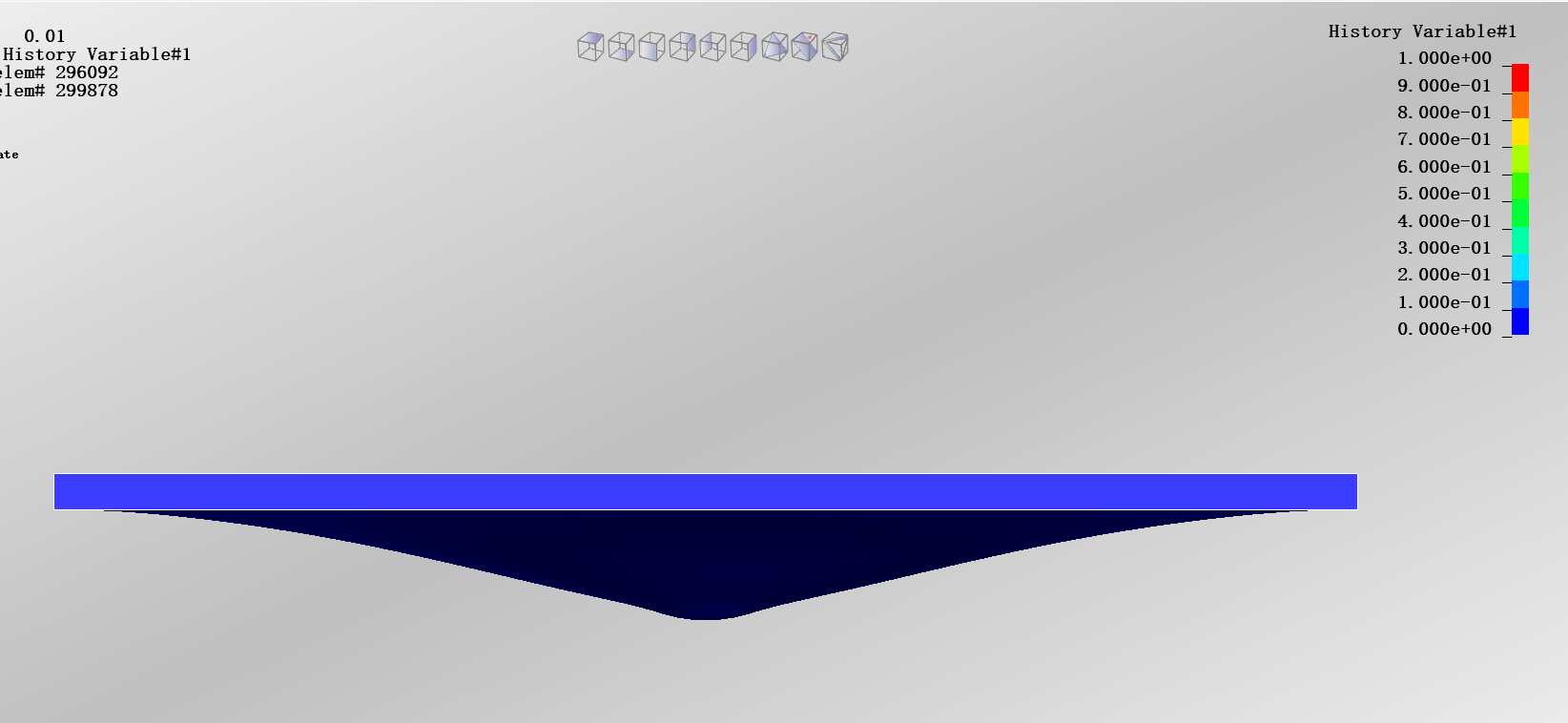
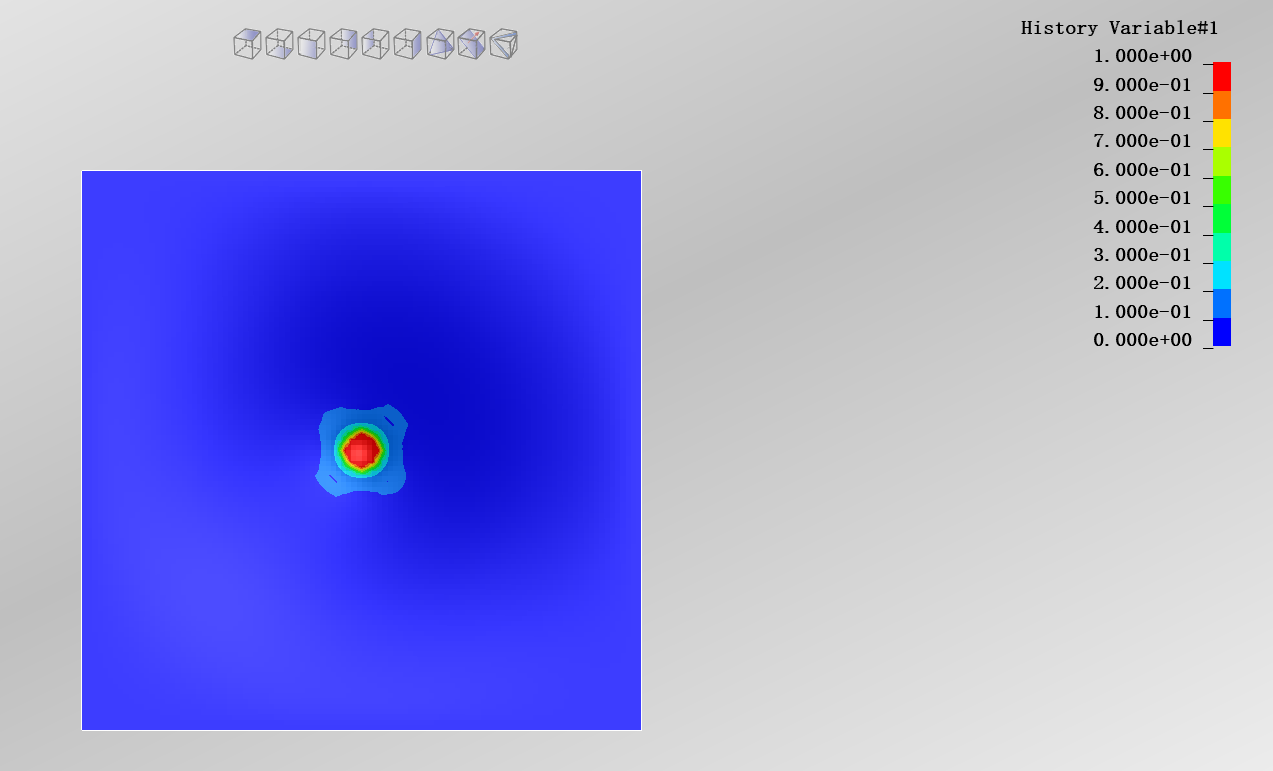
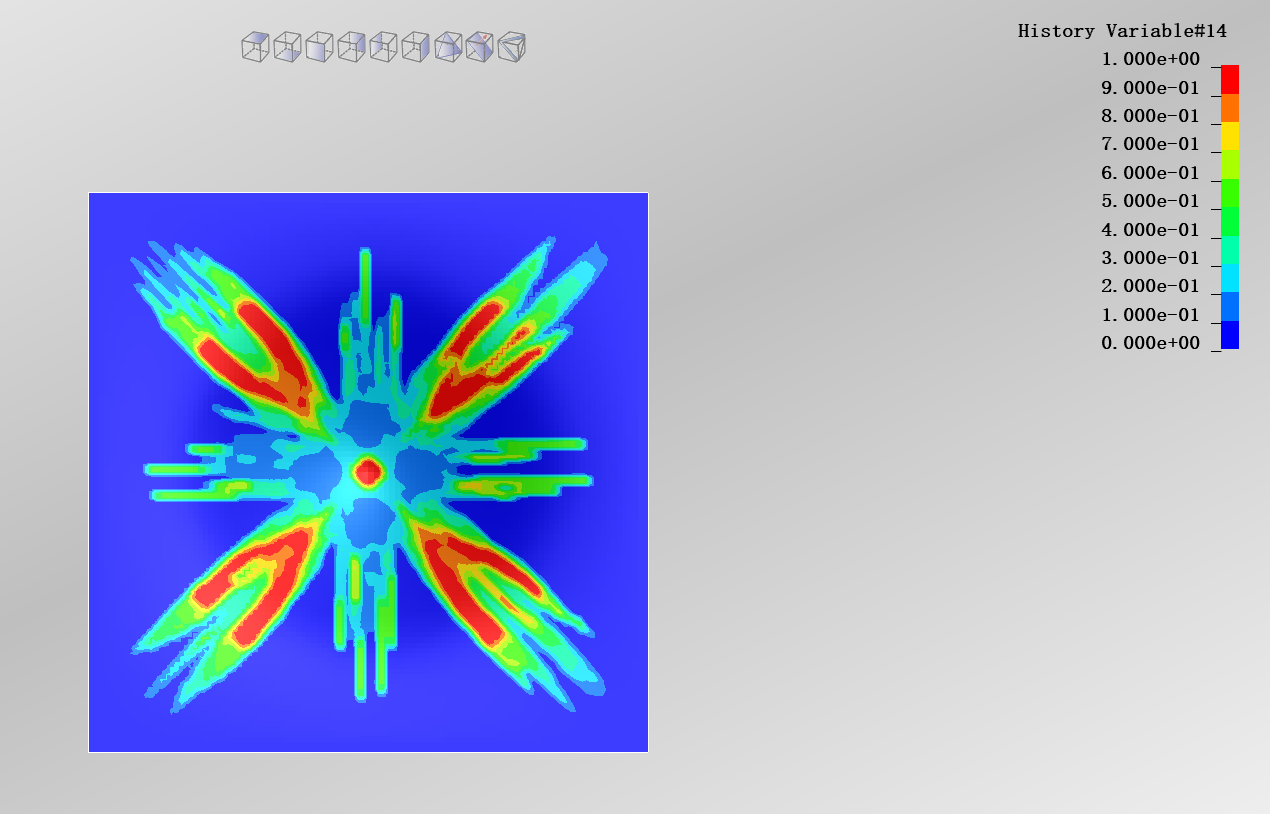
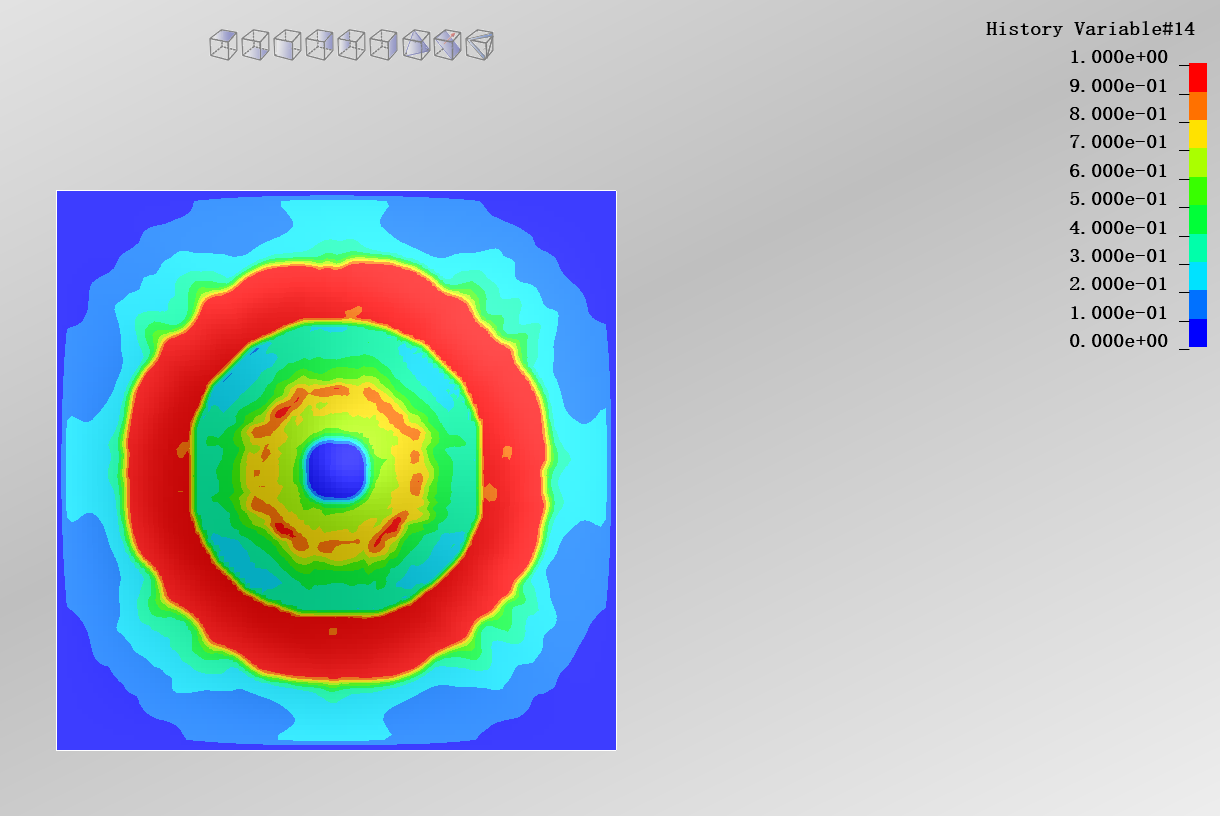
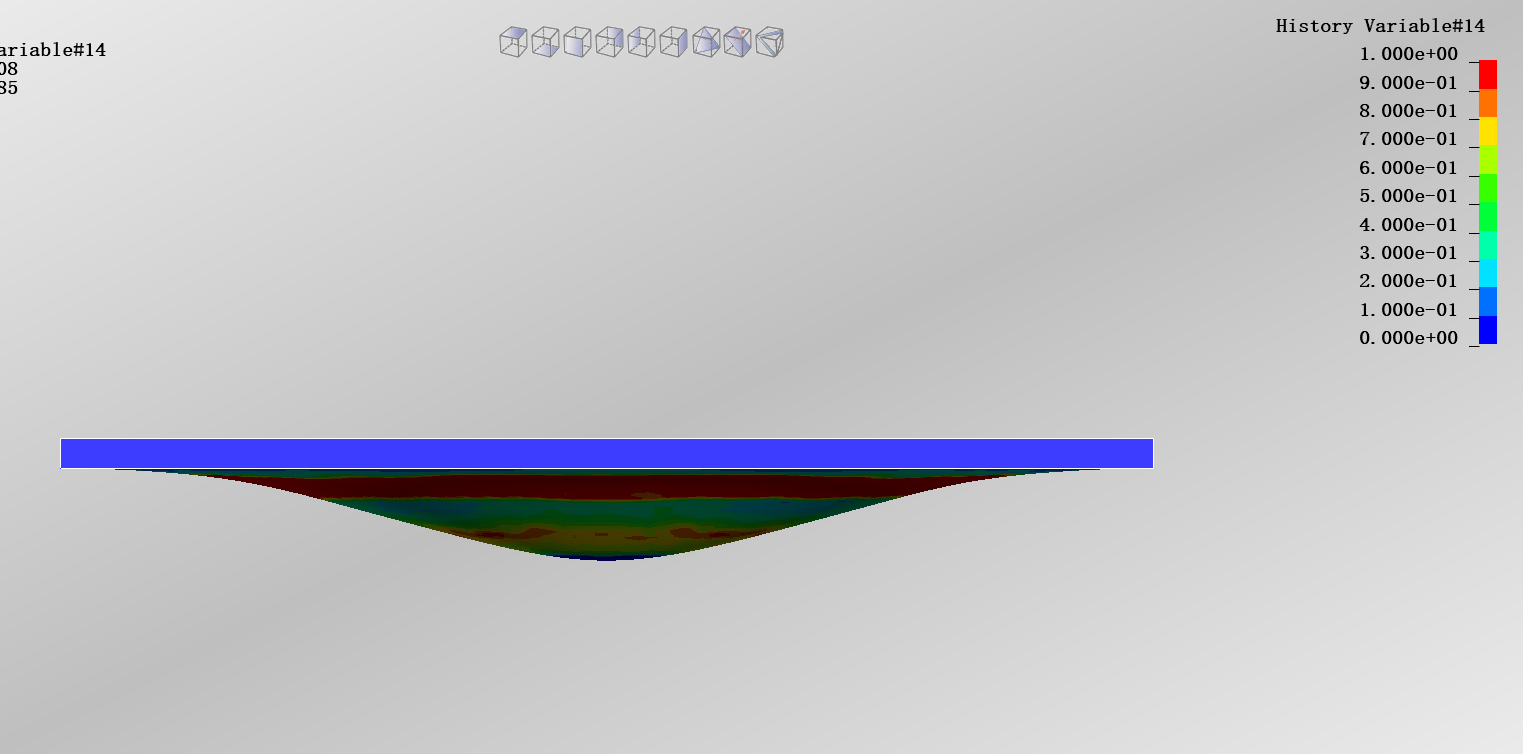
Hello everyone, I am a current master's student. I am currently attempting to develop the secondary application of the HJC constitutive model. The single-unit test has been successfully completed so far. However, in the model where the quality block impacts the thin plate, the damage and stress-strain updates of the custom HJC constitutive model are different from the evolution of the built-in HJC constitutive model of LS-DYNA. I have consulted many people and AI, and also reviewed numerous literature. I have found that the main problem might lie in the radial regression algorithm and the code for damage accumulation. Could everyone please help me identify which part of the code has the issue? Thank you very much!
HJC CODE BEGIN
subroutine umat41 (cm,eps,sig,epsp,hsv,dt1,capa,etype,tt,
1 temper,failel,crv,cma)
c
c******************************************************************
c| HJC Model Implementation with Plastic Volumetric Strain Damage |
c******************************************************************
c
include 'nlqparm'
include 'iounits.inc'
common/bk06/idmmy,iaddp,ifil,maxsiz,ncycle,ctime(2,30)
character*5 etype
dimension cm(*),eps(*),sig(*),hsv(*)
logical failel
real epsp, dt1, capa, tt, temper
c Variable definitions
real G, K_elastic, A, B, C, N, FC, T, EPSILON_RATE, EFMIN, SFMAX
real PC, UC, UL, PL, D1, D2, K1, K2, K3
real pre_sij(6), hydro_strain_Inc, eij_Inc(6), tr_sij(6)
real tr_sij_J2, Q_trial, mu_old, mu_new, mu_max, mu_plastic
real P_new, P_max, P_old_stress, P_star, T_star, T_current
real eps_dot_star, strainRate_eq, Yield_star, Yield_HJC
real eps_p_f, strainOld, Damage, e_vol_inc, d_mu_p
real smallNum, k_value, true_sij(6), P_sum_check
real K_unload, F_interp
real e_plaStrain_Inc, mu_bar, mu_plaStrain
parameter (zero = 0.0d0, half = 0.5d0, one = 1.0d0,
1 two = 2.0d0, three = 3.0d0)
smallNum = 1.0d-20
c Get material parameters
G = cm(1)
K_elastic = cm(2)
A = cm(3)
B = cm(4)
C = cm(5)
N = cm(6)
FC = cm(7)
T = cm(8)
EPSILON_RATE = cm(9)
EFMIN = cm(10)
SFMAX = cm(11)
PC = cm(12)
UC = cm(13)
PL = cm(14)
UL = cm(15)
D1 = cm(16)
D2 = cm(17)
K1 = cm(18)
K2 = cm(19)
K3 = cm(20)
if (etype.eq.'solid'.or.etype.eq.'shl_t') then
c =====================================================================
c Step 1: Extract history variables and preprocessing
c =====================================================================
P_old_stress = hsv(1)
mu_old = hsv(3)
strainOld = hsv(5)
Damage = hsv(14)
mu_max = hsv(15)
P_max = hsv(16)
mu_plaStrain = hsv(2)
c Calculate equivalent strain rate
strainRate_eq = sqrt(two/three * (eps(1)**2 + eps(2)**2 +
1 eps(3)**2 + half*(eps(4)**2 + eps(5)**2 +
2 eps(6)**2))) / max(dt1, smallNum)
eps_dot_star = strainRate_eq / max(EPSILON_RATE, smallNum)
if (eps_dot_star .lt. one) eps_dot_star = one
c Elastic predictor (deviatoric stress)
pre_sij(1:3) = sig(1:3) + P_old_stress
pre_sij(4:6) = sig(4:6)
e_vol_inc = (eps(1) + eps(2) + eps(3)) / three
eij_Inc(1:3) = eps(1:3) - e_vol_inc
eij_Inc(4:6) = eps(4:6)
tr_sij(1:3) = pre_sij(1:3) + two * G * eij_Inc(1:3)
tr_sij(4:6) = pre_sij(4:6) + G * eij_Inc(4:6)
tr_sij_J2 = half * (tr_sij(1)**2 + tr_sij(2)**2 + tr_sij(3)**2)
1 + tr_sij(4)**2 + tr_sij(5)**2 + tr_sij(6)**2
Q_trial = sqrt(three * tr_sij_J2)
c =====================================================================
c Step 2: Equation of state (EOS) and pressure parameter update
c =====================================================================
hydro_strain_Inc = - (eps(1) + eps(2) + eps(3))
mu_new = mu_old + hydro_strain_Inc
c [Improvement] Precompute dynamic unloading and tensile bulk modulus K_unload
c Reference: Interpolate between K_elastic and K1 based on compaction level
if (mu_max .le. UC) then
K_unload = K_elastic
else if (mu_max .lt. UL) then
F_interp = (mu_max - UC) / (UL - UC)
K_unload = (one - F_interp) * K_elastic + F_interp * K1
else
K_unload = K1
end if
if (mu_new .ge. mu_max .and. mu_new .gt. zero) then
! --- Loading path (skeleton curve) ---
if (mu_new .le. UC) then
P_new = K_elastic * mu_new
else if (mu_new .le. UL) then
P_new = PC + (mu_new - UC)*(PL - PC)/(UL - UC)
else
mu_bar = (mu_new - UL) / (one + UL)
P_new = PL + K1 * mu_bar + K2 * mu_bar**2 + K3 * mu_bar**3
end if
mu_max = mu_new
P_max = P_new
else
! --- Unloading and tension ---
if (mu_new .lt. zero) then
! Tension: use degraded unloading modulus according to literature
P_new = K_unload * mu_new
else
! Compressive unloading: linear return from P_max using dynamic K_unload
P_new = P_max - K_unload * (mu_max - mu_new)
if (P_new .lt. zero) P_new = zero
end if
end if
c Tension cutoff
T_current = T * (one - Damage)
if (P_new .lt. -T_current) P_new = -T_current
c [Improvement] Calculate plastic volumetric strain increment d_mu_p
c Since modulus is dynamic K_unload, the elastic volumetric strain subtraction should also use current modulus
d_mu_p = zero
if (mu_new .gt. UC .and. hydro_strain_Inc .gt. zero) then
d_mu_p = hydro_strain_Inc - (P_new - P_old_stress)/K_unload
if (d_mu_p .lt. zero) d_mu_p = zero
end if
mu_plaStrain = mu_plaStrain + d_mu_p
c Update P* and T* immediately (for denominator and HSV6 calculation)
P_star = P_new / max(FC, smallNum)
T_star = T / max(FC, smallNum)
c =====================================================================
c Step 3: Damage denominator calculation (NaN protection)
c =====================================================================
P_sum_check = P_star + T_star
if (P_sum_check .le. 1.0d-8) then
eps_p_f = EFMIN
else
eps_p_f = D1 * (P_sum_check)**D2
end if
if (eps_p_f .lt. EFMIN) eps_p_f = EFMIN
c =====================================================================
c Step 4: Yield surface and radial return (fix multiplication order of SFMAX and strain rate)
c Step 4: Failure fuse (advanced protection)
c =====================================================================
c If damage exceeds 0.999d0, trigger fuse early to avoid numerical noise
if (Damage .gt. 0.999999d0) then
Damage = 1.0d0
Yield_HJC = 0.001d0 * FC ! residual strength
e_plaStrain_Inc = zero
k_value = Yield_HJC / max(Q_trial, smallNum)
true_sij(1:6) = tr_sij(1:6) * k_value
goto 999
endif
c Yield surface calculation
Yield_star = A * (one - Damage) + B * (P_star**N)* (one
1 + C * log(eps_dot_star))
if (Yield_star .gt. SFMAX) Yield_star = SFMAX
c Add safety cutoff: prevent Yield_star from becoming negative due to numerical fluctuations
if (Yield_star .lt. zero) Yield_star = zero
Yield_HJC = Yield_star * FC
if (Q_trial .gt. Yield_HJC) then
e_plaStrain_Inc = (Q_trial - Yield_HJC) / (three * G)
strainOld = strainOld + e_plaStrain_Inc
k_value = Yield_HJC / max(Q_trial, smallNum)
true_sij(1:6) = tr_sij(1:6) * k_value
else
e_plaStrain_Inc = zero
true_sij(1:6) = tr_sij(1:6)
end if
c =====================================================================
c Step 5: Damage accumulation (numerical tolerance completion)
c =====================================================================
c Only accumulate if damage has not reached the set 'quasi-failure threshold'
if (Damage .lt. 0.999999d0) then
Damage = Damage + (e_plaStrain_Inc + d_mu_p) / eps_p_f
end if
c [Core modification]: Force numerical closure
c Once damage exceeds the threshold of 0.999999, directly set to 1.0
c This solves the precision error concern and ensures complete red in contour
if (Damage .ge. 0.999999d0) Damage = one
c =====================================================================
c Step 6: Update history variables (meeting user requirements: hsv2, hsv6)
c =====================================================================
999 continue
sig(1:3) = true_sij(1:3) - P_new
sig(4:6) = true_sij(4:6)
hsv(1) = P_new
hsv(2) = mu_plaStrain
hsv(3) = mu_new
hsv(4) = e_plaStrain_Inc
hsv(5) = strainOld
hsv(6) = D1 * (P_sum_check)**D2
hsv(7:12) = eps(1:6)
hsv(13) = eps_dot_star
hsv(14) = Damage
hsv(15) = mu_max
hsv(16) = P_max
epsp = strainOld
end if
return
end
HJC CODE END
LS-DYNA-HJC
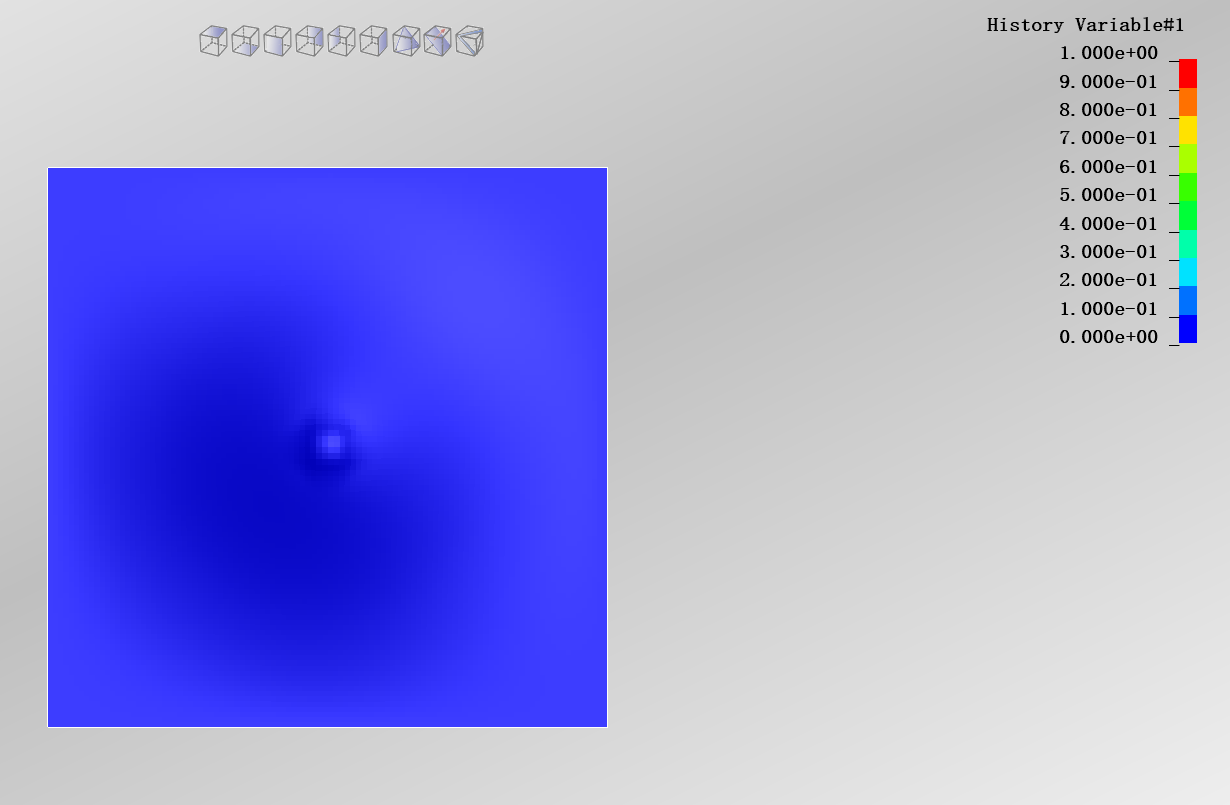
UMAT-HJC


















 You are navigating away from the AIS Discovery experience