Hello,
I am trying to understand how the interface was likely implemented in Fluent in a 2D-axisymetrical heat pipe model.
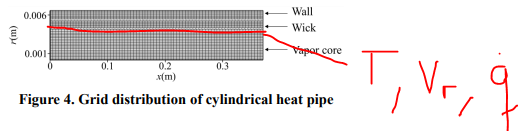
In the paper, the authors define at the interface:
- an interface temperature
- a radial velocity at the interface
- and at the same time heat transfer / heat flux through the interface must be possible

My question is:
Which type of boundary condition in ANSYS Fluent could be used for such an interface?
More specifically, I am looking for a boundary type that would allow me to:
- prescribe or update the temperature at the interface,
- prescribe the radial/normal velocity associated with evaporation/condensation,
- still allow heat flux across the interface,
- and ideally apply this in a 2D axisymmetric model.
A standard wall seems problematic because it blocks mass transfer.
A standard interior/interface seems problematic because I do not see how to directly impose both temperature and radial velocity there.
So I would like to ask:
Did the authors most likely use two separate boundary zones (for example velocity inlet / outlet type boundaries with UDFs), or is there another Fluent boundary condition better suited for this kind of coupled wick–vapor interface?
I am attaching two images:
- one showing the geometry and the location of the interface
- one showing the mesh and the corresponding interface in the paper
Any clarification on which Fluent boundary type is physically and numerically most appropriate here would be very helpful.
Thank you.


















 You are navigating away from the AIS Discovery experience