I am currently working on a project involving the simulation of a centimeter-scale, screw-driven robot. My primary goal is to accurately model its locomotion and find its equilibrium state as it moves through water.
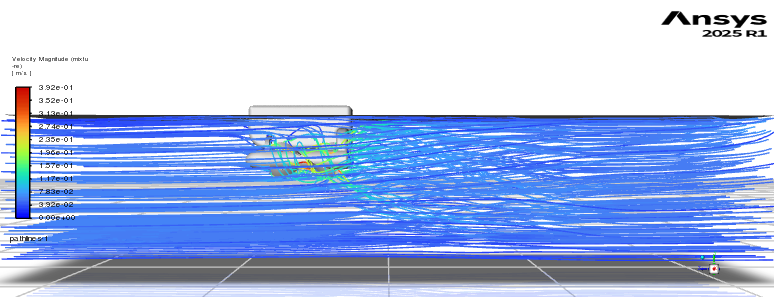
Initially, I attempted to solve this using a steady-state simulation approach to save on computational costs. However, I’ve encountered issues that the forward velocity (equals the water velocity when the net force = 0) (As shown in Image 1) deviates quite a lot from the tests in real life. And also I need to set different velocity of water manually to try to find the equilibrium state (through parametric study).
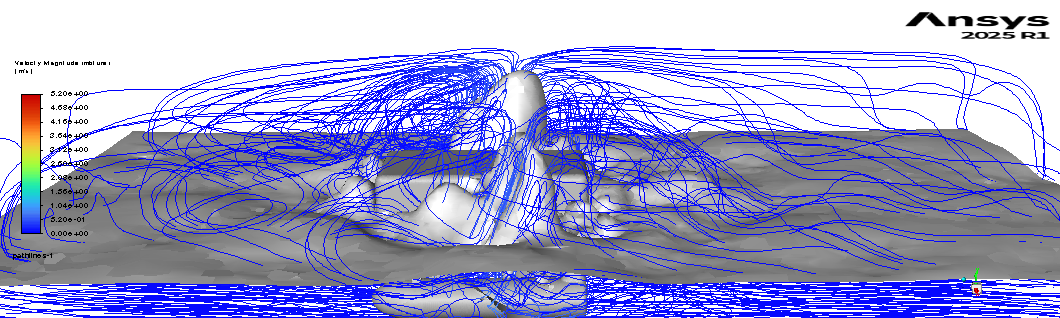
I have now switched to a transient state simulation to better capture the time-dependent nature of the fluid-structure interaction.(Image below, I don't know why this weird spike happened, I will need to debug it). While this provides more granular data, it is significantly more computationally expensive and makes finding a definitive "equilibrium state" (where thrust equals drag) a challenge (Same challenge as the steady state simulation).
Questions for the Community:
Is 6DOF (Six Degrees of Freedom) necessary? Given the screw-driven nature of the robot, would implementing a 6DOF solver be the most reliable way to let the robot "find" its own equilibrium velocity and orientation, or is it overkill for a centimeter-scale model?
Finding Equilibrium: If I want to stick with a standard transient or steady state approach, are there proven methods or specific monitor points I should use to efficiently identify when the system has reached equilibrium without running excessively long physical time scales?
Best Practices: For those working with screw-propulsion in multiphase environments, are there specific solver settings or mesh motion strategies you would recommend to balance accuracy with solve time?
Thank you for your time!
















 You are navigating away from the AIS Discovery experience