-
-
June 15, 2020 at 6:17 pm
vishwa.kasoju
SubscriberHi,
I am testing a free fall study of an object in Ansys Fluent 2019 R3 and i observed that fluent is not considering the buoyancy force for drag force estimation. I also found a thread in CFD post talking about this and they say the work around is subtracting the buoyancy force from the estimated drag force. Here is the link for the thread. https://www.cfd-online.com/Forums/fluent/105250-buoyancy-6dof-solver-fluent.html.
Can you guys please confirm if it true that fluent does not consider buoyancy forces during free fall.
Note that i also changed the operating density to density of fluid.
Thank you
Â
Â
-
June 17, 2020 at 12:58 pm
Karthik Remella
AdministratorHello,
I believe when Fluent solves for pressure, buoyancy effects are included (that is if the model is set-up correctly). Therefore, I believe that the drag calculations take into account the buoyancy effects, especially when the hydrostatic pressure is being accounted.
What are your flow conditions? Are you modeling an object which is falling under the influence of gravity through a fluid?
Thanks.
Karthik
-
June 17, 2020 at 2:28 pm
vishwa.kasoju
SubscriberHi,
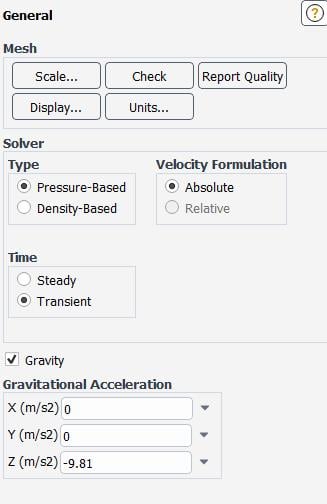
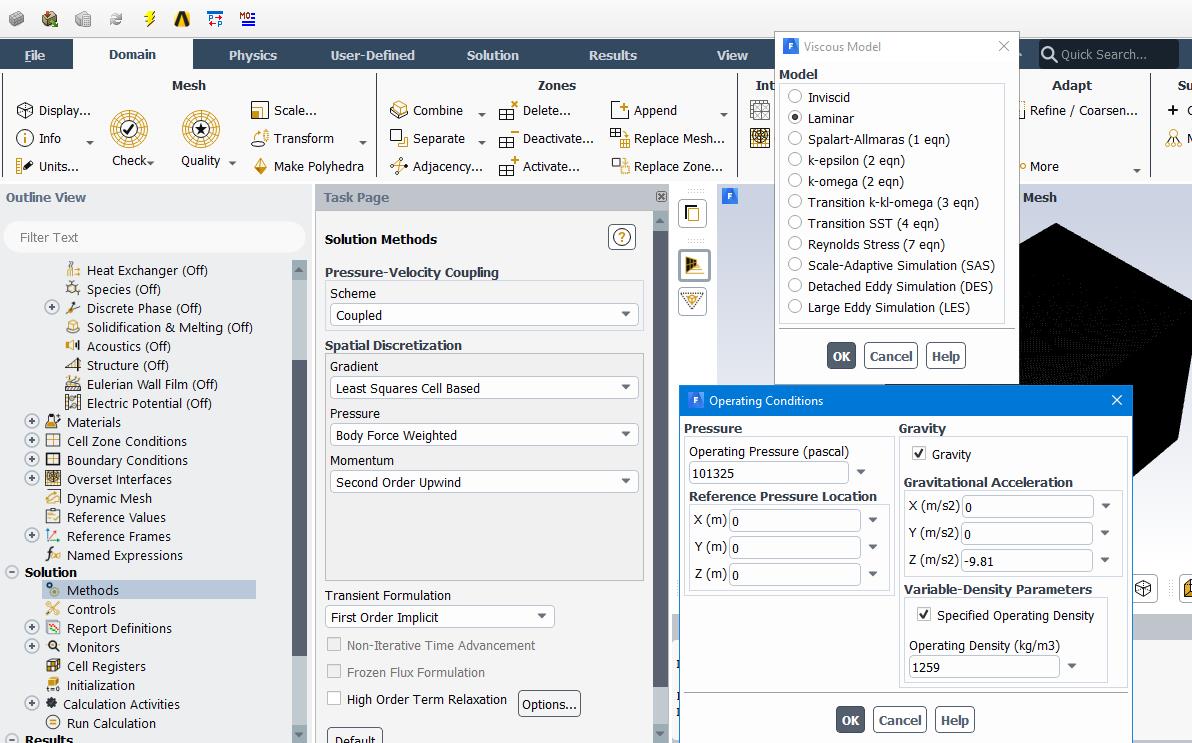
Thank you for your reply. Yes, i am modeling an object which is falling under the influence of gravity through a fluid (glycerine - density 1259 kg/m3, viscosity-0.779 used default values from fluent database). Here are my setup conditions. Please let me know if you need any more info to check if my model is set up incorrectly.
Â
-
June 18, 2020 at 7:01 pm
vishwa.kasoju
SubscriberHi,
Can someone please take a look at my setup and comment. I mentioned my issue with buoyancy force measurement in the top message.
Thanks
-
June 18, 2020 at 7:10 pm
Karthik Remella
AdministratorThe set-up looks about right to me. What density model are you using?
I think you should have the buoyancy forces accounted for in the pressure solution. And your pressure forces should include the buoyancy effects from the fluid.
Thanks.
Karthik
-
June 18, 2020 at 7:49 pm
vishwa.kasoju
SubscriberI don't understand your question - "what density model are you using?" I am using a pressure-based solver. My theoretical calculations for drag force are not matching the simulation results if we assume the fluent is accounting for buoyancy forces. When i remove the buoyancy forces from drag forces of simulation results i see that theoretical and simulations results to match. This implies that fluent is not considering buoyancy forces right?Â
Thank you
-
June 19, 2020 at 7:33 pm
Karthik Remella
AdministratorHello,
Apologies for the delayed response. Could you please set your operating density to 0 and re-run your simulation to check if you are seeing the buoyancy forces?
Also, could you please plot the contour of static pressure and let me know if you are seeing a gradient?
Thanks.
Karthik
-
July 16, 2020 at 2:31 pm
vishwa.kasoju
SubscriberApologies for the delayed response. I am still facing the same problem with buoyancy forces. I tried all possibilities with having operating pressure and density as zero and non-zero (101325 pa, 1259.9 kg/m3). I am still getting my drag forces very close to the weight of the body. Which means the drag forces are not considering the buoyancy effects. I also observed that when i specify the operating pressure for initial time step (t=0) , pressure value was applied to entire fluid domain. But in real Pressure increases with depth. Is it because i dont have any inlets/outlets? I checked the pressure contours and i see the gradient for t>0. Could you please suggest a way forward?
Â
-
July 16, 2020 at 2:39 pm
vishwa.kasoju
SubscriberSorry i forgot to add since my fluid domain is closed i see that the pressure to be constant. My question is should i have a Pressure inlet/outlet at the top of the fluid domain just above the object that is freely falling and set the pressure there to atmospheric pressure?
-
July 21, 2020 at 3:31 pm
vishwa.kasoju
SubscriberHi,
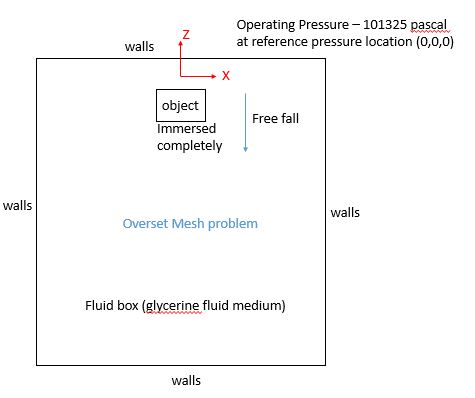
Could someone please suggest a way forward for fluent to account for buoyancy forces? I tried what Kremella suggested still i am getting the drag force on the object equal to its weight which suggests that buoyancy forces are negligible. But with glycerine as fluid medium, we should see substantial buoyancy forces theoretically. Can someone put a light on this? Apart from my fluent settings in the above pictures, the below picture shows what i am simulating.
Thanks
-
July 22, 2020 at 12:11 pm
Rob
Forum ModeratorHow heavy is the object? If you look in the Help videos we've modelled lifeboat launches (from oil platforms) and dropped things into water. Without buoyancy they'd fall out of the domain.Â
-
July 22, 2020 at 1:48 pm
vishwa.kasoju
SubscriberThank you for your reply. My object mass 0.155 grams. The object is an ellipse with two plates attached as wings. I am getting the drag force close to 1.5 N, which is equal to weight. Won't this suggest that the Buoyancy force is being neglected? I had this problem setup using help from the lifeboat launch video. The only difference is that I had my object immersed completely unlike the lifeboat problem that has VOF defined. Is it okay to have a reference pressure location with 101325 pa just above the object as shown in above picture? Can you please look at my problem setup above and comment if something looks wrong? Thank you for your help
-
July 22, 2020 at 2:19 pm
Amine Ben Hadj Ali
Ansys EmployeeIf you want to get the whole hydro-static pressure just use for operating density zero. Open the above wall set as pressure outlet with zeroÂ
-
July 23, 2020 at 2:40 pm
vishwa.kasoju
Subscriber Hi,
Thank you for your reply. I tried your suggestion of defining the top wall as a pressure outlet with zero pressure but i am getting the following message "Reversed flow on 4800 faces (48.0% area) of pressure-outlet 9." Will that have an impact on the solution? I don't see any problem with convergence though. How would i get rid of this message?Â
-
July 24, 2020 at 1:20 pm
Rob
Forum ModeratorIt means you have flow back into the domain from that boundary. If that flow interacts with your area of interest it may effect the accuracy, you'll need to do some post-processing to figure it out.Â
-
July 24, 2020 at 2:00 pm
vishwa.kasoju
SubscriberThank you rwoolhou.
I dont have the fluid flowing. The fluid is static and the object is free to fall. Is it because of defining the top wall as a free surface by defining pressure outlet with zero pressure and defining the operating pressure as 101325 pa at a reference point on the top wall? Should i lower my free surface and define a VOF model with air above the free surface to get rid of this message? Also if possible can you please suggest what kind of post-processing should i be doing to figure it out?
Â
Thank you.
-
- The topic ‘buoyancy force not considered during free fall’ is closed to new replies.

-
5039
-
1749
-
1387
-
1248
-
1021
© 2026 Copyright ANSYS, Inc. All rights reserved.