Electronics

Electronics

Topics related to HFSS, Maxwell, SIwave, Icepak, Electronics Enterprise and more.

Temperature due to induction heating analysis do not correlate with actual test

    • shailesh.dhutekar
      Subscriber
       

      Hi,

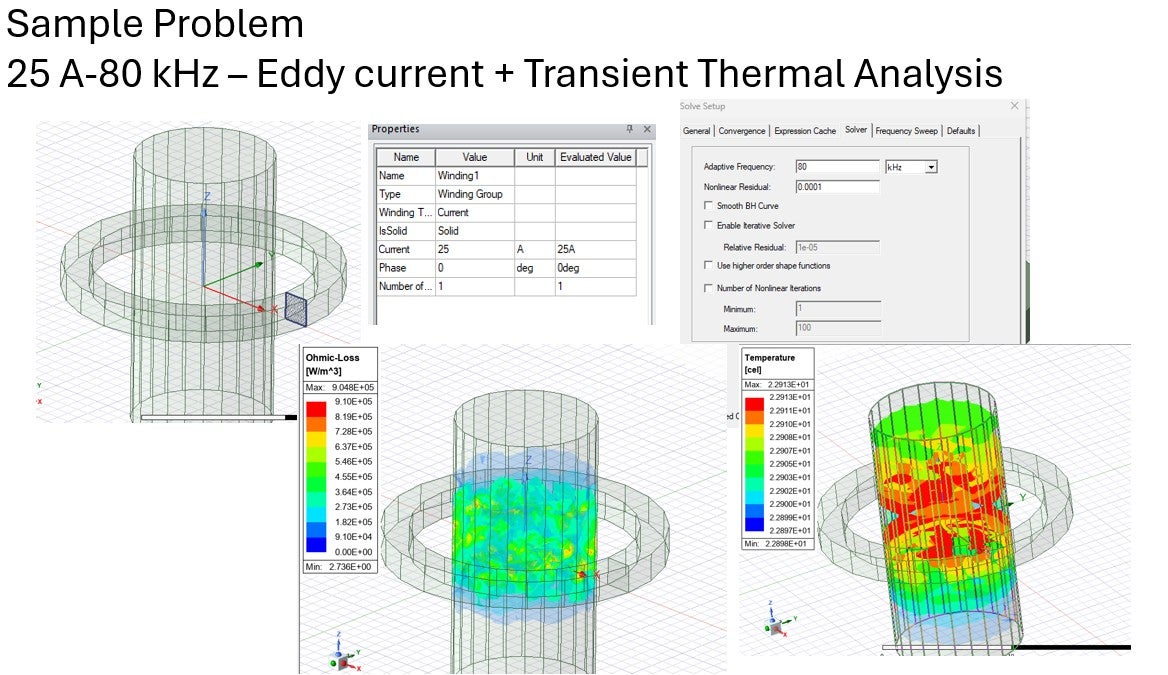
      I am working on a induction heating problem where a simple core and induction coil is used to check the temperature of core. I am using edy current analysis couplied with transient thermal to predict the temperature. Howvere, the temperature in FEA is ~ 26 deg C compare to actual temperature of 650 deg C. I am having 12 kW power source with 480 V  at 80 kHz. ( equivalent current used in the analysis is 25A). I think maxwell is underpredicting the ohmic losses. Please provide your thoughts.

    • MirandaH
      Ansys Employee

      Hi, induction heating simulation requires Electro-magnetic (Maxwell) and Thermo-mechanics (Structural Thermal) coupling is required. The loss from Maxwell needs to couple to a thermal tool for correct temperature.

      Maxwell offers an ACT extension for Transient induction heating, please refer Maxwell Help for more information. The coupled simulation process is automated using this ACT extension.

      For Maxwell model, there are few things need to check for accurate results:

      • Meshing – Skin Effect.​

        • In induction heating simulaiton. Skin depth can be very thin due to the frequency, specially in ferromagnetic materials, and this should be accounted in the mesh.


      • Materials – temperature dependent properties 
      • Materials – non linear BH curve and saturation
        • In induction heating, the magnetic field is usually strong enough to reach saturation in ferromagnetic materials -> material non linearities should be taken into account otherwise joule heating will be overstimated.

Viewing 1 reply thread
  • You must be logged in to reply to this topic.