TAGGED: 2-way-coupled-fsi, Fluid Volume
-
-
January 15, 2026 at 2:26 pm
Jox
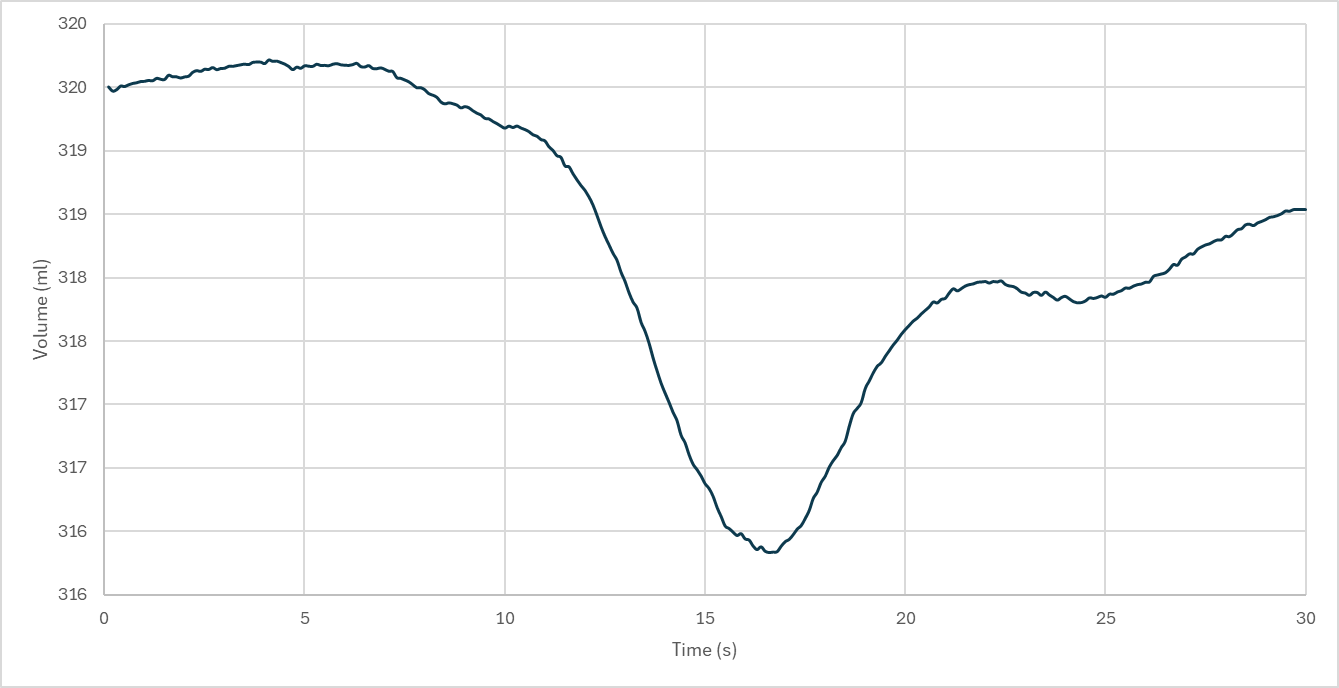
SubscriberI am modelling a fluid structure interaction (fluent and mechanical transient) of a balloon with a certain amount of fluid, and by deforming the walls of the balloon, I assess the contained fluid. The boundary conditions are all walls, and hence, no fluid loss should be occurring. This is not the case, as I deform the structure of the balloon wall, the confined fluid is seen to vary, which should not happen. I expect the deformation to increase the pressure of the contained fluid, as observed in experiments; however, the contained fluid remains at a very low pressure, which I believe may be because the fluid isn't increasing pressure with the deformation but is instead losing mass.Â
I have assessed multiple mesh densities and also time steps, but neither has helped. I have attached the volume output as a function of time for reference.
-
January 16, 2026 at 7:58 am
NickFL
SubscriberI am a little confused by what you are trying to accomplish here. Based upon what you describe, you have a closed system with no inlets or outlets, correct? And then you are changing the volume (compression) by ~1%. You expected pressure to increase, which I agree with, but how much does your hand calculation say the pressure should increase? And how much has it? Set up monitor points that show relevant quantities for the simulation during solve. Do these behave as expected?
There may also be a misunderstanding with the pressure. Read up on the pressures in Fluent (I’m on mobile at the moment so adding a link is difficult. But there are multiple threads on it here.) Make sure you are setting the operating pressure appropriately.
-
January 16, 2026 at 8:18 am
Jox
SubscriberHi Nick, thanks for the interest and response. I am trying to obtain experimental data on a balloon undergoing deformation by tracking its wall motion (pressure is also measured for the water inside the balloon). By prescribing the same wall movements in the finite element model of fluid-structure interaction, I expected a similar pressure response, but this is not the case. Below, I summarise the maximum pressure change experienced by both the experiment and simulations:
Experiments: 88.26 Pa
Simulations: 0.136 Pa
Given that the simulations show much lower pressure changes, I presume the deformation I prescribe on the balloon wall is not being translated into a pressure change but is instead minimised by volume loss.
-
January 16, 2026 at 8:55 am
NickFL
SubscriberHow are you modeling the water? What pressures are you dealing with here?
Â
What is your end goal? What is the simulation going to be used for? It is pretty straightforward to have the pressure increase with the deceased volume, but you would basically be prescribing the answer.
-
-
January 16, 2026 at 9:02 am
Jox
SubscriberI am modelling water at room temperature, and at the beginning of both simulations and experiments, the pressure is 0 Pa.
The overall goal will be to validate a medical device that monitors pressure and the amplitude of deformations it can detect with these pressure changes.Â
For your last statement, you mention it would be easy to prescribe the pressure increase as volume is decreasing, i mean, yes i can prescribe the pressure of the fluid as a function of the simulation, but what i would prefer is to understand why the volume change is happening, solve this and i hope the pressure change will also be fixed with this.
-
January 16, 2026 at 9:51 am
NickFL
SubscriberÂ
We typically assume water to be incompressible. The compressibility of water is tiny, something like 1000 bar for 1% volume change (which is comparable to what you show above). I again ask how are you modeling the water?
Based upon everything you have written, I do not see the need for a true FSI. You could create a FEA model that adjusts the pressure boundary condition based upon the volume compressed. I would expect there to be examples on the Mechanical forum on how to do this.
Just so you know, I am just arriving at my destination and my appointment starts at the top of the hour. Therefore I will be unavailable the rest of the day.
Â
-
January 16, 2026 at 1:15 pm
Jox
SubscriberAh ok, sorry. Yes, I am modelling it as an incompressible fluid, so there should be no volume change.
And I have created an FEA model of the balloon with hydrostatic elements on the internal surface. After the deformation was created, the hydrostatic elements were even further off the experimental results, being at approximately 300,000 Pa. (If I try to further pursue this, I will re-ask the question in the mechanical forum.)
I would prefer a full FSI as I would like to see the fluid response due to the contraction rather than have all the fluid converge to a single point, as seen in the FEA hydrostatic model. Thank you for the consideration, though.

-
January 19, 2026 at 9:03 am
NickFL
SubscriberKeep in mind that if you want to see the pressure wave move through the fluid you will need to resolve the wave motion in time. The pressure wave will be moving at the speed of sound which is quite quick in water. You will also need a find mesh to capture the wave and without having numerical dissipation. I do not know what the dimensions of your device is, but the above may require significant computational resources if you are computing 30 physical seconds (as shown in the original image).
-
-
-
- You must be logged in to reply to this topic.
-
5639
-
1885
-
1403
-
1298
-
1021
© 2026 Copyright ANSYS, Inc. All rights reserved.