TAGGED: combustion, k-omega-sst, les
-
-
January 11, 2026 at 12:20 pm
can.sumeyye
SubscriberI want to use sst-sas model and compare it with LES results.Â
1_Can I start with steady sst k omega model and after reaching the steady result move to the sst-sas(like the way we do in the URANS)? Or should i use interpolate etc.
2_If i can use steady rans, should i burn the mixture before movin to the sas or should i burn it after sas?
3_Are there a requiremnt for mesh for SAS (like LES)?
Thank you a lot
-
January 12, 2026 at 10:36 am
Essence
Ansys EmployeeHello,
Can you please share some more information about the combustion model(s) you are trying to use?
-
January 12, 2026 at 12:30 pm
can.sumeyye
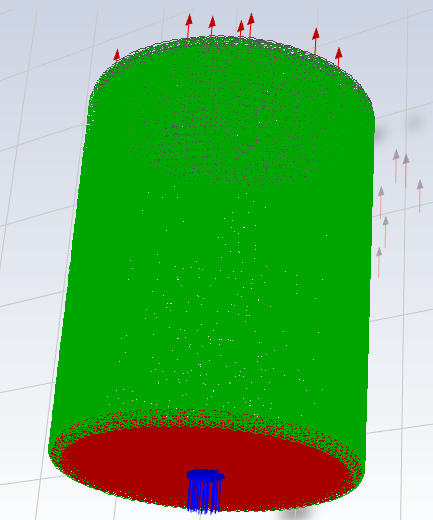
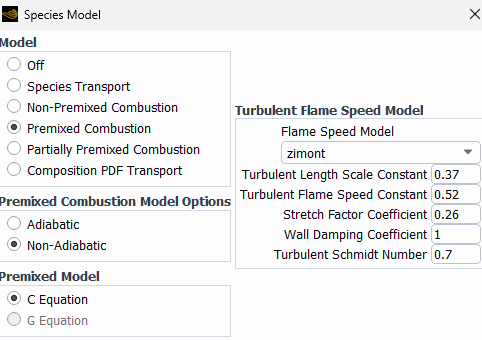
SubscriberIts premixed combustion. I use the default premixed setup with c equation and zimont model. My mixture is ch4+air and later i will try to add hydrogen. The model is at atmospheric conditions and it contains a combustion chamber with adiabatic walls(maybe later i will consider the wall heat exchance effects). For the inlet conditions, i took velocity and turbulence profiles from an experiment based thesis. I already run the steady rans models and results were satisfiying for a steady rans result.Â
-
January 12, 2026 at 3:17 pm
jcooper
Ansys EmployeeHi:
The biggest limitation with SAS is that it needs a strong source of turbulence to generate accurate results. Examples of strong sources of turbulence are: a large backward facing step, cylinder in crossflow or a swirl burner. Flows with weaker sources of turbulence, such as shear, tend to laminarize.
In answer to your questions:
1_Can I start with steady sst k omega model and after reaching the steady result move to the sst-sas(like the way we do in the URANS)? Or should i use interpolate etc.
Yes, a steady SST-kw run is a good starting point for an SAS simulation that uses SST-kw as the RANS component
2_If i can use steady rans, should i burn the mixture before moving to SAS or should i burn it after SAS?
I would move from a cold-flow RANS to cold flow SAS. The shift in models may change or even extinguish any established combustion, so starting combustion with RANS is unlikely to gain you much time.
3_Are there a requirement for mesh for SAS (like LES)?
The mesh requirements for SAS are virtually identical to LES, because SAS is essentially an LES-like treatment outside the boundary layer. An additional requirement for SAS is to treat the near-wall mesh as you would in any high-fidelity RANS simulation, ie: y+ <2 at walls in areas where flow is wall-bounded. This is most critical in any inlet area that affects fuel/air hydrodynamics. For hybrid turbulence models like SAS/DES, care should be taken to avoid any large changes in mesh size, especially between the boundary layer and freestream area. Large mesh size jumps can trigger a premature switch to LES from RANS (or back), which will adversely affect the turbulence field.
Regards,
Judy

-
January 18, 2026 at 1:06 pm
can.sumeyye
SubscriberÂ
Before implementing SST-SAS, I performed an SST-K-Omega analysis. I obtained very different results with the production limiter open and closed during combustion. Normally, it’s recommended to have the production limiter open, but with it open, the flame stayed very high above the flame domain (burner exit). The flame, which should normally stay at 35-40 mm, stayed at 50-60 mm. So I closed the limiter, and the flame moved a little closer (about 8 mm) to the burner exit. It seems that whether the production limiter is open or closed makes an extreme difference for SST-K-Omega. Does the same apply to SST-SAS? The production limiter is open by default; will this kill my turbulent eddies?
Thank you for your help.
Note: I also used this formula
 to define turbulence inlet. Maybe this caused that these two results are too different.
-
-
January 19, 2026 at 8:58 pm
jcooper
Ansys EmployeeHi:Â
The flame position is greatly affected by laminar and turbulent flame speeds, so I would consider looking into turbulent flame speed calculation before turning off the default turbulence production limiter.Â
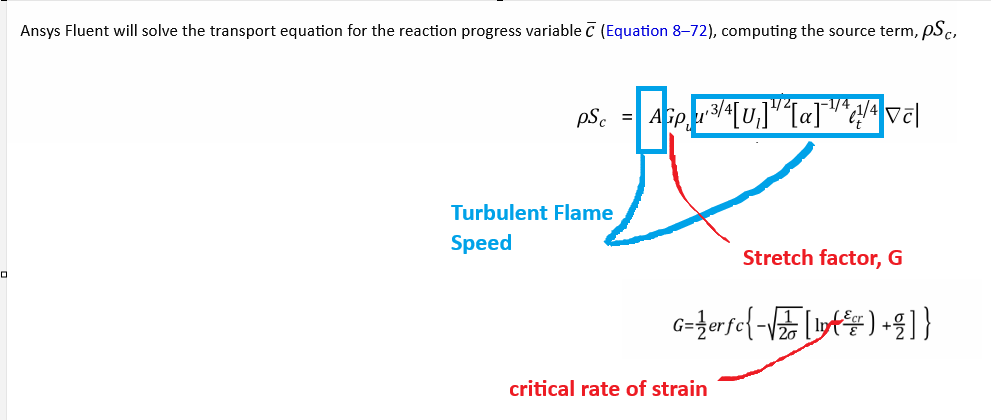
The higher the turbulent flame speed, the closer the flame will sit to the burner ... (to a point)Â The premixed model allows a constant laminar flame speed value to be specified. Laminar flame speed is used to calculate turbulent flame speed You can also adjust the Critical Rate of Strain:
If the critical strain rate is too high, the model will not predict extinction even when it should physically occur. (The default setting is for no extinction.) For lean premixed methane/air flames, typical critical strain rate values range from 3000 to 8000 s^-1.Â
Critical strain rate is used to calculate the Stretch factor, G, which multiplies the turbulent flame speed in the calculation of the progress variable source term. Below is how turbulent flame speed stretch factor and the progress variable source term are related:
I hope this helps.
Regards,
Judy
-
January 20, 2026 at 8:42 am
-
January 21, 2026 at 7:55 pm
jcooper
Ansys EmployeeDifferent turbulence models will generate different turbulent content, so the k-e and k-o SST near wall flame speed calculations might look different. Comparing the turbulent flame speeds for the 2 cases might show why the flame is extinguishing. Both solutions could still be incorrect however; the k-e solution is not necessarily a benchmark.
Note that, once you add hydrogen, you are better off with a finite rate solution because ch4/h2 mixtures deviate significantly from Le =1
-
- You must be logged in to reply to this topic.
-
5629
-
1885
-
1403
-
1298
-
1021
© 2026 Copyright ANSYS, Inc. All rights reserved.