-
-
June 3, 2020 at 8:18 pm
nika2001
SubscriberHi everyone,
While there are a lot of researches on dynamics of wetting and dynamics contact angle, it seems, Ansys fluent update contact angle during simulation. For example if you set static contact angle for a liquid slug in a capillary tube, and then force the slug to move, the contact angle changes.
In this regard, I saw a lot of discussion on how to write a udf to apply dynamic contact angle, when the "wall adhesion" option is activated while I think fluent solver updates the contact angle during simulation and there is no need to do so by a udf. Â
Actually I'm a kind of confused on this issue and wonder if someone can help me?!
Regards,

Â
-
June 3, 2020 at 10:28 pm
Karthik Remella
AdministratorHello, I'm already replied to your question here.
/forum/forums/topic/ansys-act-dynamic-contact-angle/
Please refrain from creating duplicate posts for the same question.
Thank you.
Karthik
-
June 4, 2020 at 5:40 am
DrAmine
Ansys EmployeeYou require an UDF to prescribe a dynamic contact line.
-
June 6, 2020 at 3:33 am
nika2001
SubscriberYes thank you!
But why the interface angle at the wall is not the same prescribed value in boundary condition when the interface moves. It seems that the apparent contact angle changes. Â
-
June 8, 2020 at 12:21 pm
Karthik Remella
AdministratorPlease refine the mesh and check if you are seeing a change in the angle. Also, just curious - how are you estimating the angle in your simulation? Or is this something you are eyeballing based on the VF contours?
Thanks.
Karthik
-
June 8, 2020 at 3:06 pm
DrAmine
Ansys EmployeeI would not expect that if you are imposing a static angle. Probably bad resolution! Check what Karthik wrote.
Â
-
June 8, 2020 at 5:27 pm
nika2001
SubscriberYes I measure based on the VOF contours. Actually The change in contact angle is so large.
-
June 8, 2020 at 6:20 pm
DrAmine
Ansys EmployeeI would rather use UDF or at least getzje fog gradient in the near wall cell. -
June 8, 2020 at 7:22 pm
nika2001
Subscriber Thanks for replying,
Â
Of course it is a better idea to use the gradient of vf near the wall but as I said, visually it is more twice than the static contact angle. So even in the case using the free surface normal vector in the wall adjacent cell, the problem will remain for sure.
Â
I am sure that the static contact angle changes during the oscillation. even in the work of those researchers who used dynamic contact angle, they try to validate the resulting apparent contact angle.
Regards,
Â
-
June 9, 2020 at 5:51 am
DrAmine
Ansys EmployeeWhat is now your question?
-
June 9, 2020 at 6:18 am
nika2001
SubscriberThanks for your collaboration!
Â
Why the contact angle ( or better to say slope of the interface) change  during the motion of the interface for the constant static value while it is mentioned in Fluent theory guide that the slope in the first cell is set according to the prescribe contact angle?
*** In this regard I checked the slope of interface in the first cell adjacent to the wall for different vof iso-value surfaces.Â
Â
Can we say the change in the slope of the interface in first cell is due to numerical errors such as diffusion?
Â
Why people use the contact angle as a criteria for validation while they prescribed the dynamic contact angle in advance?
Â
Regards
Â
Â
-
June 9, 2020 at 11:12 am
DrAmine
Ansys EmployeeThe angle might change and the is what a lot of scientist are claiming: one does not need a dynamic contact angle if one does use very fine mesh and shaprly convect the interface.
The same amount of researchers claim that one does require a dynamic contact angle to avoid any wrong capturing of contact line.
Â
Again I still wonder if storing the gradients of the volume fraction and doing the dot product with face normal will return the same angle or a changing angle.
Â
Again all above assuming you have a proper resolution.
The wall adhesion is posing a boundary for the free surface and not a boundary for the wall itself
Â
Cheers
-
June 9, 2020 at 6:11 pm
nika2001
SubscriberThank you so much for your great collaboration!
But I think in the first cell adjacent to wall, the angle should equal to the prescribed contact angle as claimed in Fluent theory guide and the resolution of the grid does not matter? Do you agree with me?
Â
Regards,
Â
-
June 10, 2020 at 7:20 am
DrAmine
Ansys EmployeeNo: it will depend on the resolution too as that contact angle information is feed into gradients calculation and if that is not well captured you will end up with garbage as result-
-
June 10, 2020 at 4:12 pm
nika2001
SubscriberIf the contact angle is fed as a boundary condition for the interface How do you say it depends on the grid resolution?!!!!!
Regards,
-
-
June 10, 2020 at 5:13 pm
DrAmine
Ansys EmployeeBecause the result you got will depend on how good you are capturing gradients. If you reports you want to share please do if not it does not make you further discuss on this without even looking to your result. -
June 11, 2020 at 2:49 am
nika2001
SubscriberSo sorry to ask that much questions and thank you.Â
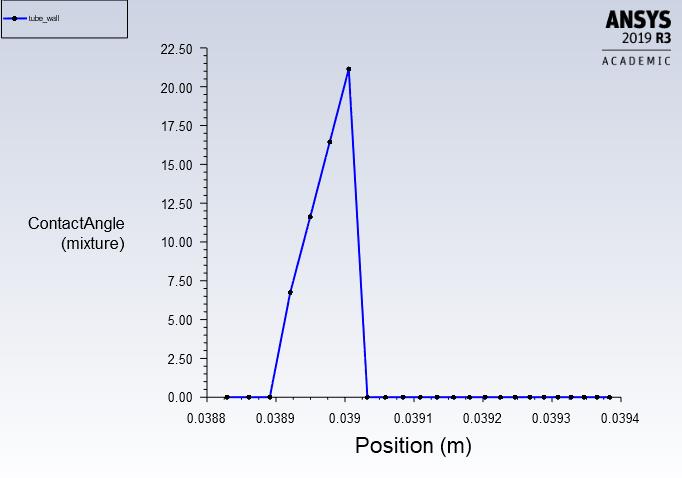
I did what you said and calculated the angle based on the gradient of volume fraction (smoothed VOF gradient in fluent ). Just want to know if the high aspect ratio could cause such a deviation from the prescribed angle(25 deg)? coz the first cell height on the wall is 1 micron while up to 15 microns in width. what about smoothing of gradient, do you think this also could affect the deviation of angle from the prescribed value?Â
Best regard,
-
- The topic ‘Dynamic contact angle’ is closed to new replies.
-
5889
-
1906
-
1420
-
1306
-
1021
© 2026 Copyright ANSYS, Inc. All rights reserved.