Ansys Assistant will be unavailable on the Learning Forum starting January 30. An upgraded version is coming soon. We apologize for any inconvenience and appreciate your patience. Stay tuned for updates.
Fluids

Fluids

Topics related to Fluent, CFX, Turbogrid and more.

Regarding multiphase flow simulation

    • saxenadevesh94
      Subscriber
      I have a Eulerian 3D three phase simulation. The mesh size is 25k. The solution is neither converging nir diverging. The time step taken is 0.005 sec. SIMPLE scheme, second ordr upwind in momentum and QUICK for volume fraction is used . How to speed up convergence
    • Karthik Remella
      Administrator

      What do you mean by the solution is neither converging nor diverging? Are you able to converge the simulation every single time-step? In the transient simulation, this is extremely important. Otherwise, you would always end up with the wrong results.


      If you are doing this, you could perhaps try an adaptive time-step. Not sure if this would speed up the simulation (it might). It completely depends on the minimum grid size (and the CFL stability criterion).


      Thanks.


      Karthik

    • saxenadevesh94
      Subscriber

      I am not able to converge the solution in every time step. I have tried adaptive time step as well, but same issue still persists. 


      Regards


      Devesh

    • Karthik Remella
      Administrator

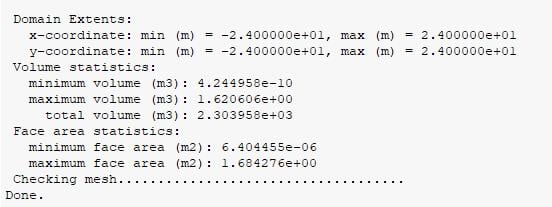
      Can you calculate the min time-step required for the simulation based on a CFL number of 1? You will need to obtain the minimum length scale in your domain. Use 'Mesh' -> 'Check' -> 'Perform Mesh Check' to print out the minimum volume based on your mesh. I'd take the cube root of this value and you should have the min length scale for your mesh. Use the velocity scale of your problem and calculate the minimum time-step required based on the CFL number = 1. Please use this time-step and ensure that you are running sufficient number of iterations per time-step. The default value is 20. Please increase them if you need to. Please let me know your findings.


      Here are some posts which might be useful.


      /forum/forums/topic/time-step-size-6/


      /forum/forums/topic/fluent-time-stepping-method-cfl-based-problem/


      /forum/forums/topic/time-step-size-and-courant-number/


      Thanks.

    • saxenadevesh94
      Subscriber

      Thank you for your suggestions. The time step calculated using C=1, is 1sec. I am using a time step of 0.005 sec. The maximum no of iterations are kept at 100. I also have couple of udfs to hook into the model. Those are drag model and momentum source term. I first initialized the problem with drag model udf. After convergence is achieved, I added the momentum source udf. The continuity and velocity residual suddenly jumps from 0.001 to 10^4. Is the addition of Udf in steps wrong or should I add all at once.


      Regards


      Devesh

    • Karthik Remella
      Administrator

      Hello,


      Have you linearized the Momentum source term? I'm sure you already might know this - but your source terms have to be linear. There seems to be a spike in your residuals because of the source term. How large is your source term?


      Have you double-checked if the momentum source is being added correctly? You could print the values and check. Use the fprintf or message commands.


      Adding UDF is steps is alright as long as they are not interdependent. If I understand correctly, you are using the obtained solution as the intial conditions for the new simulation run. This is perfectly fine. However, from a stability standpoint, after you add the source term to your momentum equation, the solution becomes unstable.


      Also, when you add the additional momentum source, what happens to the velocity scales? Does it increase or decrease?


      Thanks.


      Karthik


    • saxenadevesh94
      Subscriber

      Yes, the momentum source term is linearized. The velocity residual remains same, however the continuity residual jumps from 0.001 to 10^4. Can you please elaborate on what you mean by velocity scale. Is it the units or the order of residual.


      Thanks


      Devesh

    • saxenadevesh94
      Subscriber

      The source term is of the order of 10^7


    • Karthik Remella
      Administrator

      Is your momentum source an analytical expression? If so, could you please type it out here? 


      Okay, so the continuity jumps. Does it converge every single time-step after the spike? Could you please reduce the time-step after you add the source term and increase the number of iterations to see if you are able to obtain a converged solution every single time-step?


      Thanks.


      Karthik

    • saxenadevesh94
      Subscriber

      The momentum source term is as follows:


      2σ(ε_S/(1-ε_G ))^(1/3) (5.416/d_p )(1+88.1 ρ_G/ρ_L )∇ε_L


      where, σ is the surface tension coefficient between air and water.


      dp is the particle diameter.


      ε_G represents the volume fraction of solid phase.


      The solution does not converge in every time step. Instead it diverges after a few iterations. I have reduced the time step upto 10^-6. It converges upto a few time steps, then suddenly it diverges.


      thanks


      Devesh

    • Karthik Remella
      Administrator

      Couple of thoughts on how to debug:


      • Are you printing out the values of the source term and are they consistent with your hand calculations (I'm assuming that they are not significantly different). I'm also curious about these values just before the solution diverges. Do some of these values become really small or larger?

      • What happens if you slowly ramp-up the source term over time?

      • Just before the solution diverges, could you please try and plot the values of all physical parameters that feature in your source term and identify if there is an anomaly somewhere?


      Thanks.


      Karthik

Viewing 10 reply threads
  • The topic ‘Regarding multiphase flow simulation’ is closed to new replies.
[bingo_chatbox]