Ansys Assistant will be unavailable on the Learning Forum starting January 30. An upgraded version is coming soon. We apologize for any inconvenience and appreciate your patience. Stay tuned for updates.
Fluids

Fluids

Topics related to Fluent, CFX, Turbogrid and more.

Interface smearing Euler-Euler

    • j.j.a.v.zutphen
      Subscriber

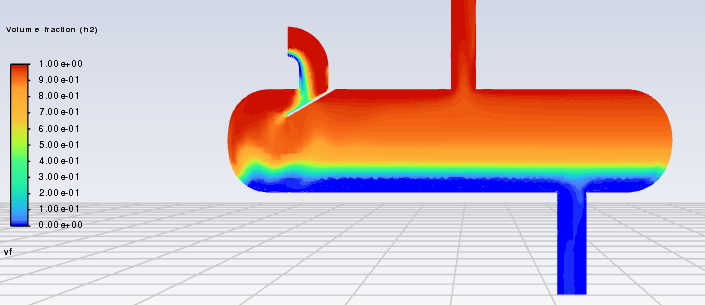
      I am doing a 3D steady state inhomogeneous Eulerian simulation of a gas-liquid separator.
      My focus is in looking how much gas leaves out the liquid outlet in the form of little bubbles.
      I have to define the bubble diameter myself but this greatly influences the outcome.
      Also the liquid-gas interface starts smearing which is unrealistic. I am using a multi-fluid VOF hybrid model with the interface defined sharp/dispersed.

      How does the simulaiton define where a disperse phase is present/created and how do I prevent it from smearing by having droplets everywhere.

      Hopefully you understand what I mean by this, I will gladly explain more.
      Kind regards,
      Jasper

    • Rob
      Forum Moderator

      What are the phase diameters set at? That result does look very noisy, so also check convergence: are you running steady or transient?

      • j.j.a.v.zutphen
        Subscriber


        Hello Rob,
        I am using the steady state solver, currently the diameter is 1e-5 mm (standard setting).
        I have water as the primary phase and H2 gas as the secondary phase, since I am most interested in the bubbles.
        Increasing the diameter reduces smearing, but small bubbles are not taken into account for the separation then.
        Kind regards.


    • Rob
      Forum Moderator

      OK. At 10 microns the gas will pretty much follow the fluid. Given the inlet looks stratified how much bubble phase are you expecting? Are you trying to model a knock out drum?

      • j.j.a.v.zutphen
        Subscriber

        Yes, I am trying to model and then optimize a knockout drum.
        I do not have much validation data so I was hoping the model could give me insights in what kind of bubbles are created and how they would move through the drum.
        Kind regards.

    • Rob
      Forum Moderator

      I remember doing those for my first year design course. We did have computer assistance but I can't remember what the package was - it was DOS based and for vessel sizing. 

      Anyway. I'm a little stuck in how much I can help as staff are limited by the rules Legal put in place. So, first question. How much (by volume) do you have for gas and liquid? Is the inflow conditioned (ie are the inlet pipes long enough to have stratified flow? Where's the mesh packer? Have you read the Coulson & Richardson books? 

      • j.j.a.v.zutphen
        Subscriber


        By volume ~90% Hydrogen 10% water, the inflow is stratisfied (long inflowpipe & done previous simulations). 
        For now vessel volume taken to be 1L, flowvelocities at 0.5-2m/s
        Water droplets carried out by the gas-outlet are out of the scope of my project, so a demister mesh is not needed.
        A bubble coalesence mesh could be placed at the liquid outlet, but if this mesh is needed would be based on the simulations results.
        I did do research before that gave general design guidelines, but since I am doing my master thesis in CFD using only this will not suffice.
        Kind regards.


    • jcooper
      Ansys Employee

      Hi: The Eulerian model in Fluent does not explicitly capture the interface between phases. Instead, it treats the phases as interpenetrating continua, which can lead to a smeared interface once the phase interpenetrations, such as small bubbles, are smaller than the mesh size. This is different from the Volume of Fluid (VOF) model, which is designed to capture sharp interfaces explicitly. (The VOF model is unsuitable for flows where the phases are interpenetrating on a small scale, however.) 

      Refining the mesh in the area where things are getting fuzzy is helpful for both models.

      • j.j.a.v.zutphen
        Subscriber

        Hello,
        This model already has the hybrid model "multi-fluid VOF Model" and "sharp/dispersed" options ticked. Other than locally refining the mesh around the gas-liquid interface, do you have any other tips on how I could both capture a realistic interface and follow bubbles that are created, without having predetermined inputs on what these bubbles would look like?
        Kind regards.

    • jcooper
      Ansys Employee

      Hi:

      Sorry, I don't have any other tips.  The very thing that makes Eulerian multiphase able to handle small-scale interpenetration of phases also makes it bad at capturing the details of bubbles.  Models that aim to distinguish the phases, like VOF, are inherently better at resolving bubbles.

    • Rob
      Forum Moderator

      Is your aim to model bubbles leaving through the water outlet, or to see if bubbles travel in the water? Think carefully about the purpose of your model: passing your Masters Thesis isn't a very good reason for starting a CFD run. Are you interested in how bubbles are entrained, in what size can reach the outlet etc. So far I'm easily inside Chemical Engineering general (and more critically public) knowledge. From there, is VOF a better option, or must we use Eulerian? Whenever I've modelled these units the liquid depth is sufficient to not worry about bubbles, however droplets in the gas stream are an issue hence mesh packers etc. 

      • j.j.a.v.zutphen
        Subscriber

        In general the aim is to model if and how many bubbles travel through the water outlet & shrinking/optimizing the design to where no/little bubbles exit through the water outlet.
        The gas outlet will have a full condensing drying system behind it in the future, so that is why it is left out of the scope, but I have not yet looked into how much liquid water leaves the system there.
        Eulerian is not a must, I disregarded the VOF model because I thought it would not capture the bubbles smaller than the cell size (1-2mm).

        Thank you very much for your in depth help by the way.

    • Rob
      Forum Moderator

      So, now look at where the bubbles are coming from: what causes them given the inflow is stratified? In reality, how are bubbles removed from the liquid stream assuming they don't get sucked out of the bottom? 

      One thing everyone misses in CFD, and especially with multiphase, is a very clear understanding of the real physics. 

      • j.j.a.v.zutphen
        Subscriber

        The bubbles are formed by entrapment in areas with high turbulence and interface density. But modeling this using a VOF would require very fine mesh and transient solving. My model does not have to be at this level of accuracy, I would mainly be interested in how many bubbles are formed and how they flow.
        Perhaps these bubbles cannot really be modelled, and since I don't know the bubble diameters the VOF model would fit best for me?
        Kind regards?


    • Rob
      Forum Moderator

      Yes, so bubbles form as gas is entrained into the liquid. So, do we design to reduce the speed of the liquid, or assume a liquid speed (inlet) and look at what size bubbles can separate from the flow? If we don't need to worry about the free surface, what other options have we got?

      • j.j.a.v.zutphen
        Subscriber

        The flowrates are fixed, but the design can reduce the inlet velocities by calming measures. I am not sure if you are hinting at this but I know there are options in adding lagrangian particles, I could introduce a range of particle sizes to see which ones can separate, this however does not solve the problem in that I do not know what kind of bubbles are created.
        Kind regards

    • Rob
      Forum Moderator

      If you need to know the bubble size you will need to resolve with VOF. If you need to know how bubble size influences the separation then single phase with DPM may be an option: the method you're using is "fixed lid" and is commonly used to avoid using VOF in mixing tanks.

      Modelling multiphase in Fluent is easy, choosing and setting up the models correctly is somewhat less so. 

Viewing 9 reply threads
  • You must be logged in to reply to this topic.
[bingo_chatbox]