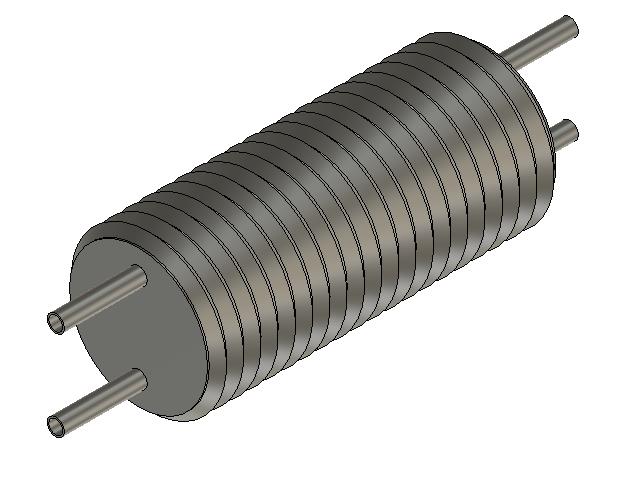
-
-
May 2, 2020 at 10:49 pm
-
May 3, 2020 at 12:33 am
peteroznewman
SubscriberWhat question do you have that you want the simulation to answer?
-
May 3, 2020 at 1:11 am
firsthero
Subscriberhow much compression is needed to achieve the desired flow rate and pressure
-
May 3, 2020 at 1:45 am
peteroznewman
SubscriberAre you pumping air or water?
How do the valves work? Do you have details inside that you can show in a section view?
-
May 3, 2020 at 1:55 am
firsthero
Subscriberair, and the pump is empty, and they're just normal valves for now
-
May 3, 2020 at 11:10 am
peteroznewman
SubscriberDefine "normal" valves. Simulation requires a painful amount of detail.
What are the performance characteristics of the valve? For example, the pressure vs flow rate curve when they are open?
Or if you don't have that, then you model the physical shape of the tiny parts in the valve and let the solution solve for the flow through the valve.
Also, why are there two tubes on each end? Explain which tube does what and which way the valves are allowing flow.
-
May 3, 2020 at 1:21 pm
firsthero
Subscriberok they're check valves, 2 tubes let in air and the other 2 let air out
-
May 3, 2020 at 3:00 pm
peteroznewman
Subscriberfirsthero,
I looked at your other posts since you joined the Community 4 weeks ago. I see that you had a good plan to start in 2D with a CFD model. I didn't see if you were successful at that attempt. A rubber pump with check valves is a very complex model because it requires a two-way Fluid-Structure Interaction (FSI). I think this is way beyond your current level of ability and understanding. I recommend you enroll in the free, online course linked to at the top of this page. There you will get exposure to structural models, 2D CFD models and 3D CFD models. Once you have completed that course, you can reconsider this model.
Note that a two-way FSI model is not available in the Student license, so for that reason, I am done with this discussion.
Good luck.
-
May 3, 2020 at 3:08 pm
firsthero
SubscriberI was able to resolve my 2d problem.
And i just want to simulate the pump itself, forget the check valves for nowÂ
Â
-
May 3, 2020 at 3:11 pm
peteroznewman
SubscriberOkay, now do a 3D model that does not involve any moving structural parts. Then go on to have some rigid body moving.Â
With regard to 2-way FSI, what kind of license are you using? Â
-
May 3, 2020 at 3:14 pm
firsthero
Subscriberansys student 2020
-
May 3, 2020 at 3:19 pm
peteroznewman
SubscriberThat means you will not be able to solve a rubber pump with that license. You would need a Research license. That may be available at your University. Ask a Professor about that.
-
May 3, 2020 at 3:41 pm
firsthero
Subscriberi got a friend who has ansys 19.2 i can use his computer
Â
-
May 3, 2020 at 9:00 pm
peteroznewman
SubscriberDecide on a 3D flow problem with no moving parts and get a steady state solution.
Once you have that done, learn how to transfer the pressure to a Static Structural model for a 1-way FSI.
The above steps are covered in the free, online course linked to at the top of this page.
Next do a 3D Transient flow problem with no moving parts. Post questions in the Fluid Dynamics section.
Then transfer the pressure to a Transient Structural model for a 1-way FSI.
Finally you can attempt a 2-way FSI. There is a lot to learn. Good luck.
-
May 3, 2020 at 9:11 pm
firsthero
Subscriberthank you,Â
you've been of great help
-
- The topic ‘Simulating a Rubber Pump’ is closed to new replies.
-
4888
-
1587
-
1386
-
1242
-
1021
© 2026 Copyright ANSYS, Inc. All rights reserved.