-
-
April 11, 2025 at 1:02 pm
boettner
SubscriberHi everyone,
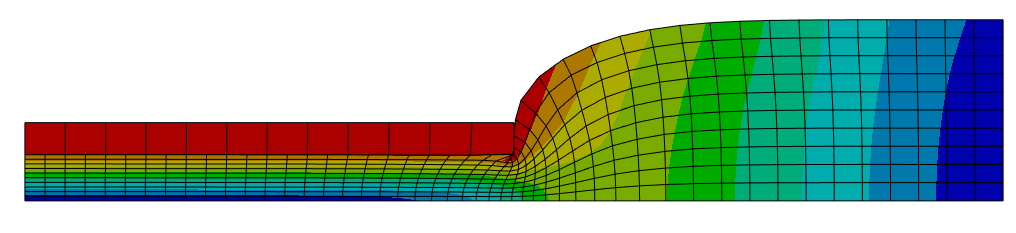
I am trying to set up a 2D static analysis of a foam material that is compressed on one side to about half its thickness:
As a result, the elements close to the compression plate exhibit a large deformation, causing my simulation to fail no matter what I try. However, I think this should be doable, as similar working examples have been posted online. The material of the foam is defined as such:
TB,hyper,matid,1,2,foam ! Units of MPa
TBDATA, Â 1,0.003595230317364466,1.4745768145906895,0.003595236891314886,1.4745768210058428
TBDATA,5,7.789397958302508,7.789397953328129The compression plate is more or less undeformable. To make the simulation converge, I have tried the following things:
- A lot of substeps
- Refining the mesh
- Nonlinear adaptive region and trying almost every option this method has
- Switching to Uniform reduced integration with hourglass control (this did converge, but the results where highly unphysical)
The convergence fails almost always because of large element distortion. Although th remeshing seems to work fine (as shown above), the solver is not able to find a solution after some point. So maybe the meshing is not even the problem, but then I do not know what is.
I am really looking forward to your answers, as I am totally clueless on whats going on here. Any help is much appreciated!
Best regardsÂ
-
April 11, 2025 at 1:22 pm
Armin
Ansys EmployeeHello,
I recommend adding a small fillet to the corner of the compression plate where it contacts the foam to avoid a sharp corner. Additionally, I suggest checking out the following two videos from free Ansys courses, which provide useful guidelines for addressing such issues:
https://innovationspace.ansys.com/courses/courses/topics-in-hyperelasticity-using-ansys-mechanical/lessons/how-to-handle-element-distortion-errors-in-hyperelastic-materials-lesson-3/
https://innovationspace.ansys.com/courses/courses/numerically-accurate-results/lessons/understanding-and-dealing-with-artificially-high-stresses-lesson-3/
Â
-
April 11, 2025 at 3:22 pm
boettner
SubscriberThanks a lot for the help!
As suggested, I did add a fillet to the compression plate:
Â
And to avoid any complications by a wrong calibration of the material model, I switched the model to a linear elastic material (Youngs Modulus 6 MPa, Poisson Ratio 0.25). This still does not converge! I watched the videos you suggested and I think that I ruled out / tried every solution they provide. This seems extremely strange to me, as their example is quite similar to mine except mine is in 2D. Do you have any suggestions on how I can proceed from here?
-
April 11, 2025 at 3:36 pm
Armin
Ansys EmployeeNo problem, and thanks for considering the different options.
Since you have already ruled out the possibility of the material model being incorrect, I suggest checking the contact parameters between the two bodies, such as reducing the contact stiffness, to see if any improvements can be obtained. Additionally, as an alternative option, consider performing an explicit dynamic analysis with LS-DYNA, which is particularly helpful for cases with significant nonlinearities and might be beneficial in your situation.
-
-
-
April 13, 2025 at 11:19 am
peteroznewman
SubscriberHi boettner,
I have some experience getting hyperelastic models to converge. Please use File, Archive in Workbench to save a .wbpz file and upload that to a file sharing site such as Google Drive (using the share with anyone setting) and I will take a look. I agree with Armin that LS-DYNA may be helpful so you can look at that, but I will be looking at trying to converge in the Static Structural analysis.
-
April 15, 2025 at 3:09 pm
boettner
SubscriberThanks to both of you for the helpful hints!
Please excuse the late reply, I took the last few days to work with your advise, and I think out of pure luck I did manage to get closer to the answer. By setting the material constants so that the material is highly compressible (for Ogden foam this means beta=0 I think), the simulation did converge with no issue at all:

TB,hyper,matid,1,1,foam ! Units of MPa
TBDATA, Â 1,212.3430001698137,0.032298469953598315
TBDATA,3,0Unfortunately, the model is a rather poor fit to my experimental stress-strain-curve (uniaxial compression):
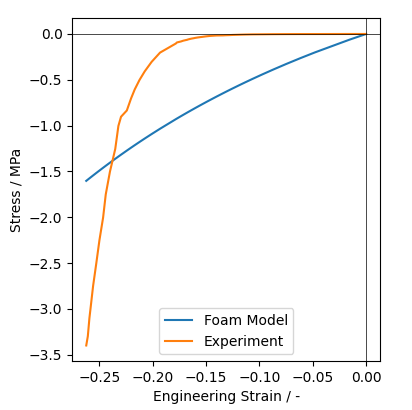
I already tried to increase the number of model parameters, but this does not seem to influence the quality of the fit at all. This is quite unfortunate, as I would like to keep this compressibility behavior of the model (both for convergence and physical reasons), and I did not find another hyperelastic model in the Ansys manual that is described to be suited for compressible materials. Do you have any suggestions how to proceed from here? Are there other material models that might be suited for this case or am I just doing the parameter fit wrong? From a physical point of view, all I know from the material is the compressive behavior as shown above (isotropic) and that it does not exhibit Poissons effect, i.e. it is 100 % compressible.
If you still want to have a go at it, I did upload the model and the experimental data to this drive folder:
https://drive.google.com/drive/folders/1xNa_71elsAy79zBdcke_JlTXTjmVDEL3?usp=sharing
Â
Thanks again for all your effort!
Â
-
April 22, 2025 at 1:07 pm
boettner
SubscriberFortunately, I was able to come up with a solution. In case anyone is interested:
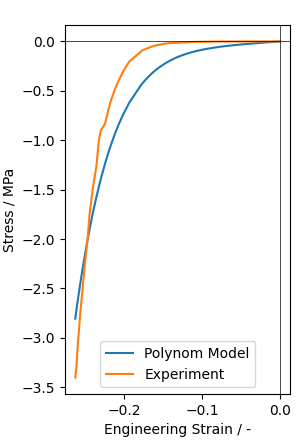
Using the polynomial form hyperelasticity, I was able to create a material model of a highly compressible material with a nice fit to my experimental data:
TB,hyper,matid,1,3,poly ! Units of MPa
TBDATA, Â 1,0.1,0.1,0.1,0.1,0.1,0.1
TBDATA, Â 7,0.1,3.0458919120748447,22.108146343304487
TBDATA,10,180.36491000740045,0.6371212201374521,0.01The accuracy of the fit can be increased even further if the order of the polynom is increased.Â
Thanks again for everyone that gave their support!
-
- You must be logged in to reply to this topic.
-
6485
-
1906
-
1458
-
1308
-
1022
© 2026 Copyright ANSYS, Inc. All rights reserved.