-
-
March 3, 2025 at 5:12 pm
jadenlongdon
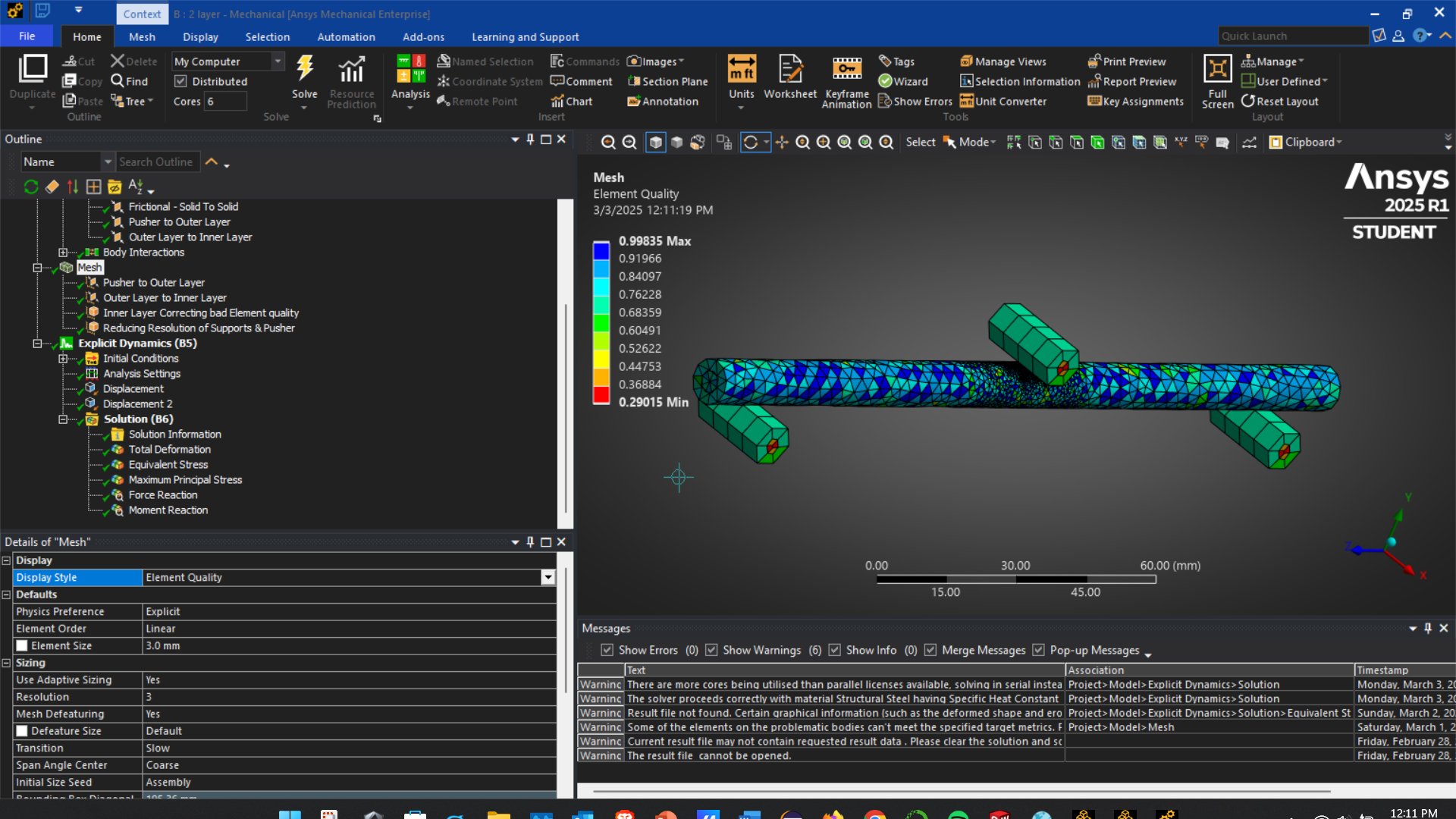
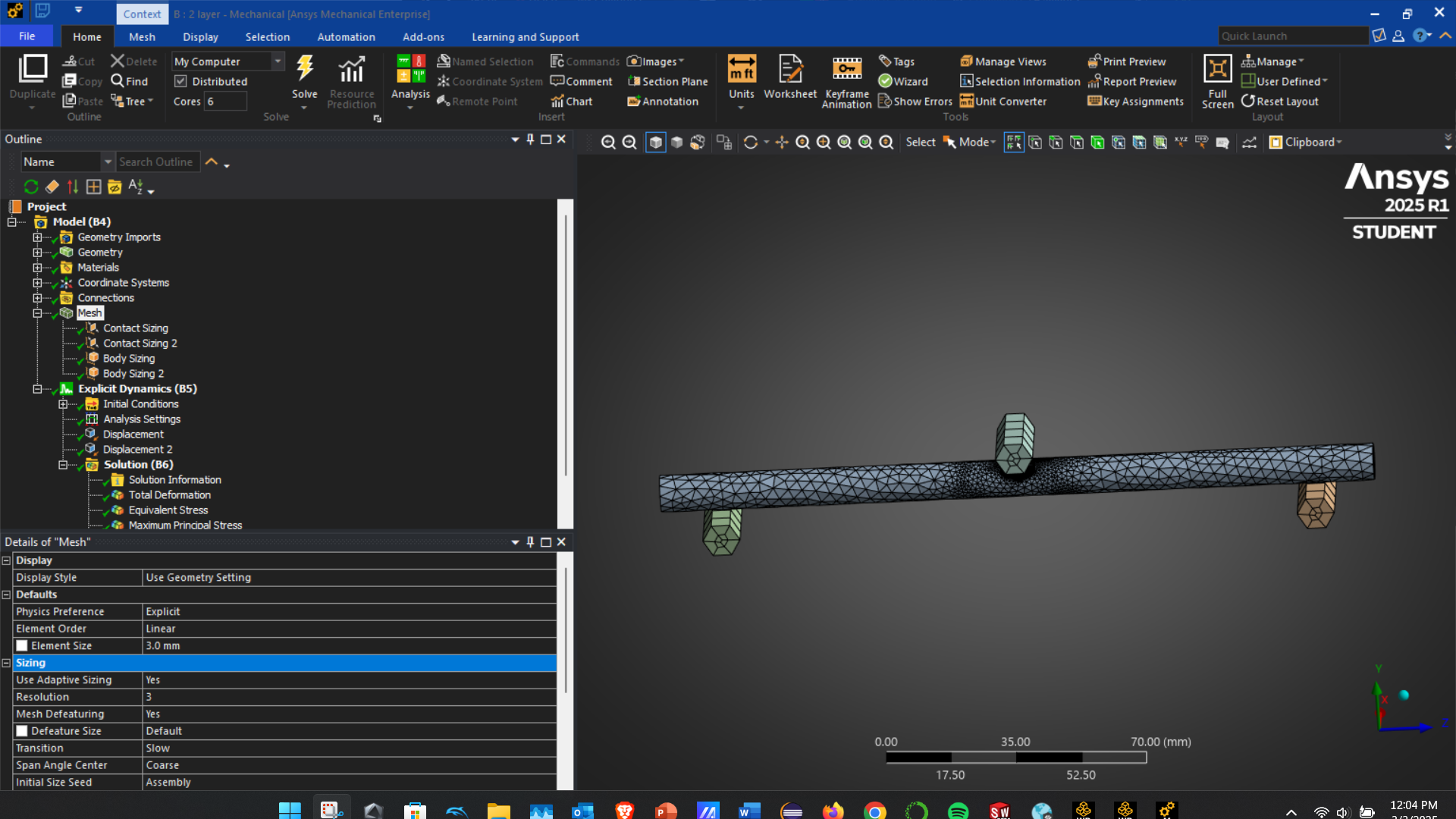
SubscriberHi I am trying to conduct 3 point bending test using an explicit dynamic solution as I want the simulation to showcase failure on my nested cylindrical rods. Currently when I conduct my test, especially trying to find my results, I am struggling with run time being past 3 hours when I run a resolution higher than 4 on my contact surfaces. I was told to try cutting my model via symmetry to reduce the number of elements my computer has to solve, but I still want to simulate the breakage that I get when using my full scale model in explict dynamics.Â
Â
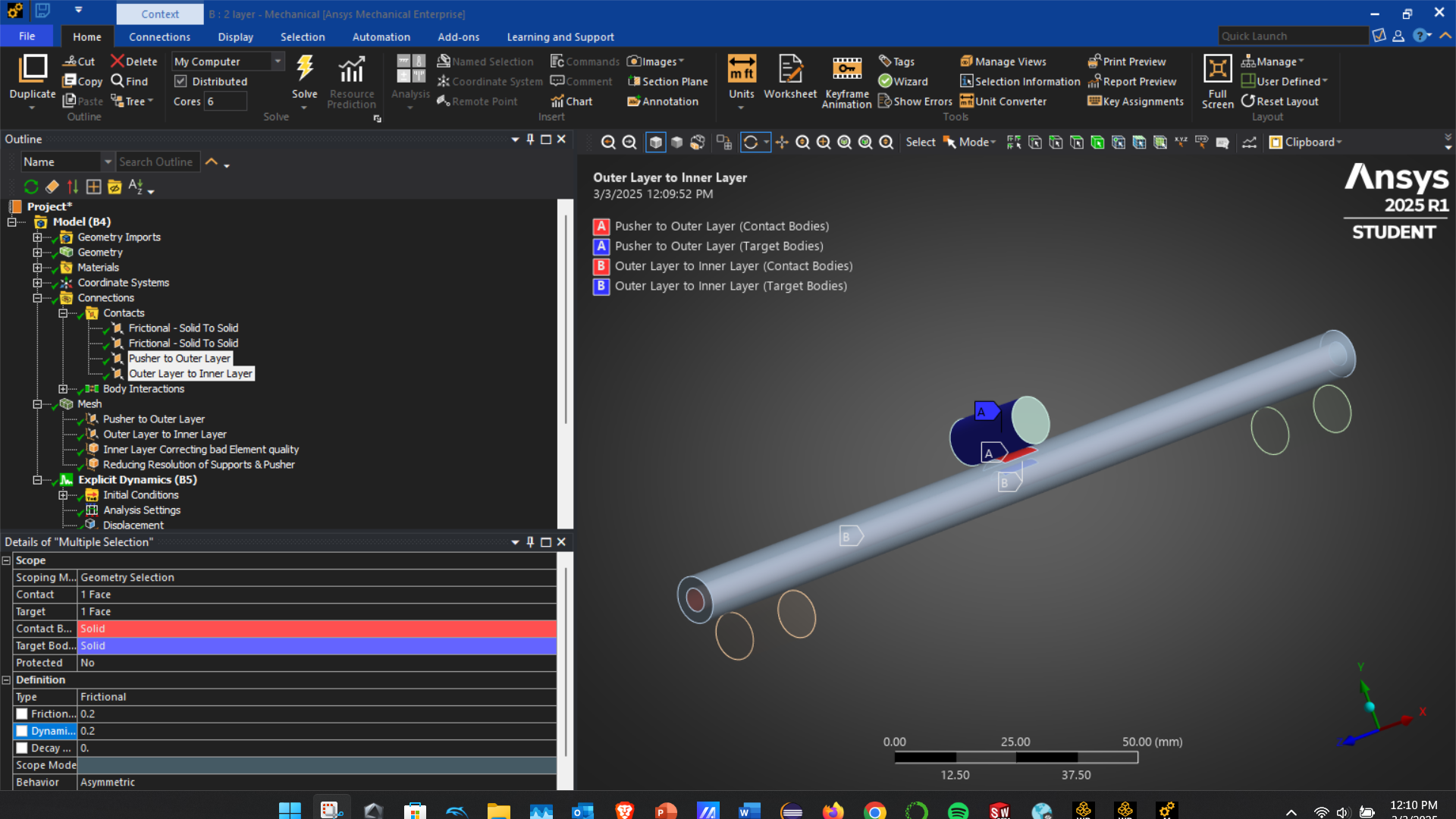
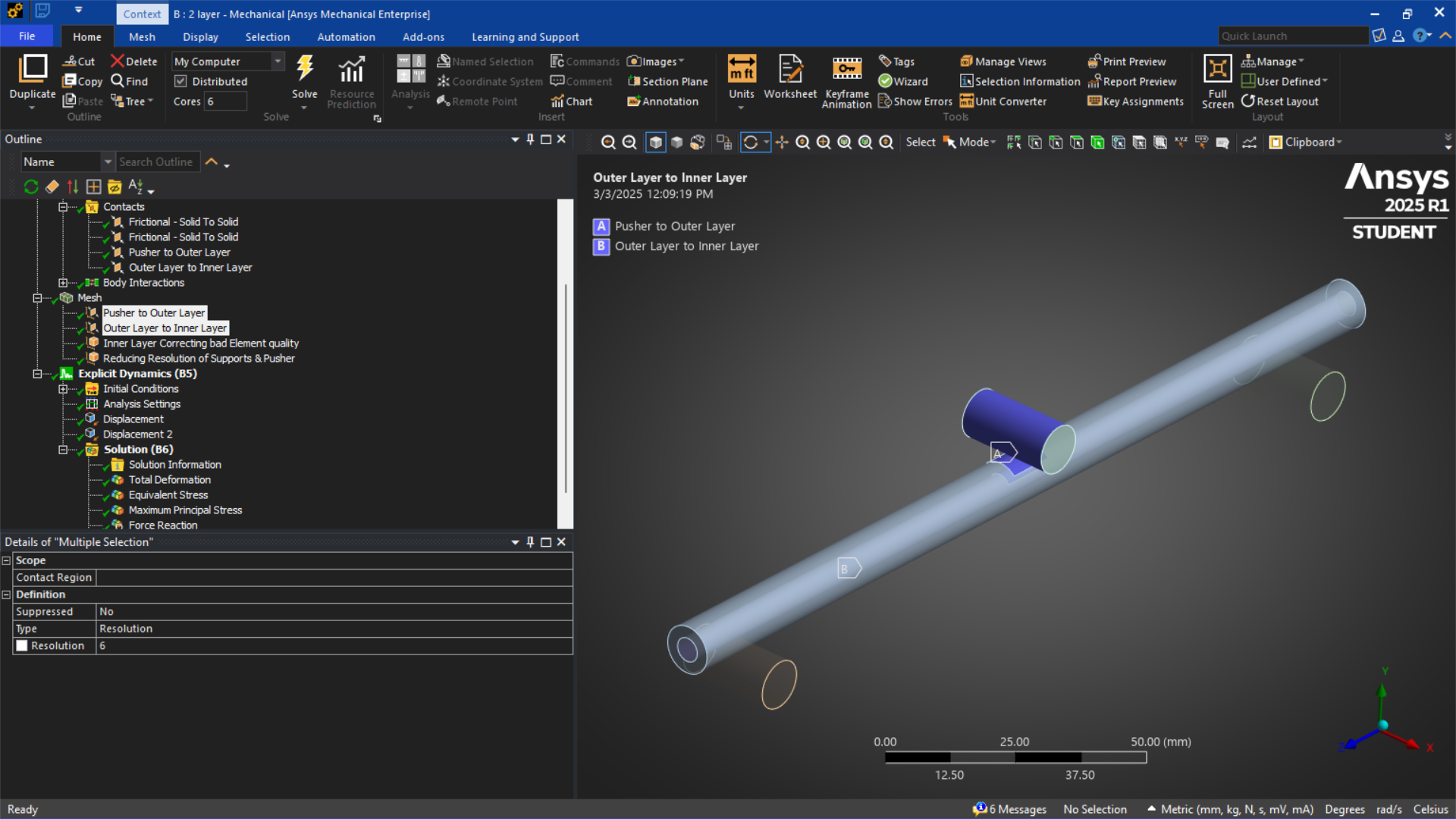
When I try to use the converge tool in the solution for my equivalent stress, it will not solve. Below I left screenshots of my contacts settings and how they are applied, as I just spent over 10+ hours running a solution for it to not even fully solve, and at this rate I spend more time waiting for my simulation to fail rather than get applicable data.Â
Â
IÂ
Â
I thought of using instead of resolution as my way of converging, but use direct optimization using the parameters of my element size up to 3mm and my solution values of equivalent stress, max principal stress, and total deformation, however I am not sure if that will actually give a proper convergence that I actually need.
Â
Â
-
March 3, 2025 at 6:11 pm
Armin
Ansys EmployeeHello,
I have a few suggestions for your model:
- In explicit dynamics analysis, the step size is determined by the smallest element in the model. Therefore, it is generally recommended to use a uniform mesh as much as possible. You can try using a coarser mesh in the tube (which will run faster) and then refine the mesh as necessary. If you still need to use a very fine mesh, consider looking up "mass scaling," a numerical technique that can reduce run time but must be used cautiously.
- For explicit dynamics analysis, it is recommended to use hexahedral mesh instead of tetrahedral mesh whenever possible to reduce the computational time.
- If you're interest, the following video provides more information on the topics discussed above: Time Step in Explicit Dynamics - Lesson 2
-
March 3, 2025 at 6:50 pm
jadenlongdon
SubscriberWould my end time be my critical time as the video mentioned I should calculate, or maximum time step?
-
March 3, 2025 at 9:57 pm
Armin
Ansys EmployeeThe critical time step size is determined primarily by the mesh size and the wave speed (dependent on the material properties like density and Young's modulus). This is often described by the Courant-Friedrichs-Lewy (CFL) condition discussed in the video. Note that this is the time step size used by solver to solve the analysis and is different than the End Time that you provide to indicate the end time of your analysis.
-
-
- You must be logged in to reply to this topic.
-
6369
-
1906
-
1457
-
1308
-
1022
© 2026 Copyright ANSYS, Inc. All rights reserved.