-
-
February 27, 2020 at 5:02 am
user deleted
SubscriberHi,Â
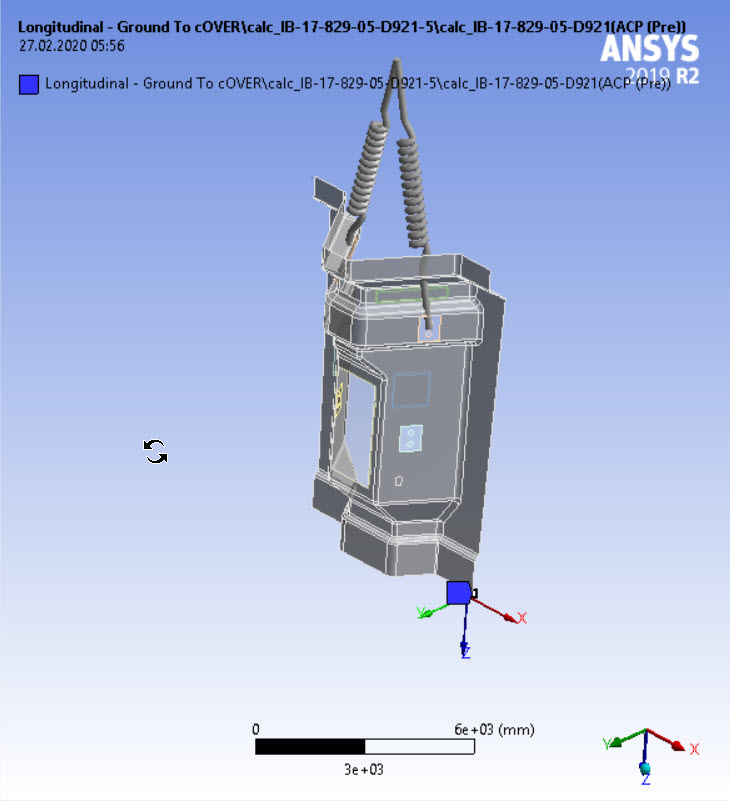
already long time I am trying to solve problem of 2 point lift analysis of GRP cover.
It is very difficult to settle down in my head 3 things.
1. When we choose position of the lifting point, position of the upper point (master link/tochka podvesa) what is the rule for that? Should they be all in one line/aligned? I am always struggling to find correct upper point, find COG in the model. Could please someone give me a good tips how to arrange it?
2. I use springs for stabilization of the model. 33000N/m for the modeling of the slings and 100N/m for additional springs that are used to stabilize model. Could you please advise why do I choose this stiffness of the springs? I just copy past it but dont understand the mechanism, can it be comparable with stiffness of metal springs or stiffness of rope, just want to understand why should I use those values.
3. Could somebody please explain what is the difference between structural analysis and transient analysis? What should I assign in transient analysis to run if faster (weak spring off,non linear off - for example). I want to understand the mechanism once again.
Thank you in advance
Â
-
February 27, 2020 at 10:43 am
peteroznewman
Subscriber1) The CG of the part and the two lifting points on the part define a plane. The skyhook point must be in that plane and above and between the two lifting points to have a static equilibrium while hanging. The higher the skyhook is above the lifting points, the lower the tension in the lifting springs.
2) The lifting springs can have the same stiffness as the rope/strap/cable/chain used to lift it. You can turn on Weak Springs in the Analysis settings and let the solver automatically add "stabilizing" springs so you don't have to do that manually. With a single skyhook, the model is singular since the body is free to spin around that point with zero resistance. That is why you need weak springs, to make the model nonsingular so the matrix has a solution.
3) Structural means deformation of solids (as opposed to Thermal). Structural can be Static or Transient. The solver can use simpler equations and get a solution in less time if it can assume small deflections and rotations. That is called a linear model. If the deformations or rotations are not small, then Large Deflection should be turned on and the solver will use more complicated equations and will need to iterate to find the solution, which will take more time. That is called a nonlinear model.
-
- The topic ‘2 point lift analysis and transient analysis, stiffness of slings’ is closed to new replies.
-
6344
-
1906
-
1457
-
1308
-
1022
© 2026 Copyright ANSYS, Inc. All rights reserved.