Electronics

Electronics

Topics related to HFSS, Maxwell, SIwave, Icepak, Electronics Enterprise and more.

Transient analysis of Induction motor

    • Sadegh
      Subscriber

      • Hi there 

        I have designed a 2d induction motor and I want to obtain some transient characteristics of that.

      • I chose the transient solution and defined windings and applied their corresponding voltages. I have also defined a band which covers the rotor for rotational movement. Now I want to plot (for example) torque-speed curve. and I don't know how to do it in Maxwell.


      • I would appreciate it if anyone could help me.

    • ranjanpal999
      Subscriber

      Hi,


      You can follow below steps


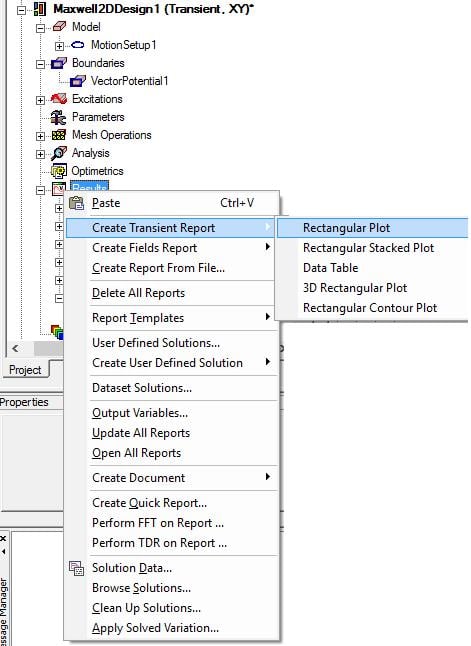
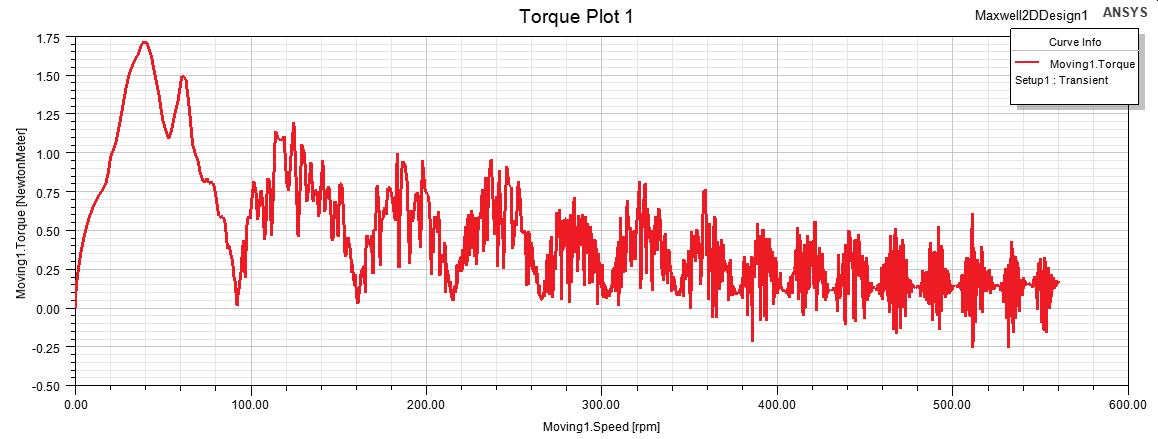
      menu Maxwell2DDesign > Results > Rectangular Plot, as shown in below figure


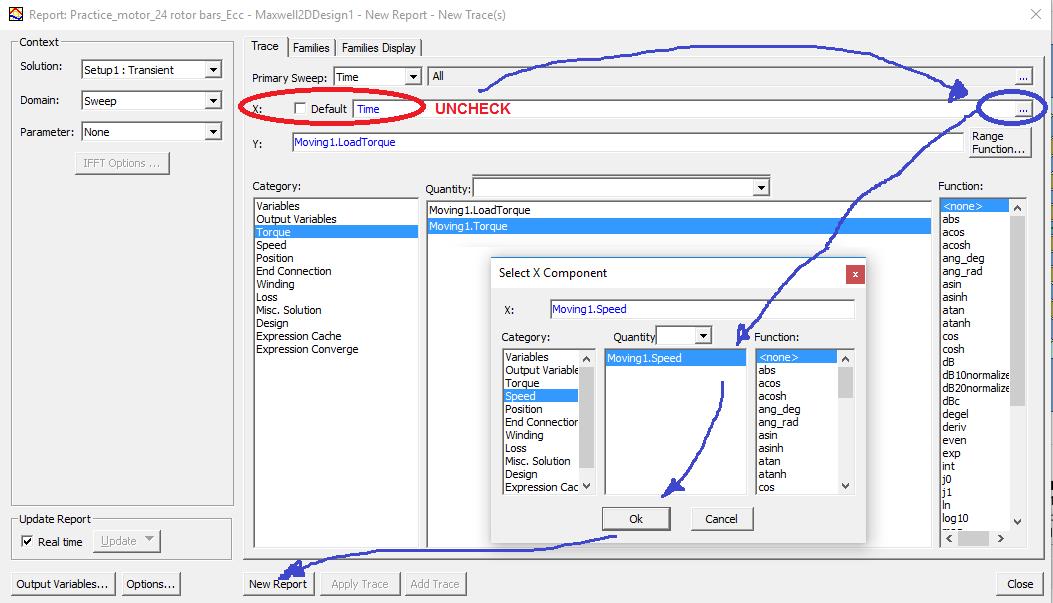
      and then choose the 'speed' option instead of 'time' as shown below


      Hope that this works!

    • Sadegh
      Subscriber

      thank you for your reply.


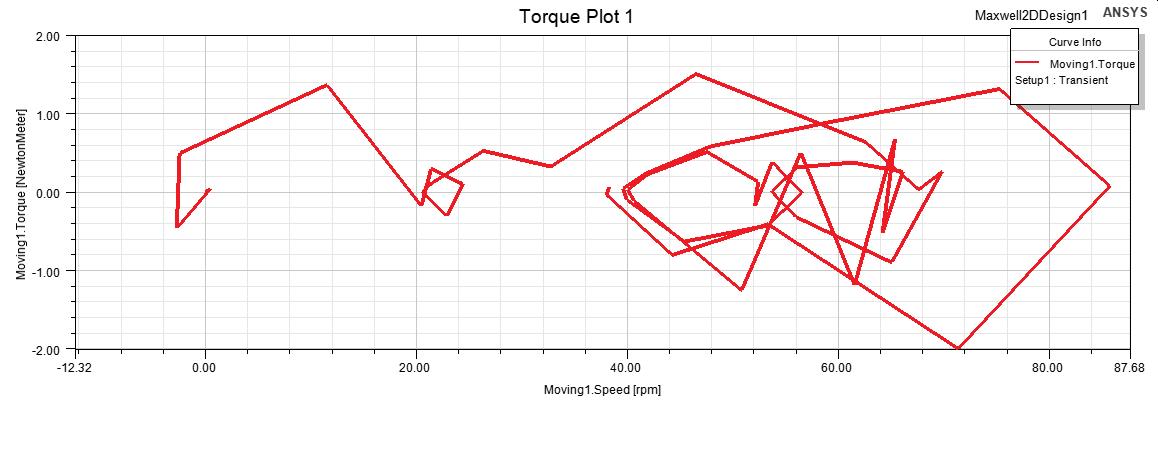
      I ran the simulation but the results don't seem to be correct. the geometry is surly right and I applied a 3 phase voltage to windings (Va= Vm cos(wt) , Vb=Vm cos(wt- (2pi/3)) ,  Vc=Vm cos(wt+ (2pi/3))) 

    • ranjanpal999
      Subscriber


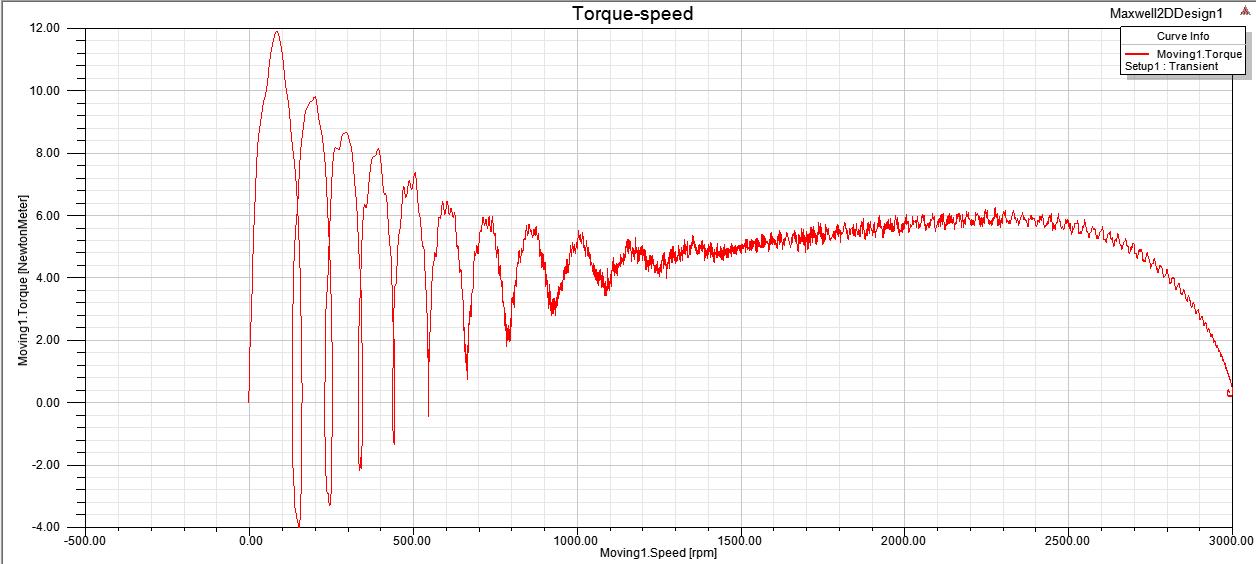
      The graph should be something of this sort.


       Perhaps in your case some input parameter must have gone wrong.


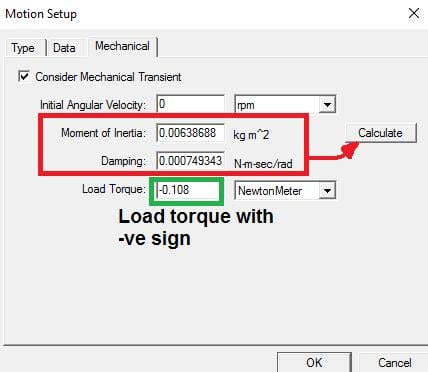
      Check the motion setup settings as such:


      Also try to reduce the time step of simulation to may be around 0.0002s

    • Bharathi123
      Subscriber

      I designed the Flux reversal machine in 2D, I got magnetostatic results at no load and me unable to get flux linkages, inductance values, and transient analysis got an error as  3dts error the machine termination.  How I solve the error, Sir. Please help me

    • Sadegh
      Subscriber

      With Vm=220sqrt(2), I applied a voltage Va=Vm cos(wt) to first winding and Vb,Vc to the two other windings and I got the following result.


      I still don't know how does Maxwell apply voltages to windings!! I wonder if it applies to the whole winding or it applies to each coil separately? Should we divide the applied voltage by the number of coil or not?

    • Sadegh
      Subscriber

      Hi 
       if you are using magnetostatic analysis, in order to get flux linkage you should use built-in calculator. let's suppose you want to calculate flux linkage between slot 1 and slot 2 here are the steps :


      0:Find all the Az(magnetic vector potential) on slot 1 and and slot 2.
      1: Sum all the Az on slot 1 and slot 2
      2: Multiply the result of first step by stack length(L).
      3: Divide the result of second step by area of slot.

      you can generalize this method for all kind of winding


    • ranjanpal999
      Subscriber

      Hi Sadegh


      Once you prepare the RMXpert model by putting the voltage values and convert that to MAXWELL2D, the voltages as per the cosine function are automatically set for the PHASES.


      We need not do anything else.

    • Sadegh
      Subscriber
      #Ranjanpal999
      Do you know how does Maxwell apply voltages to windings?
      For example, Va=Vm cos(wt)
      And we have a phase winding consists of 12 coils and these coils are series.
      Now at the winding properties in Maxwell, I choose voltage for excitation but I don't if I should apply (Va) or I should apply (Va/12) or something else.

      Please kindly help me out.
    • ranjanpal999
      Subscriber

      For the time being I am not aware of this.


      Perhaps I will try to  figure out and let you know.

    • Sadegh
      Subscriber
      Ranjanpal999
      I found it. There is no need to divide the voltage by number of coils.
      You simply apply the desire voltage with corresponding inductance and resistance to a winding.
      And I think if we use symmetry for a machine, we should consider it for resistance and inductance.
Viewing 10 reply threads
  • The topic ‘Transient analysis of Induction motor’ is closed to new replies.