Ansys Assistant will be unavailable on the Learning Forum starting January 30. An upgraded version is coming soon. We apologize for any inconvenience and appreciate your patience. Stay tuned for updates.
Preprocessing

Preprocessing

Topics related to geometry, meshing, and CAD.

How to work with high skewness when adding ground inflation

    • pvenkatesh
      Subscriber

      Is it acceptable to create meshes with high skewness around areas of inflation? If so, would it affect whether the solution with converge or not?


      I'm currently simulating an FSAE car, and I've added 10 layer of inflation to the car walls and the ground, which results in a good chuck of cells being highly skewed (around 3 million cells). 


      Here is the geometry for the simulation:
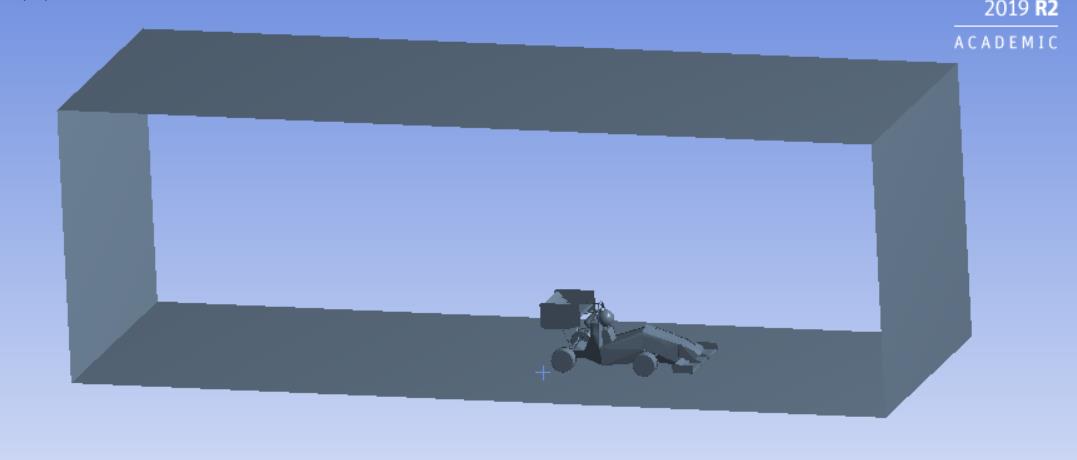

      Simulation geometry


      And here are my inflation parameters, quality, and mesh metrics. The first layer thickness was determined using a y+ calculator with a reference length of 2.5 meters.
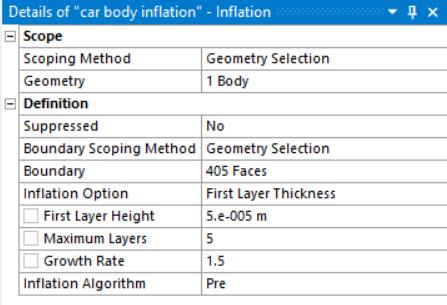
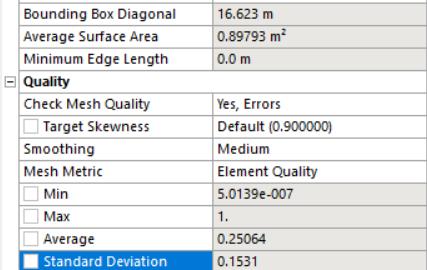
      Car Body Inflation   


      Mesh quality


      For the inflation, the scope is the entire domain, and the boundaries are the car walls. The same parameters apply for the ground walls. The growth rate is set to 1.5 to reduce skewness for higher levels of inflation layers.


      1) The ANSYS manual mentions that the max skewness should not exceed 0.99, but a lot of my elements have a skewness close to 0.99. (And the maxiumum is 1, but I'll have to take a look at the geometry for that.) Will the skewness in inflation significantly affect the time it takes for the solution to converge? Are there any ways to improve mesh quality other than reducing face sizing? 


      2) Would the solution be accurate if I only included inflation in some parts of the ground? (maybe a small patch under the car)




    • Rob
      Forum Moderator

      If you click on the worst bar in the graph you'll be able to see where the poor cells are. You can then see why they're bad and revise the mesh (or geometry) to resolve this. This could mean adjusting surface sizing or altering geometry (removing sliver faces for example).


      In terms of skew, the worse it is the more likely you'll have problems converging the solution and in getting the right answer.  Y+ is a measure of the near wall cell height and is used for checking/setting up wall functions. You also need a good volume mesh to capture wake & wake interaction regions. I see far too many "good y+ meshes" which are rubbish as the volume mesh is poorly resolved for the flow. 

    • blackbaddl
      Subscriber

      What does your tire-street contact look like? Sharp contacts in this area can cause a lot of trouble. Try it like this (if this not already the case)


    • Rob
      Forum Moderator

      Pretty much, you're aiming to smooth corners and help the mesh fit in/around the geometry. 


      In the above look at how the wheel touches the ground: will a simple block give a better mesh than the approach you've used? 

    • vganore
      Ansys Employee

      Please see this tutorial as well showing fluent meshing for FSAE cars. We have made a complete series on external aerodynamics.  


      https://youtu.be/YSDH0YNfP9o?t=14

Viewing 4 reply threads
  • The topic ‘How to work with high skewness when adding ground inflation’ is closed to new replies.
[bingo_chatbox]







