-
-
January 13, 2020 at 8:57 am
mikel
SubscriberHow is posible to créate a mixture of water + disolved oxygen? When I open the mixture panel to specify the properties of the mixture, fluent treats it as a gas mixture.
-
January 13, 2020 at 10:28 am
Rob
Forum ModeratorFluent treats it as a mixture: what you set determines whether it's more like a liquid or gas.Â
-
January 13, 2020 at 10:32 am
mikel
SubscriberHi again, I want to créate a mixture of wáter and disolved oxygen. For that I créate a mixture with species transport and wáter (liquid) and oxygen (gas) species. Is this correct to define wáter with disolved oxygen? Because then the density values are not logical.
Thanks
-
January 13, 2020 at 10:40 am
mikel
SubscriberI want to see the change of disolved oxygen in wáter depending on temperature (henrys law). For that I define a ulerian multiphase model with species transport primary phase (wáter+oxygen) and secondary phase (only oxygen). Then I active species mass transfer from h2o (liquid) to oxygen (secondary phase) taking into account the henrys law. Is this correct?
Thanks
-
January 14, 2020 at 6:17 am
DrAmine
Ansys EmployeeThe mixture creation is correct that is however your turn to provide the right mixing law.
The second point sounds ok. In older version Fluent required that both phases should be mixture phases so that I used to create a second dummy oxygen for gaseous phase check docu if this is still required. -
January 14, 2020 at 6:18 am
DrAmine
Ansys EmployeeEdit: moving to Fluids. -
January 14, 2020 at 7:49 am
mikel
SubscriberHi again and thanks for your advice, I Will explain you wich is my model and the daughts that I have:
I want to see the change of disolved oxygen depending on temperatura (henrys law). For that I créate an EE model with species transport and I define my primary phae (wáter+oxygen) and secondary phase (only oxygen). Then I actÃvate species mass transfer from H2O to oxygen and I apply a tempertature difference but something doesnt work well. When I didnt put I temperatura difference nothing happens so this is correct and when I put a temperatura difference fluent start calculating the volumen fraction of oxygen but the residuals are very strange...
1-When I actÃvate species mass transfer with henrys law I didnt change anything in the species mass transfer model only I actÃvate henrys law, is this correct?
2-When I define my materials I put volumen-weighted-mixing-law density in the mixtures and then I put that the density of the species change depending on temperature. I didnt change the other properties of the materials. With only the density is enough?
3-When I initialize, I define the quantity of the disolved oxygen that is in the primary phase and I put that the secondary phase volumen fraction is 0 because in the starting point I dont have bubbles and then when there is a temperature difference start this creation of bubbles. Is this initialization correct?
Thanks

-
January 14, 2020 at 8:01 am
mikel
SubscriberHi again, and what do you mean with Edit; moving to fluids?
Thanks
-
January 14, 2020 at 10:29 am
DrAmine
Ansys EmployeeI moved the topic to the Fluids Category which is subgroup of the group Physics Simulation.
-
January 14, 2020 at 10:43 am
DrAmine
Ansys Employee1/You require some input to have an interfacial area different from zero: either you use a small value for gas or look in the command search after area-density under heat-mass-transfer menu
2/can be enough at first
Again Fluent highlight that it require a gaseous mixture made of at least two components.
You can still use an UDF to overcome any limitations.
-
January 14, 2020 at 11:26 am
mikel
SubscriberHi and thanks for your response but I dont understand very well your 1) response.
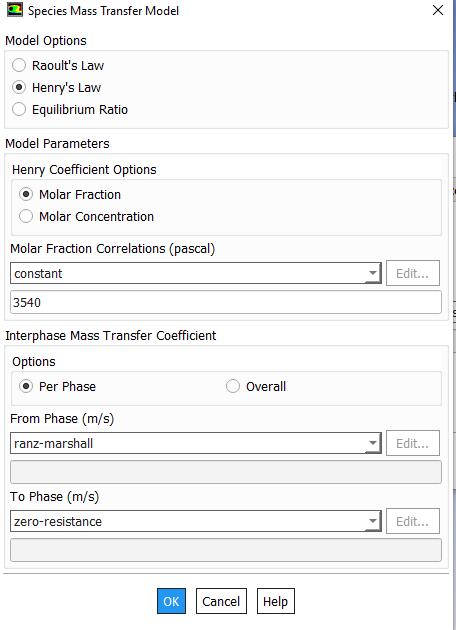
In my phase interaction between two phases (wáter+oxygen) and (only oxygen) I define three things. The Surface tensión depending on the temperatura, the interfacial-área (ia-gradient) and species mass transfer from liquid to gas phase like you can see in the image. The definition of the species mass transfer is correct to see the change of disolved oxygen in wáter?
-
January 14, 2020 at 11:38 am
DrAmine
Ansys EmployeeIf you start from only liquid (gas volume fraction) interfacial area is zero and mass transfer is zero. For that reason you need to provide some nucleation. Look after the command I mentioned.
Again: please look into the Fluent documentation regarding species mass transfer: you require for gas two components, otherwise you require an UDF. Just create oxygen + oxygen_copy as components of the gaseous phase.
-
January 14, 2020 at 11:55 am
mikel
SubscriberHi again, I have created the gaseous mixture with (oxygen + oxygen_copy) but i have some questions:
1-The picture that I post with species mass transfer model is correct? or I have to define something more inside?
2-In my initialization I have my primary phase wáter+disolved oxygen (a small porcentaje) and then the volumen fraction of the secondary phase is 0 because in the starting point the disolved oxygen in wáter doesnt change. Is this correct?
3-Also I dont know if I need something more to modelate whatever I want. I dont understand where I have to add some input to dont have interfacial are zero. Maybe you want to say in the initialization part but I did that.
Thanks
Â
-
January 14, 2020 at 1:17 pm
DrAmine
Ansys Employee1/ok
2/you need seeding otherwise no mass transfer: again look after the command I shared or initialize with small amount of gas
3/if interfacial area is zero then the mass transferred is zero: take some minutes to read the documentation.
-
January 14, 2020 at 1:32 pm
mikel
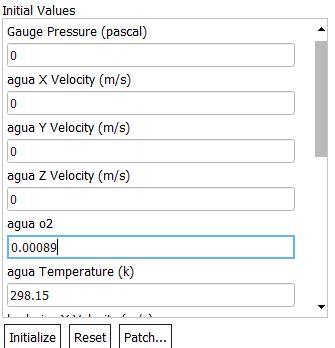
SubscriberHi again, in my initialization I put the primary phase (imagine wáter 0.9 and disolved oxygen 0.1) and then the volumen fraction of the secondary phase that is only oxygen 0. I am puting the disolved oxygen mass fraction in the primary phase to have wáter+disolved oxygen.
Why is not correct to put the value 0 in the secondary phase volumen fraction?
thanks
-
January 14, 2020 at 1:59 pm
mikel
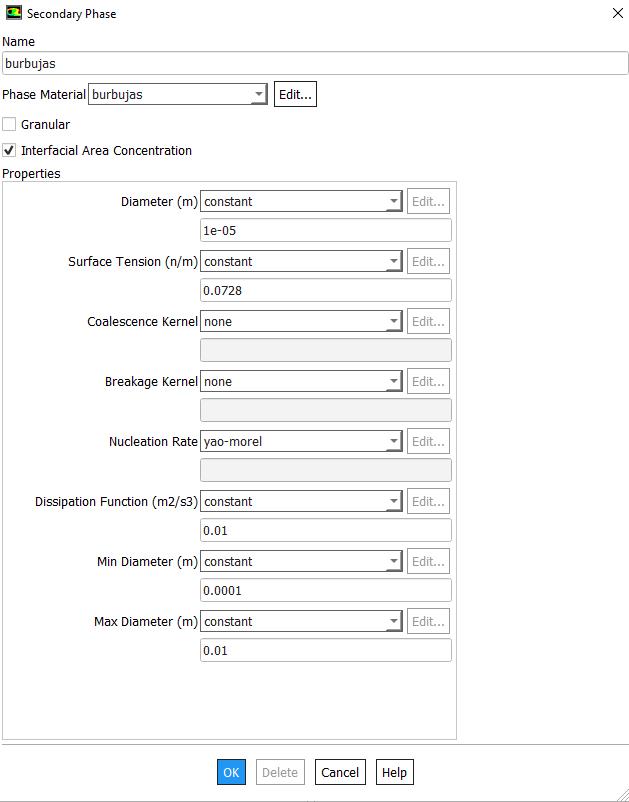
SubscriberHi again, this is my secondary phase interfacial área modelation but i dont know if it is correct...

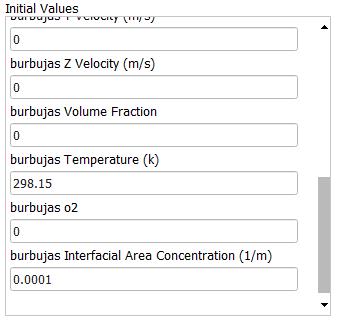
Also, I have some daughts about how to initialize my model as I asked you in the last post, this are the values that I put (mass fraction of disolved oxygen in wáter, volumen fraction of gaseous mixture = 0 and default interfacial área concentration
Thanks
-
January 14, 2020 at 3:22 pm
mikel
SubscriberHi again, with interfacial área do you mean the volumen fraction of the secondary phase?
-
January 14, 2020 at 3:36 pm
DrAmine
Ansys EmployeeHi Mikel: you should be patient. We are not always looking to any updates regarding any questions.
Why using Interfacial Area Transport Model: just start with simple constant diameter for sanity check.
For seeding: AGAIN look after the command I shared. Provide mass fraction equal to 1 to the dummy oxygen gas.
-
January 14, 2020 at 4:14 pm
mikel
SubscriberHi again, sorry but I dont understand you very well.
In my case, I have primary phase (wáter+oxygen) and secondary phase (oxygen+dummy oxygen). I have daughts to initialize the problem;
1-I put mass transfer from wáter to oxygen. I think that this is correct or I have tio put from wáter to dummy oxygen?
2-When I initialize I put my primary phase like wáter + disolved oxygen (for example mas fraction of wáter 0.9 and oxygen 0.1) and I think that this is correct.
3-Then when I initialize I have to put the mass fraction of dummy oxygen in my secondary phase and the volumen fraction of this secondary phase. I dont understand very well the meaning of that. How I have to put this. I was thinking to 1 in the mass fraction of dummy oxygen and 0 in the volumen fraction of my secondary phase but I dont know if this is correct. Can you help me with that please.Â
Also where I can find the coomand that you are saying because I cant find.
Thanks for all
-
January 14, 2020 at 5:44 pm
DrAmine
Ansys Employee1/right
2/yes. You still require some seeding to avoid zero area density or using area density transport with non zero minimum (not tested in this constellation) and bust complicated for the beginning
3/dummy oxygen mass fraction to be one -
January 14, 2020 at 5:57 pm
mikel
SubscriberThanks for your help, in summary I have to define the quantity of disolved oxygen in my primary phase and then put that my secondary phase all is dummy (mass fraction 1) but I have one question:
Is 0 the value of the volumen fraction of my secondary phase when I initialize the model? I think that yes but I am not sure.
Thanks
-
January 15, 2020 at 8:21 am
mikel
SubscriberHi again, I read in some fórums that the species mass transfer is from the disolved oxygen to the gaseous phase of oxygen, is this correct? or the species mass transfer is from H2O(l) to the oxygen gaseous phase?
Thanks
-
January 15, 2020 at 5:40 pm
DrAmine
Ansys EmployeeDissolved to gaseous oxgen -
January 15, 2020 at 5:57 pm
mikel
SubscriberHi again, I have I daught about my initialization:
I have to put the disolved oxygen mass fraction in wáter (primary phase) and also the mass fraction of dummy oxygen of my secondary phase that is 1.
But is 0 the value of the volumen fraction of my secondary phase (gaseous phase) when I initialize the model? I think that yes but I am not sure.
Thanks for your help.
-
January 17, 2020 at 6:20 am
DrAmine
Ansys EmployeeAs I said from the beginning you require a small volume fraction to trigger mass transfer or use the text command I mentioned or write your own UDF
My last comment here good luck.
-
- The topic ‘dissolved oxygen in water’ is closed to new replies.
-
5669
-
1890
-
1419
-
1304
-
1021
© 2026 Copyright ANSYS, Inc. All rights reserved.