-
-
October 26, 2019 at 3:52 am
hassanjafari6
SubscriberHi there,
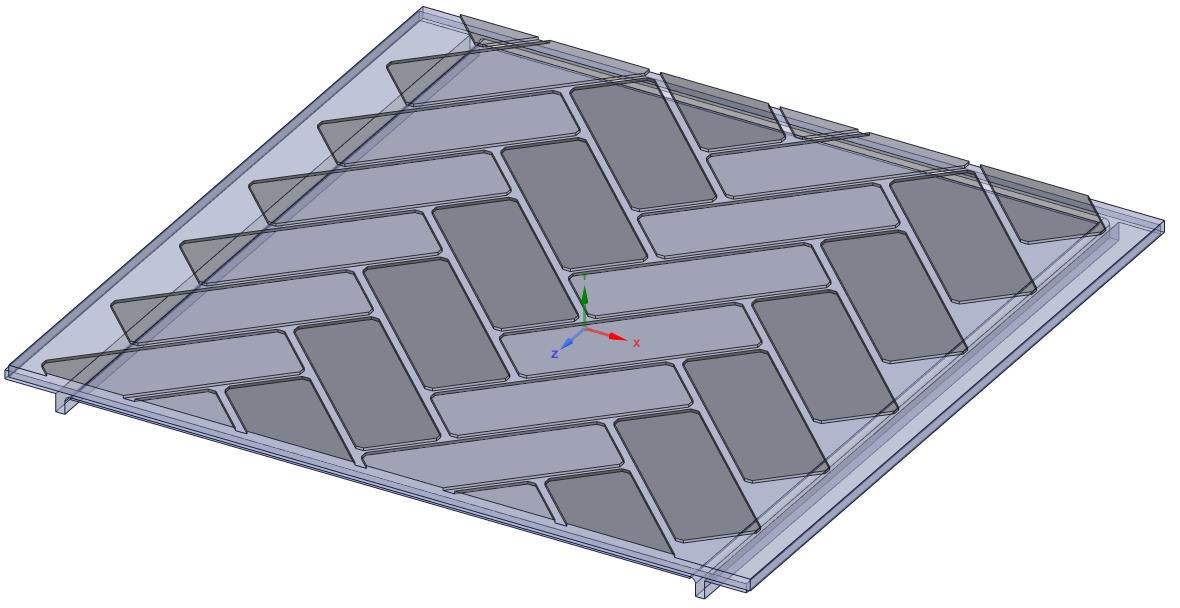
I'm going to simulate a tile that is made by gray cast iron. There is a heating mat behind this tile, actually the heating mat consist of a wire that is covered by two aluminum covers. But I simplified it and just putted a layer of aluminum exactly behind the tile. The point is that, I know the generated heat by the wire is 150 W/m2 according to the catalog. The environment's temperature is -15 and consequently the initial temperature of both bodies are -15, I need to know after 1 hour of heating what will happened for both bodies? Will the tile be heated enough or not, I need to figure out the temperature changes and finally make a decision that is this heating mat fair enough for my work or I have to choose another one. I have no Idea about heat convection, radiation on these material.
I would be happy if you guys help me.
You can see my file in(IGS) the attachment.
-
October 26, 2019 at 4:12 pm
peteroznewman
SubscriberWhat CAD system created this geometry?
Don't use IGES to move solid geometry between systems, it is much worse than STEP or Parasolid. The IGES file came in as 264 surfaces and no solids.
You must make an assumption about heat convection to build a model of just the solids. You can make two models, one with a very low and one with a very high value for heat convection.
If you don't want to make an assumption about heat convection, then you have to include the air around the tile and let FLUENT compute the air flow convecting heat away from the tile. Is there an unlimited supply of air at -15 C? Is there a forced air flow or is it stagnant air?
You don't say what the final value of tile temperature is.
What version of ANSYS are you using? Are you on an unlimited license or the limited Student license?
-
October 31, 2019 at 8:28 pm
hassanjafari6
SubscriberDear peteroznewman,
Thanks for your response and sorry for my delay.
I've attached a simplified file again. The total heat convection that I assumed is 26.97 W/m2.
In this file the materials are copper for heating cable, aluminum for wire's cover and cast iron that is located at top of the aluminum cover.
The manufacture of the heating cable told me that it's power is 240 W/m2, and after 2 minutes it reaches to 65 degree and will be constant in environment's temp (22 degree).
But for my conditions, the initial temp for environment and all parts is -15 degree.
I need to know when the top layer of the cast iron will reach to 5 degree.
I'm using SOLIDWORKS for CAD
If you need more information that I have missed please let me know.
All the best
-
November 1, 2019 at 12:28 am
peteroznewman
SubscriberI see you have three solids, the bottom pad of aluminum, a sweep that represents the wire, and the top pad that would be cast iron. However, the aluminum body interferes with the wire, so were you planning on not using the wire? The bottom pad has a thin fin protruding from two edges. Get rid of that fin.
In your first post, you said the heating pad has a power of 150 W/m2 according to the catalog, but you in your second post you say 240 W/m2, so which is it?
Does the heating pad include a controller to maintain a set temperature? That would be difficult to add to the model for a beginner. The temperature vs time is what the model will calculate. You can see what the temperature is after 2 minutes.
The wire might dissipate some number of Watts per meter of length of the wire. Is that a value the manufacturer provides? In that case, you need to keep the sweep solid and subtract a cavity in the bottom pad to hold the wire.
Is the manufacturer assembling the pad and then quoting Watts per square meter of area of the pad. Then you don't need the sweep. It's not clear from your description. Maybe you can include a link to the manufacturer's website.
In your reply, create a Transient Thermal model and see what you get.

-
November 1, 2019 at 8:36 am
hassanjafari6
SubscriberHonestly, there is two kinds of heating system, one of them is heating cable that not included of aluminum cover and the second one is heating mat (A cable covered by aluminum cover). You are right, at the first post I mentioned 150 W/m2, but now I'm using another one. But the point is that the supplier gave me some info about the second heating cable, I have added a aluminum cover by myself. That's why I'm gonna use wire as a separate part.
I have checked with company again and they told me that the temp will be fixed when it reached to 65 degree. The total length of wire for 1 square meter is 11.1 meter that the power is 240 W for that. There is no info about dissipating power of wire.
As I mentioned the manufacturer is giving me this wire without cover, Im going to add just a simple cover to this wire in order to reach to a uniform output temp to heat up the top cast Iron.
I have created a transient thermal model, but I'm not sure how should give power to wire? Should I use 240 W/m2? or any other thing.?
-
November 1, 2019 at 9:48 am
peteroznewman
SubscriberThe heating wire has a flat face where it touches the aluminum pad. Imprint that face onto the outside of the aluminum pad and suppress the wire, you won't need that in the model. Now you will have a face that has the S bend sweep of the heating wire. Since the wire has a temperature controller, assign that face a temperature of 65 degrees. You will have to ignore the small error of the 2 minute heating up time. Assign an initial temperature of -15 degrees to all the bodies. Assign the convection condition to the top surface of the cast iron and solve.
-
November 1, 2019 at 10:15 am
hassanjafari6
SubscriberAt what time should I mention that the face has 65 degree? from the start point? or in 2 minutes?
Because at the start point the temp for all bodies is -15 degree. it will take some times to reach to 65 degree.
What should I do?
-
November 1, 2019 at 10:33 pm
peteroznewman
SubscriberSimulations always begin at t=0.
You could break the simulation into two steps. Step 1 could end at 120 seconds and the temperature can ramp from -15 to 65 degrees, then Step 2 could end at 3600 seconds (1 hour) and the temperature could be fixed at 65 degrees during step 2.
-
November 2, 2019 at 2:25 pm
hassanjafari6
SubscriberThank you so much for your guideline, I will perform what you mentioned and evaluate the result.
All the best
-
November 8, 2019 at 9:56 am
hassanjafari6
SubscriberHi again,
I have simulated the tile according to what you said.
But, I just tested it in 120 sec to see the reaction and results in this period, not for 1 hour.
According to the heating cable manufacturer the wire can reach to 65 degree in 2 minutes. As you said, I draw the cable imprint at the bottom of the tile as is shown in attached file. Then, I gave the initial temp -15 and after 120 sec the final temp 65 degree.
The thickness of the tile is about 11.5 mm.
but the results seems to be incorrect in my idea. Because after 2 minutes the top of tile reached to 65 degree from -15, its a little insensible for me. Would you please take a look to the attached pdf file of the result and tell me is this method correct or not?
All the best
-
November 8, 2019 at 3:01 pm
peteroznewman
SubscriberCast Iron has high conductivity so it is no surprise that the 65 can make it to the other side in 2 minutes.
I need to know when the top layer of the cast iron will reach to 5 degree.
Do you mean the time when the last corner reaches 5 degrees? In your images, the corners are still at -15 degrees after 2 minutes. You could put a Temperature result on the vertex at the corner and plot that as a chart.
-
November 9, 2019 at 7:50 am
hassanjafari6
SubscriberHonestly, I need the top layer of the cast iron reaches to the 5 degree, so it seems that I have to control the temperature and turn it off and on by a thermostat.
How can I trust to this result? Should I perform a experimental test and compare them together?
At the present analysis the minimum temp at the corner is 15 degree not -15.
All the best
-
November 10, 2019 at 9:11 pm
peteroznewman
SubscriberYes, you will need a thermostat to control the temperature of the cast iron. However, the location of the thermostat is critical. It is possible to add a thermostat element into the model to turn the heat input on and off as a function of the temperature at the thermostat measurement point.
Yes, you should do an experiment and measure the temperature on the cast iron and compare it with the model. You can tune the model inputs to match the experimental result more closely.
-
- The topic ‘Transient-Thermal analysis of two connected body with two different material’ is closed to new replies.
-
6084
-
1906
-
1436
-
1308
-
1021
© 2026 Copyright ANSYS, Inc. All rights reserved.