-
-
September 24, 2019 at 1:40 pm
tanmoy
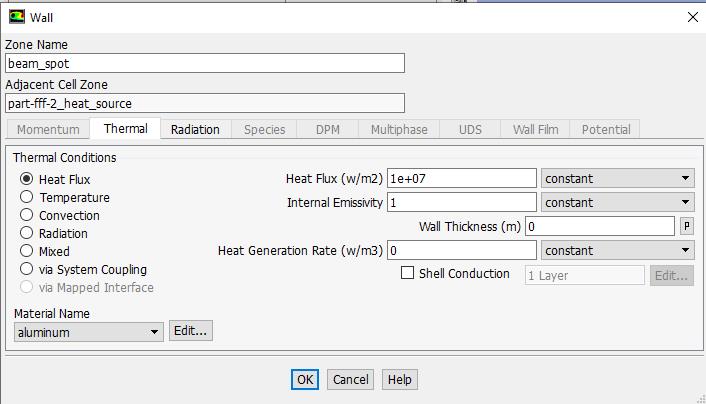
SubscriberMy geometry is inside a vacuum chamber. One of its faces has a circular area with a heat flux boundary condition. Now my question is how will I ensure that radiation heat loss is happening to the ambient. Since my geometry is in the vacuum so there is no point of convection or conduction. Now I found the initial temperature option but not ambient temperature option!
In transient heat solver, there is an explicit option for initial and ambient temp. But I am unable to find that in FLUENT.
Thanks in advance. -
September 24, 2019 at 3:02 pm
Rob
Forum ModeratorIf it's an external wall there's a "radiation" option under the thermal tab.
-
September 25, 2019 at 9:37 am
tanmoy
SubscriberThanks for replying rwoolhou. But My point is that circular area which has a Heat flux is gaining the highest temperature. I mean heat loss by radiation in that region will be greater than other region. But here in Heat flux tab only "internal emissivity" is available no "external radiation temperature" tab.
For my geometry that circular region is gaining temperature aroung 3000-4000 degC. and surrounding temperature ( temp of the vacuum chamber) will be around 20-20 degC only. I cant ignore heat loss by radiation.
-
September 25, 2019 at 10:45 am
Rob
Forum ModeratorLook in the Thermal tab.
-
September 25, 2019 at 11:02 am
-
November 4, 2019 at 8:41 am
tdsotm
SubscriberHi tanmoy,
did you manage to solve it? I came across the same problem and I'm looking for some hints.
-
November 4, 2019 at 2:45 pm
tanmoy
Subscriberhey tdsotm,
You just need to convert ur heat flux into the Heat generation rate by considering a thin layer (wall thickness). Then go to the "radiation"(inside Thermal tab) and put external temp and all with that heat generation rate with wall thickness. Remember to input wall thickness. For "zero" wall thickness heat generation will be zero.
Cheers!
-
June 4, 2020 at 5:44 pm
BeEazy
SubscriberSorry to dig up an old thread, but do you know why the ambient temperature in the vacuum is 20 C? I am not sure whether to model mine at 0 K (like space) or 20 C (like room temperature)
-
June 4, 2020 at 7:05 pm
tdsotm
SubscriberHi
you should specify temperature of the surfaces surrounding your object. If you’re simulating a spacecraft which rejects heat into space, then you should use ~3 K. But when you, for example, conduct a simulation for validation purposes, then in your model you implement a vacuum chamber in which you put the spacecraft. In this case ambient temperature depends on the temperature of the chamber’s walls, so it could be 20 C or whatever you specified in the TVAC test procedure. -
June 8, 2020 at 6:31 pm
BeEazy
SubscriberThank you!
-
- The topic ‘How to set Radiation loss to the ambient in ANSYS fluent?’ is closed to new replies.

-
6450
-
1906
-
1457
-
1308
-
1022
© 2026 Copyright ANSYS, Inc. All rights reserved.