-
-
August 31, 2019 at 4:34 am
VinayN
SubscriberNOOB ALERT !!
I have modelled retaining wall with soil all around it. I have the following issues with this model,
1) I successfully solved the model with initial angle of internal friction 42 deg and final angle of internal friction 20 deg. The same model won't solve with the values changed to 30 deg and 20 deg respectively. It says solver error couldn't converge on solution.
Initially I couldn't solve with 42 deg too but then I had to make a coarse mesh that seemed to solve the issue. Please let me know what is actual problem and also insight about step controller will helpful.
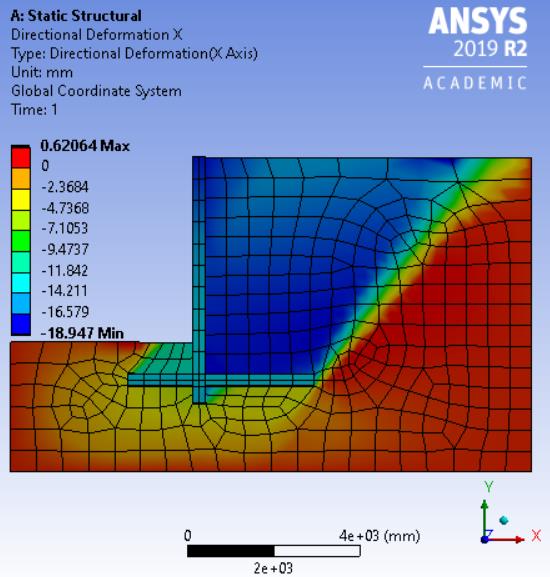
2) I changed the solver from program controlled to direct as suggested by ANSYS. initially my deflection at top of the stem was 9 mm but with direct solver it got down to 6 mm. What is happening ?
3) Can someone evaluate the attached model. It'll be really helpful.
Thank you.
Â
-
September 1, 2019 at 10:28 pm
peteroznewman
SubscriberI opened your model. Your mesh is too coarse.
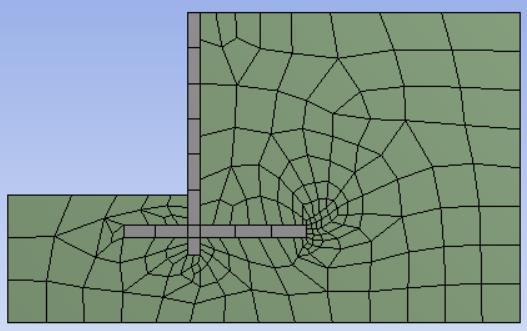
I made your mesh a bit finer, it can get much finer than this.
You could even abandon a 3D model and do a 2D model.
You used a Rough contact, I changed it to Frictional with 0.2 coefficient of friction.
The bottom and left edge of the soil is too close to the wall, make twice as long/deep.
I turned on Large Deflection.
You have to change the Analysis Settings so the Initial Substeps is 100.
But you also have to include a Command Object to use NEQIT,100
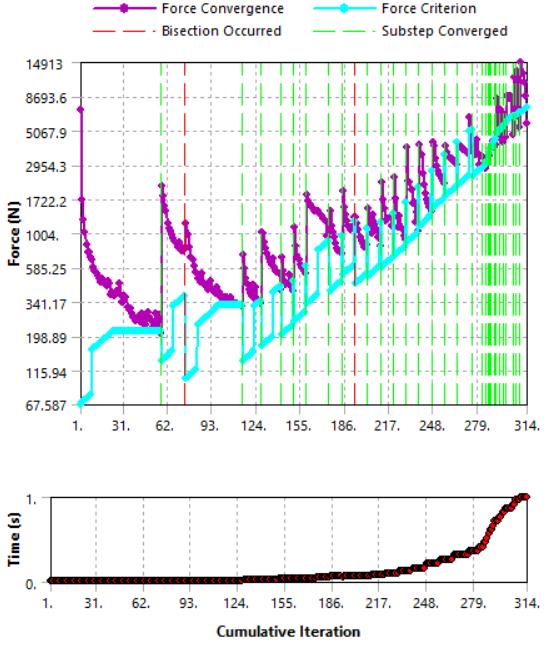
You can see the first stubstep needed 62 iterations to converge. The default setting is the solver will bisect the substep size at 26 iterations.
Attached is an ANSYS 2019 R2 archive.
-
September 2, 2019 at 2:46 am
VinayN
SubscriberThank you so much Mr.Peter !!
Just to make things more clear, could you please explain me about the following.
Â
1) Under what conditions would you choose rough over frictional ?Â
2) Could you please explain me about Sub steps , what is time stepping, NEQIT etc. Only thing is understand is if we include more sub steps we can capture more information. I can't find posts related to this at my level of understanding.
3) I understand Violet line in graph are Newton-Raphson residuals and blue line corresponds to tolerance. What about the bisections, should first convergence occur before first bisection ?
Â
Regards
VinayN
-
September 2, 2019 at 3:44 am
peteroznewman
Subscriber1) Rough means when two bodies are in contact, they will not slide relative to each other. Frictional means they can slide relative to each other. Just decide if sliding is an important part of the model.
2) When the solver is given a load to solve for, it may fail to solve if it uses the full load. Substeps divide the load down to a smaller value that makes it more likely that the solver will be able to converge on that smaller load. When it does, the next increment of the full load can be applied and the solver works on that load. This continues until the full load is reached.
3) The solver performs iterations during a nonlinear solve. The solution logic is set up to do 26 iterations before cutting the load in half, which is called a bisection, and trying again. But if you look at the trend in the convergence plot, you might see that if it just keeps iterating, the solution will converge. NEQIT is the command to override the default of 26 iterations.

Â
-
September 3, 2019 at 5:07 am
-
September 4, 2019 at 4:26 pm
peteroznewman
SubscriberThe first configuration is required to take exactly 100 substeps. If it finds a difficult part, it can't use more substeps to get past the difficulty.
The second configuration is more likely to converge and might complete in fewer iterations than 100 substeps.
-
- The topic ‘Post processing analysis of retaining wall’ is closed to new replies.
-
6379
-
1906
-
1457
-
1308
-
1022
© 2026 Copyright ANSYS, Inc. All rights reserved.