-
-
August 12, 2019 at 12:14 pm
Rozpruwacz10000
SubscriberHello,
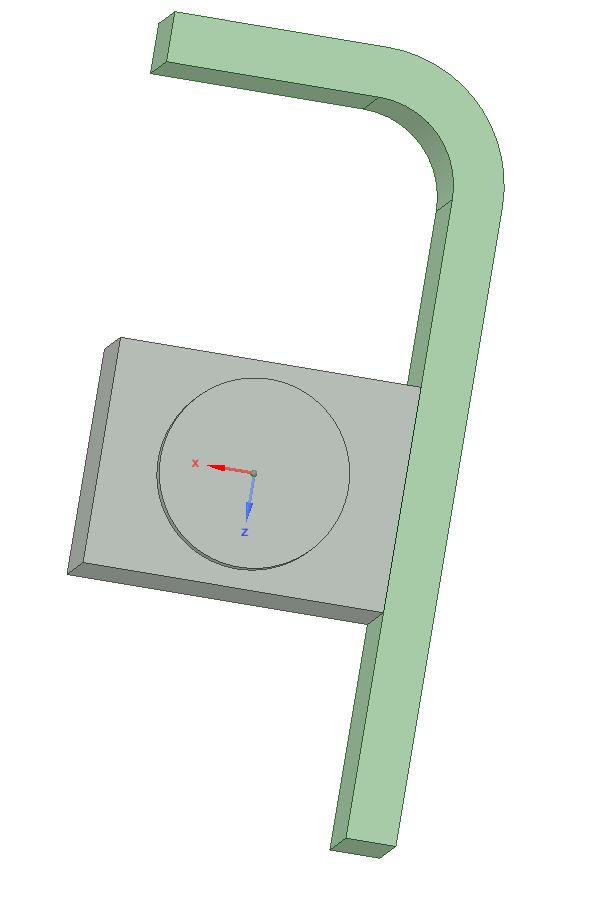
I'm looking for a way to simulate cooling process of a circuit breaker. I'm troubled by contact resistance heat generation. I have two parts of electrical elements carrying current that are in contact. There is heat generation in each element, due to a current flow and I know how to eneable it in fluent. I don't know however how to enable some kind of 'surface generation' on the contact, to simulate heat generation by contact resistance.
I would much apreciate your help.
-
August 12, 2019 at 2:57 pm
Amine Ben Hadj Ali
Ansys EmployeeCan you add a sketch of your problem?
-
August 12, 2019 at 3:51 pm
-
August 13, 2019 at 5:10 am
Amine Ben Hadj Ali
Ansys EmployeeYou can assume a thickness to the wall separating the two bodies and here a resistance in normal direction will be modeled or you use shell on that wall or resolve that wall as a solid and assign proper solid material properties. -
August 13, 2019 at 9:09 am
Rozpruwacz10000
SubscriberThanks for taking interest in my submition Amine. I'll try using generation to thin wall on contact.
-
August 14, 2019 at 7:23 am
Rozpruwacz10000
SubscriberCould you advise me what turbulent initial conditions should I use?
Parts that I've sketched are conected to a radiator. Everything is placed in a cylindrical duct with inlet and outlet at atmospheric conditions. I know that the flow is turbulet - I have velocity measurements at the outlet.
My mesh is 0,9 skewness, with 10 layered inflation aimed to get y+<1. I'm ussing RNG k-epsilon, boussinesq for bouancy, pressure inlet and outlet and hydraulic diameter plus turbulence intencity at the boundaries. What intencity should i use? I founnd that for fully developed duct flows it should be 5%, but my flow is not developed since duct takes air from atmosphere. Reiduals go down for 600 iterations and then they go up and my other monitors become non-stable.
Best regards,
Wojtek
-
August 14, 2019 at 9:07 am
Rozpruwacz10000
SubscriberOk, it seems that my case is transient so it was a problem with steady solver. I'd still ask you about turbulent initial conditions.
-
August 14, 2019 at 9:10 am
Amine Ben Hadj Ali
Ansys EmployeeIf you do not know any turbulence quantities stick to medium defaults. Standard turbulence models would recover from overestimated turbulence quantities. Initial conditions for transient run should correspond to real initial state.
-
August 14, 2019 at 9:12 am
Rozpruwacz10000
SubscriberOk, thanks a lot for your help.
-
August 14, 2019 at 2:04 pm
Amine Ben Hadj Ali
Ansys EmployeeGood Luck
-
August 20, 2019 at 1:32 pm
Rozpruwacz10000
SubscriberIf I may trouble you with another question. I'm going to include radiation in my analysis (for learning purposes). Can i always treat pure air as fully transparent medium? If so, what radiation model should i use? I was thinking about S2S model but my geometry is quite complicated, lots of small faces on radiators. I've read that this could significantly increase computational effort when using S2S. Am I wrong?
-
August 20, 2019 at 3:35 pm
Amine Ben Hadj Ali
Ansys EmployeeJust try s2s and cluster faces to reduce efforts while preprocessing view factors
-
- The topic ‘Contact Resistance Heat Generation – Fluent’ is closed to new replies.
-
4939
-
1639
-
1386
-
1242
-
1021
© 2026 Copyright ANSYS, Inc. All rights reserved.