-
-
July 8, 2019 at 4:06 pm
simone01
SubscriberHello,
I'm trying to simulate the fluid dynamics in a mixing bioreactor.
 I have a sparger with 35 holes (6mm) embedded in the liquid phase which is necessary to guarantee the supply of oxygen. To model the air supply, I am using the velocity inlet as boundary condition on the surface of the holes. I am using the MRF approach to solve the rotation of the impellers.
Since it is necessary to use a multiphase model (water and air), I would like to ask you: which is the correct model among the Euler-Euler Approaches? (Vof, eulerian, mixture). What’s the motivation? The liquid volume in the reactor is 3 m^3 and the volumetric flow rate is 3 m^3/min, so the velocity inlet for each hole is 50.5 m/s.
Reviewing the guide and the literature, it seems like none of these models can’t track individual air particles unlike the Euler-Lagrange approach. Can you confirm and provide some explanations?
In other words, should I not expect to see individual air bubbles when using the Euler-Euler approach and any of the three models? Once again, what is the motivation?
Thank you

-
July 8, 2019 at 5:10 pm
q9999
SubscriberHi,
- Â "I have a sparger with 35 holes (6mm)" - great, not too many small holes, the mesh should be easy to make, no need to apply porous zone,
- "which is the correct model among the Euler-Euler Approaches?" - VOF is not very expensive and good for preliminary calculations,
- using VOF you should be able to see nice air bubbles,you should pick a suitable time-step in your URANS simulation to be able to catch the bubbles/ligaments dynamics,
- take a look at my results:
Â
BR,
Jakub
-
July 9, 2019 at 10:23 am
Rob
Forum ModeratorPretty much what Jakun suggests if you can afford the cell count to resolve the bubbles: read the theory around the VOF model. However, the best approach depends on what you're trying to determine: multiphase modelling needs a good understanding of what is happening, you then pick the model based on this.Â
-
July 14, 2019 at 4:38 pm
simone01
SubscriberThanks for the answers.
I have already done some research to understand what was the best multiphase approach for my case, it seemed to me that it was the eulerian but I wasn't sure. This is a tutorial by Ansys on a similar case:
https://www.youtube.com/watch?v=aW6uykz2mYI&t=2s
and these are the other sources I refer to:
https://www.ansys.com/en-gb/products/fluids/multiphase-flows/multiphase-flows-models
http://www.afs.enea.it/project/neptunius/docs/fluent/html/th/node293.htm
Â
If you could give me more material where I can study I would be grateful.
To better understand the multiphase model I simplified the geometry, first in 2d, then in 3d but with only one hole on the bottom, and the reactor geometry approximated to a cylinder. The results obtained show differences between the two models.
Thanks for your help
-
July 15, 2019 at 4:58 am
DrAmine
Ansys EmployeeIf it is mixing application even if some parts might separate later the only working model when it comes to mixing is the Eulerian Model. VOF might be much more cheaper but as you cannot afford temporal and spatial resolution of the ligaments which might appear stick to Eulerian Model. -
July 18, 2019 at 10:58 am
simone01
SubscriberIf it is mixing application even if some parts might separate later the only working model when it comes to mixing is the Eulerian Model. VOF might be much more cheaper but as you cannot afford temporal and spatial resolution of the ligaments which might appear stick to Eulerian Model.
Thank you for your prompt reply.
From your reply I understand that if a high temporal and spatial resolution are not affortable, the use of VOF instead of Eulerian is suggested, is it correct?
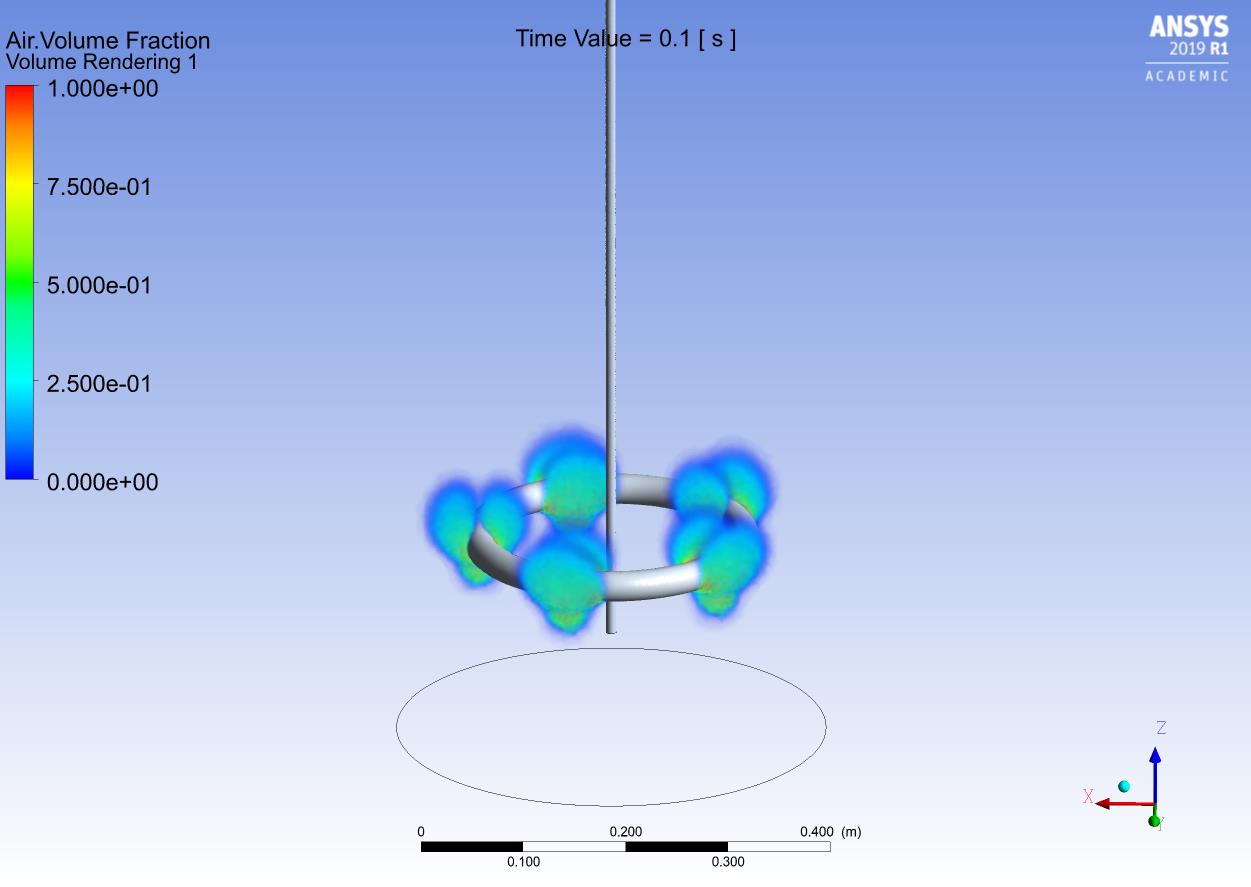
The image shows the solution that I obtained with the Eulerian method applied to the simulation of air flowing out 5 holes placed at thebottom of the sparger (time step size equal to 1e-4 s, hole size equal to 6 mm, air velocity inlet equal to 50.5 m/s, minimum cell size equal to 0.75 mm). Was I supposed to see bubbles instead of the flow that I
am actually visualising? If so, could it be due to low spatial and temporal resolutions?
Best regards
-
July 18, 2019 at 11:36 am
DrAmine
Ansys EmployeeIt is hard to explain the basics here.Â
If you have one or a small number of particles you can use VOF. If not you use Eulerian Model. Eulerian Model can be used with VOF if entrainment and slip are important. On the other hand Eulerian Model is for interpenetrating fluids where the flow is really mixed.
Regarding what I have said: real VOF (resolving all ligaments and theier evolution) is very expensive.Â
Â
http://www.awmc.uq.edu.au/filething/get/4877/P26_Strongin_WTMTX15.pdf
Â
Â
-
July 18, 2019 at 2:03 pm
simone01
SubscriberThanks for the reply. So in my case, considering the high volumetric air flow rate coming out of the sparger holes (3m^3 / min) compared to the reactor volume (3m^3), eulerian is the best choice. Regarding the images I posted in the previous message (I used the eulerian method), do you think therefore that the fact of not seeing the individual bubbles but rather a mixed air-water flow is normal or could be due to the low spatial resolution?
However, to use the real VOF you mentioned, should I activate the Eulerian model and then in the window under Eulerian parameters activate "Multi-Fluid VOF model?
Thank youÂ
Best regards
Â
-
July 18, 2019 at 2:08 pm
DrAmine
Ansys EmployeeYes you can use MutiVoF but I would not recommend it. Your application is typical for Eulerian Model with population balance later.
Does your phase come dispersed into the domain or as contentious fluid?
-
July 18, 2019 at 2:50 pm
simone01
SubscriberThanks for the reply.Â
I expect to see the air come dispersed into the domain.
Best regards.
-
July 18, 2019 at 2:55 pm
DrAmine
Ansys EmployeeThen the proper approach without discussing PhD here is Eulerian and later on population balance.
-
March 11, 2021 at 5:57 am
aishum96
SubscriberSorry for interruption, but how do we calculate the volumetric flow rate in a batch type operating tank(no inlet, no outlet).nI need to calculate the flow number for which I need Volumetric flow raten -
March 11, 2021 at 6:20 am
DrAmine
Ansys EmployeeHow is that flow number defined according to u?n
-
- The topic ‘Multiphase model – Bioreactor’ is closed to new replies.
-
6379
-
1906
-
1457
-
1308
-
1022
© 2026 Copyright ANSYS, Inc. All rights reserved.