-
-
June 17, 2019 at 11:21 am
henriquecar
SubscriberHello guys.
I am simulating a steady-state water flow past a bare hull underwater vehicle in ANSYS Fluent for validating purposes based on an article. The problem is that for every velocity and angle of attack the drag coefficient is correct but the lift coefficient is off by up to 50%. I have performed mesh dependency tests, tried several turbulence models, increased/decreased inflation layer size and y+, but still failing to understand the cause.
I've also turned up the gravity effect but I got no difference in the results whatsoever. Could this be because the weight is being balanced by the buoyant force? Or it is not balanced and there is no weight because the geometry is defined as hollow (I only have surfaces defining the hull body because I have used a subtract boolean feature).
Any help is appreciated. Thank you in advance! -
June 17, 2019 at 11:25 am
DrAmine
Ansys EmployeeCheck if the lift direction vector (used in the dot product with the force applied on the wall) is correct. Check reference values. If all are correct then add details about modeling (turbulence, mesh,..)
-
June 17, 2019 at 12:46 pm
henriquecar
SubscriberThank you for the prompt reply.
Yes, the direction vector is correct. 0 1 0. The reference values are also correct, as the drag coefficient is returning correct results.
The mesh is mostly tetrahedral with face and body sizings for the hull walls and inflation layers.
The turbulence model used is k-epsilon with enhanced wall treatment, but I have tested with others as k-omega SST and different near-wall treatments to no avail.
Could the gravity have an effect as the vehicle is submerged? The hull has no weight. I'm guessing it does not as it is balanced by the buoyant force.
-
June 17, 2019 at 1:45 pm
DrAmine
Ansys EmployeeIf gravity is on: have you set the right operating density?
-
June 17, 2019 at 2:23 pm
henriquecar
SubscriberI did specify density for water but not for the hull body as the geometry is not a body but only made up of surfaces. I have subtracted the body to the fluid domain. How can I specify the hull density in this case?Â
Regards,
Henrique
-
June 17, 2019 at 2:37 pm
DrAmine
Ansys EmployeeAdd a sketch of your case so that we understand better.
-
June 17, 2019 at 2:38 pm
DrAmine
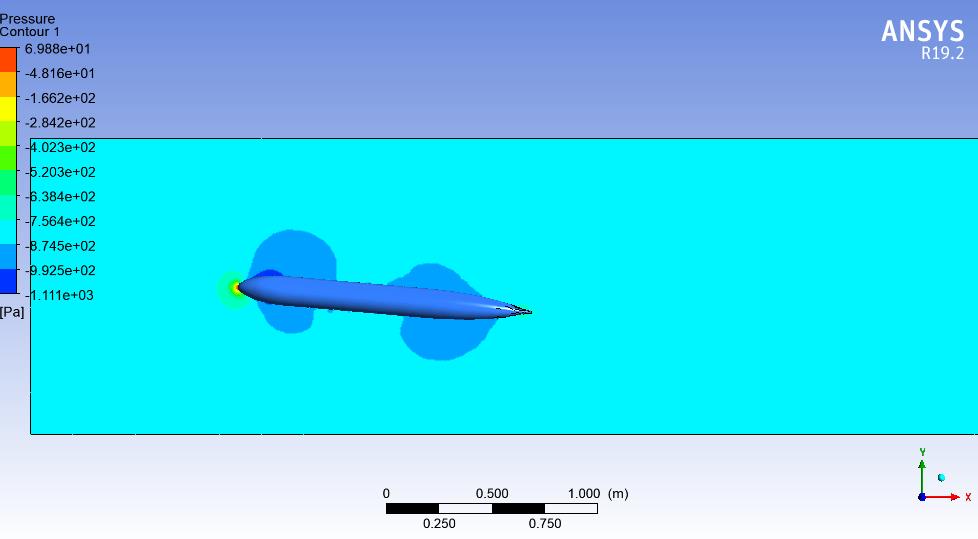
Ansys EmployeeAnd tell me which operating density have you used. Thanks! Also a plot of the static pressure is good to see.
-
June 18, 2019 at 1:32 pm
henriquecar
SubscriberHi Amine.
Â
Here is the pressure contour. The hull is at a 5 degree angle and the flow is on the positive x direction at 1.4 m/s in this case. The simulation is steady-state and converged. The drag coefficient is 4.083e-2 and the lift coefficient 1.955e-2, the latter having a 50% error relative to an article I am validating to. I have tried a second validation to another article and still get big differences in the lift coefficient, but never in drag.
The density of water I used is 1020 kg/m^3.
Looking forward for your reply. Thank you in advance.
Â
Best regards,
Henrique
Â
-
June 18, 2019 at 2:04 pm
DrAmine
Ansys EmployeeThe operating density please under Boundary Conditions.
-
June 18, 2019 at 2:29 pm
-
June 18, 2019 at 2:32 pm
DrAmine
Ansys EmployeeTo be safe check that box and use the density of water as you do only water in your domain. Furthermore please add screenshot of the mesh resolution along the body.
-
June 18, 2019 at 2:39 pm
-
June 18, 2019 at 3:34 pm
DrAmine
Ansys EmployeePlease try converge deeper might the lift coefficient change and also double check if the force direction applied is normal to inflow direction. -
June 18, 2019 at 11:12 pm
henriquecar
SubscriberI have ran the simulation way past convergence and it doesn't change anymore.
I'm certain that the force direction is normal to the flow direction.
As I have pointed out, I have similar simulations for other velocities and angles of attack and they all return those lift errors. 0.4, 0.6, 0.8, 1, 1.2 for 0, 5, 10 and 15 degrees. the simulations for 5 degrees are the ones that return the largest erros, don't know if that is relevant.
I have been trying to solve this issue for weeks and I haven't figured it out yet.
Thank you for your assistance, still.
-
June 19, 2019 at 4:37 am
DrAmine
Ansys EmployeeHow are you considering the angle of the attack? In the inlet boundary? -
June 19, 2019 at 9:54 am
henriquecar
SubscriberThe angle of attack is considered in the geometry, I import the geometry and mesh it already at an angle. In the inlet boundary I just specify flow in x direction.
Â
Regards,
Henrique
-
June 19, 2019 at 12:50 pm
Rob
Forum ModeratorHas the paper corrected for buoyancy effects in the results?  You won't be accounting for any buoyancy in the model.Â
-
June 19, 2019 at 2:19 pm
henriquecar
SubscriberNeither paper has mentioned that so I assumed they didn't.
-
June 19, 2019 at 3:29 pm
Rob
Forum ModeratorSo, if you add the force in Fluent to the buoyant force what do you get?
-
June 19, 2019 at 7:41 pm
henriquecar
SubscriberI get a very high lift force as the buoyancy force is many times greater than the lift force
-
June 20, 2019 at 10:16 am
Rob
Forum ModeratorI don't think we'll be able to solve this on here: I suspect it's a simple issue with the reference values but would need the case to check. Can you talk to your supervisor and ask them to log a support call (assuming your University has software)? We (ANSYS or Partner) can then get the files and look: we can't do that through the community.Â
-
- The topic ‘Wrong results for lift force every simulation’ is closed to new replies.

-
5874
-
1906
-
1420
-
1306
-
1021
© 2026 Copyright ANSYS, Inc. All rights reserved.