Ansys Assistant will be unavailable on the Learning Forum starting January 30. An upgraded version is coming soon. We apologize for any inconvenience and appreciate your patience. Stay tuned for updates.
General Mechanical

General Mechanical

Topics related to Mechanical Enterprise, Motion, Additive Print and more.

Springs are not constraining rigid body motion at all

    • abhisheky
      Subscriber

      Hi, 

      So, I'm working on a problem involving the human elbow joint - specifically modeling the flexion/extension motion of the elbow joint using a revolute joint. 


      To take advantage of the faster computational time, I've modeled the bones and cartilage as rigid bodies. I've provided body-body joint supports between cartilage and bones as fixed joints, constrained the upper arm bone as a fixed joint to the ground, and modeled the flexion/extension joint as a revolute joint without any stiffness. 

      I've modeled joint behavior as rigid.

      Then, I added springs with certain stiffness values to model ligaments and muscles. 


      When I add a moment load and solve, I get an unconstrained motion. However, I'm expecting motion that is constrained by the springs. 

      I tried changing the following but to no avail:


      1. Weak Springs on and off


      2. Large Deflection on


      3. Switched spring behavior from tension and compression to just tension.

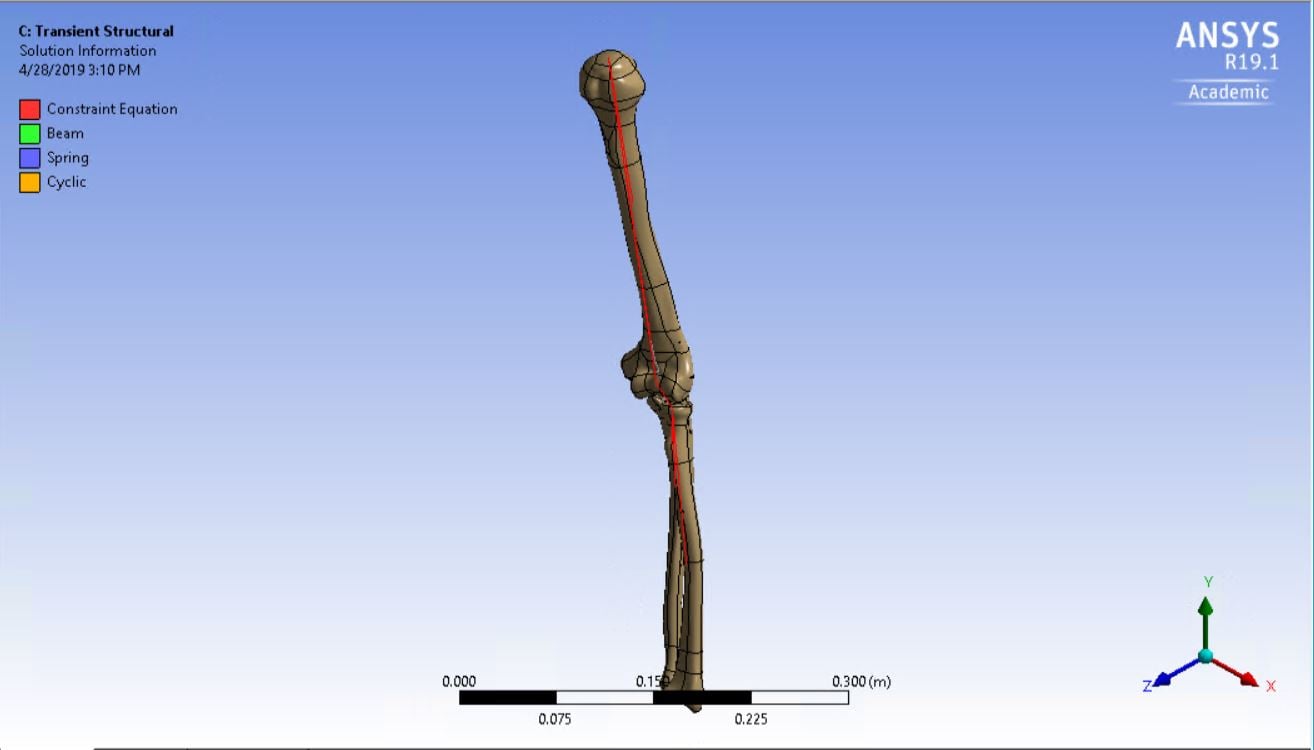
      I also checked the solution information graphics tab after the solution was reached and noticed only the constraint equation lines show up. No springs were denoted in the solution information. 

      I'm not sure what I'm missing but the springs are not constraining the revolute joint motion at all. Can someone please help?


    • peteroznewman
      Subscriber

      Add a Modal analysis to your model and solve that.  See if any parts flap about in an unexpected way. That may reveal the problem.  If not, please create a Workbench Project Archive .wpbz file and after you reply, the Attach button will appear for you to upload this file to your reply.

    • abhisheky
      Subscriber
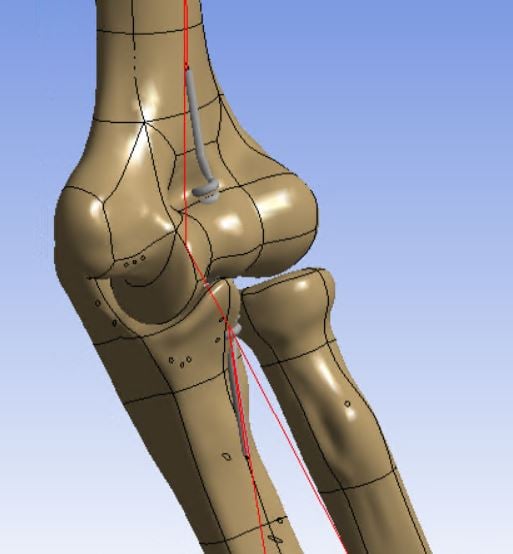
      Thanks, Peter for your reply. I've attached some screenshots of the solution information tab showing the rigid bodies and the single spring. Thank you very much for your help. 


      In order to quickly isolate the problem, I simplified the geometry and constraints. Right now, the model has 3 rigid bodies constrained by 3 joints:


      1. Body - Ground - Fixed


      2. Body - Body - Fixed


      3. Body - Body - Revolute


      I've added one spring with a pinball of 0.005 mm to ensure there is no overlapping of constraints. 


      I ran the simulation with standard earth gravity and rotational velocity on the revolute joint. I still end up with unconstrained motion. I added a spring probe to check if the spring length is changing, and it does change. 


      I also, added torsional stiffness to the revolute joint to see if that changes anything, but still ending up with unconstrained motion.


      Interestingly, in the solution information tab, I see only constraint equations pertaining to the joints (I presume?) in red. However, I do not see any spring connections in blue. Which tells me that the solver is not really detecting any springs in terms of FE connections.


      I should add that I'm also getting this warning as soon as the solver begins 'One or more MPC contact regions or remote boundary conditions may have conflict...With other applied boundary conditions or other contact or symmetry regions. This may reduce solution accuracy. Tip: You can graphically display FE Connections from the Solution Information Object. Refer to Troubleshooting in the Help System for more details.'


      However, I've not been able to figure out where the conflicts are if any.


      Lastly, I changed the time steps from 1s to 0.002 s to see if that is causing an issue, however, no change in results. 

    • peteroznewman
      Subscriber

      When all the bodies are rigid, and you are only using joints and springs, it is better to use the Rigid Dynamics analysis. You will find the attached ANSYS 19.2 archive moves the way you want.

    • peteroznewman
      Subscriber

      The steps are very simple.


      1) In Workbench, Drag and drop a Rigid Dynamics analysis onto the Model cell.


      2) Double click on Model to open Mechanical


      3) Drag and Drop Standard Earth Gravity and Joint - Rotational Velocity loads from Transient (C5) onto Transient 2 (D5).


      4) Change the Step End Time in Analysis Settings to 10 seconds.


      5) Click on Solution and add a Total Deformation result.


      6) Solve.


      You can animate the total deformation result.

    • abhisheky
      Subscriber

      So, I repeated these steps and got the rigid body motion which was similar to what I was getting before with Transient Structural.


      My concern is that if I'm inputting a rotational velocity of 0.017 rad/s or 1 deg/s for 10 s on an unconstrained system, then I will end up a total relative rotation of 10 degrees. 

      But, since I have constraints in the form of spring stiffness, shouldn't the relative rotation for the same period of time be smaller? Furthermore, the solution information tab still does not show the spring as a spring constraint in FE connections. Which tells me that the spring stiffness is not being used by the solver.


      I'm fairly new to ANSYS so is my thought process accurate?

    • peteroznewman
      Subscriber

      The Rotational Velocity load applies a constraint on the angle of the joint. At the end of 10 seconds at 1 degree/s, it will have rotated 10 degrees.


      Springs on the mechanism will not change the angle the joint rotates, they will change the moment (torque) that is required during the motion.


      Add a Joint Probe to your results. Plot the Z axis Moment. You will get a graph. Now change the spring longitudinal stiffness, say by a factor of 10, the moment will increase.

Viewing 6 reply threads
  • The topic ‘Springs are not constraining rigid body motion at all’ is closed to new replies.
[bingo_chatbox]